Putin’s Press: A Mixed Methods Analysis of State Control Over Russian Media Coverage & Framing of the January-February 2021 Protests
In Russia, journalists are imprisoned or killed each year, and while hard censorship has largely subsided, the realities that characterize the current Russian media sphere include state influence over the media and self-censorship.
The project employs a quantitative research design, using coding and data analysis to identify trends in coverage of the protests by different media groups across the two-month period. Additionally, the quantitative findings are supplemented by a qualitative interview conducted with a Russian media actor, in order to provide insights into the experiences of journalists in the Russian media sphere, particularly with regard to self-censorship.
Furthermore, while the hypothesis expected that state efforts to censor media groups would lead to an increase in anti-protest framing by independent media groups, the data concluded that framing of the protests by independent media groups was not found to be significantly impacted by instances of state intervention in the media sphere, aside from some slight increases in pro-protest coverage.
For my Master’s degree project, I investigated the Russian media sphere by collecting and analyzing 1,739 articles from 3 categories of Russian news media (state-owned, state-controlled, and independent) and comparing their coverage of the January-February 2021 Russian protests in order to uncover the interrelationships between government influence and media coverage in the Russian media sphere.
Findings include that state-influenced media groups employ far fewer frames for coverage than independent media groups, illustrating the protests more negatively and with less diversity in terms of their framing of the protests.
Finally, it was found that state-controlled media groups, while still conforming to the domination of anti-protest framing that characterizes state-influenced media groups, are much less predictable in terms of their tendencies to self-censor or instead include ‘extra’ government-unapproved information in their articles.
State-owned: RIA Novosti, Rossiyskaya Gazeta, Argumenty i Fakty
State-controlled: Kommersant, RT, Izvestia
Independent: Mediazona, Novaya Gazeta, TV Rain
Introduction
“Journalism in Russia does not exist.” These were the words of Russian media actor Dmitry Saltykovsky, as he explained to me that the Russian media sphere has been stalled for at least the past 10 years, and has not been able to make much progress due to a lack of freedom and opportunity for journalists. The level of government control over various media groups, in addition to the common practice of self-censorship, pollute the media sphere in Russia and help to obstruct press freedom, even in crucial and controversial historical moments like during the 2021 protests in support of Putin’s main political opponent Alexei Navalny.
On January 23, 2021, protests erupted in over 100 cities across Russia, becoming the largest the country had seen since at least 2017 (Khurshudyan and Dixon 2021). The following weekend, on January 31, protests again swept the nation, and over 5,500 arrests were made, marking a record high in Russian history (TV Rain Inc 2021). The final day of these protests was set as February 2 by the Anti-Corruption Foundation (ACF), an organization founded by Alexei Navalny, the same day as Navalny’s court date to decide whether he would stay temporarily sentenced, or be transferred to a permanent facility.
While some state-friendly sources imply that the protests were not at all related to Navalny, for many, Navalny’s recent salience in the media catalyzed the decision to go out and protest. However, these protests were not completely pro-Navalny, and would be better characterized as anti-Putin or anti-corruption. The role of the Russian media in promoting and decrying the protests has been particularly vital, and recent government efforts to punish media groups and censor content from independent media sources raises questions about the role of the Russian state in controlling media coverage of the protests, leading to the research question:
To what extent has state media control impacted coverage of the January-February 2021 protests across Russian media sources?
The aim of this project is to investigate the coverage of these protests in the Russian online media sphere, specifically focusing on the differences in coverage across various state-owned, state-controlled, and independent media groups. This analysis is conducted via a quantitative media content analysis, supplemented by a qualitative interview with Russian media actor Dmitry Saltykovsky. This investigation intends to shed light on the level of press freedom in Russia and the self-censorship choices made by journalists, as well as help to identify the specific measures taken by the Russian state to influence and control the media sphere.
As Saltykovsky so poignantly asserted: “I would say that censorship is not very prevalent anymore, now it is not even censorship, but self-censorship”. Russia has long been infamous for its reliance on propaganda and censorship to control media narratives, so it is unsurprising that since the introduction of democracy, Putin has struggled to maintain key democratic principles like press freedom, and has continued to rely on traditional methods of silencing or punishing criticism, though these methods often have democratic ‘twists’. For example, while traditional censorship would include state review of all printed content, and printing any non-approved content could certainly be punishable by extreme means, now, only some of the printed content is reviewed by the state, and many of these extreme punishments – while not expressly stated – are instead implied, which is often enough to make a journalist think twice before publishing even borderline controversial information.
From this perspective, the influence of the state on not only the media groups it directly controls, but rather the entire media sphere, becomes evident. Journalists and other media actors take notice when a fellow media actor is fired, jailed, or killed for the crime of publishing anti-Kremlin information, and while independent media groups do exist, they are forced to survive in a media environment that is often hostile to independent narratives that oppose those which are government-approved. All of this pressure, and the fact that independent news groups make easy targets for Kremlin criticism, encourages the practice of self-censorship by journalists, as it has essentially become a tool for survival that might allow media actors to keep their jobs and their lives. Crucially, self-censorship not only encapsulates the exclusion of information from a news story, but also the framing of the included information to support or emphasize a pre-determined narrative, in this case pro-government narratives.
The gatekeeper theory, which identifies the media as agenda-setters for the public, provides the theoretical basis for this project, along with the idea of news framing, summarized as the attribution of a thematic argument to a piece of information in a story, usually connecting to a larger narrative in the public sphere. This foundation is then built upon with the idea that an increase in independent news media groups increases the diversity of coverage in the media sphere. Russia’s history of state intervention in the media sphere is discussed here as a potential deterrent for independent media coverage diversity of the protests, establishing the basis for the hypothesis that independent media groups covered the protests more negatively following instances of state censorship and punishment of media actors.
This project will first establish the historical context of the media in Russia, as well as provide contextual background on Navalny and his role in catalyzing the protests. Following this, the literature review will establish the theoretical basis for the study and explain the key concepts of media agenda-setting and framing. Next, the planned methodology will be explained, then the quantitative findings from the data analysis will be presented and discussed, as well as compared with the qualitative findings from the interview. Finally, limitations of the project will be noted and conclusions will be drawn. But first, a brief outline of the intended format of the project must be described.
Uninspired by the format of traditional research papers, I am choosing to display my findings on my personal eportfolio website, in order to combine multimedia elements including images and video from the interview. The text is almost entirely the same, with some slight modifications given formatting considerations, but the main difference is the user experience of the information intake. The goal is for any reader, Russian or English speaking, from a general background, not necessarily highly educated, to be able to 1) understand the main point that Russian government control of media groups influences coverage in the overall Russian media sphere, and 2) read through, or at least scroll through, the data presented, to understand how coverage differs across media groups and how self-censorship is represented in the media.
In order to achieve this, I designed a more appealing website with elements such as scrolling or moving images to help demonstrate and emphasize specific instances of coding bias or identify patterns across the quantitative and qualitative data. For example, when discussing the graphs, I employ a slideshow feature that allows readers to click through the graphs and easily compare the data points from various media groups in a visually convenient way. This is one aspect of traditional research articles that I have struggled with in the past, as I have found it is easy to overlook seemingly minor differences in data because they are not easily visually recognizable in the paper format. This is therefore something that I am eager to present in a way that is both appealing, as well as easily comparable and understandable.
I urge readers to view the project only in online format, and only on a full-sized desktop screen, as it was not designed for mobile or tablet viewing. Much of the inspiration for creative visualizations of the project comes from my recently completed website design for my Graduate Research Assistantship working on the new Hivemind Speculative Fiction Journal at Georgia Tech, through which I was able to actively practice my design skills and get ideas for the layout of my project. In addition, a brief version of my project and findings in Russian is available on my eportfolio, along with the multimedia elements mentioned above and the video of the Russian interview. Understanding the realities of publishing an online portfolio that offers a space for discussion, most notably the threat of Russian trolls taking down or otherwise obstructing the use of the website, I am not providing any space for discussion or commenting, but rather only the information included in this project. With this in mind, the remaining text details the basis and findings of this research project.
Historical Context
2.1 Background of Russian Media and Censorship History
Before delving into the literature to identify various factors that may impact Russian media and censorship, it is important to first understand the historical context of the media in Russia, as well as how it is influenced by historical factors in modern times. In order to investigate the intended material, it is imperative to appreciate the context of Russia’s semi-pluralistic media system, as well as its semi-democratic political system system (Lancaster et al. 2011; Toepfl 2011). It is no secret that Russia has a history of employing and obstructing news media in whichever way seems to fit the ruling government, but a brief look at the history of Russian state media relations will uncover the lasting effects of this relationship.
In 1991, after the collapse of the Soviet Union, Russians were introduced to many new ideas regarding the media; ideas such as the market economy, freedom of expression free from ideological control, political pluralism, and the ability to create new public institutions (Khvostunova 2013). Before this, in the Soviet Union, the media was almost entirely seen as a mouthpiece for the state, and did not operate to criticize any government decisions. This dramatic change post-USSR saw the media industry embrace private ownership and take on a watchdog role, often criticizing communism and the Yeltsin regime, while being highly paid and remaining relatively safe (Ralph 2013).
Even with the liberalizing new state efforts, this new equilibrium quickly became unstable and unsustainable. This can be seen as the first stage of media privatization, in which new private media companies were created, catalyzed by the free market forces, and in which old media institutions were repackaged and resold as private companies (Khvostunova 2013). As one author writes, “Glasnost itself needed certain guarantees, the most important of which were a developed civil society, coordinated market transformations, and the development of democratic institutions based on establishing a truly effective judicial and law enforcement system” (Dzialoshinskii 2001). However, despite the formal institutional changes after the dissolution of the Soviet Union, long-established informal relations stayed largely the same, and many journalists were fired and forced to change professions if they were unwilling to cooperate with corrupt government officials.
The second stage of media privatization began with Yeltsin’s embrace of political polycentrism, balancing the powers of the oligarchs, corporations, and regional administrations (Khvostunova 2013). During this time, journalists were still relatively protected, but the media was largely used as an instrument of political power, celebrated for its impacts on public opinion and its ability to present specific topics as salient, while underreporting others that may have been undesirable. However, this was also the time of NTV, Russia’s first independent news channel, lauded for its professionalism and objectivity even under political pressures, a time when the media was generally seen as playing a crucial role in forming public opinion, especially when it came to elections (Khvostunova 2013).
Circumstances changed again with the news of Vladimir Putin’s presidency in 2000, accompanied by a turn from a polycentric to a monocentric political system, and thus setting in motion the third stage of Russian media privatization. Putin’s early years of power set the stage for the rest of his rule, with near immediate efforts to centralize power, eliminate political opponents and alternatives, and secure control over not only the government, parliament, and judiciary, but the media as well. In the early 2000s, many government agencies, as well as close friends and allies of Putin, gained financial or managerial control over 80% of regional media, 70% of electronic media groups, and 20% of the national press (Vartanova 2012). Effectively, this meant that freedom of expression was still possible, however, ownership of those media groups that reached the largest audiences was highly concentrated in the hands of those powerful few in Putin’s inner circle.
The symbolic beginning of the end of the fragile free media atmosphere created in stage 1 was the government takeover of the holding company MediaMost in May 2000, an almost militaristic effort including pre-dawn raids of the offices of MediaMost and its media group NTV, in which tax police, backed by officers from the General Prosecutor’s office and the FSB, searched the premises for 12 hours (P. Baker 2001). Additionally, NTV was forced to discontinue a popular satirical political program called “Kukly” (Puppets) that used puppets to represent major politicians and other figures in the Russian public, famously including Putin. This show is often mentioned as one of the main reasons why the channel was seen as a threat to the Kremlin.

Vladimir Gusinsky, the owner and founder of the MediaMost group, was arrested in June of 2000 on charges of misappropriating funds, but shortly after his arrest, Kremlin representatives offered him a deal to sell the company at a set price of 300 million USD in return for the dropping of his charges, which he accepted (Pankin 2004). This extortion, officially called an ownership transfer, meant that all three of Russia’s top television channels, Rossiya-1, Channel One, both of which are owned by the Russian state, as well as NTV, now owned by Gazprom, a state-controlled energy giant, would be at least moderately within reach of government control (Federal State Statistics Service 2010).
Viktor Shenderovich, who wrote the “Kukly” show, was unofficially banned from television, as other stations feared backlash from the Kremlin if they hired him as a writer, especially as a political writer (Dixon 2003). Gazprom’s takeover of NTV lead to many leading journalists, including Shenderovich, being fired or leaving the company, and later two independent media groups which absorbed many of these journalists were also shut down (Shenderovich and Olsen 2008). This exemplifies the third stage of media privatization, which arguably still persists in Russia. In this stage, independent interest groups were dissuaded from interfering with state-controlled or state-sanctioned media, often via financial, judicial and legal consequences for vocal opponents, or even simply for supporters of those who have been discredited or displaced by the government.
Arguably, the Russian media landscape has changed with the rise of online news to replace the gradually decreasing popularity of television and print news (respondents who had watched television within the last two weeks decreased from 94% in 2015 to 88% in 2020) (Deloitte 2020). However, the standards of formal and informal media relations have not changed much since Putin’s first presidential term, and many patterns, such as the use of law enforcement to legally punish political opponents and corrupt control or manipulation of media content, can be identified within the content of this research paper in the events surrounding the January-February 2021 protests.
2.2 Putin’s Navalny Problem
In order to understand the factors contributing to the January-February 2021 protests, it is important to first understand some background information about Alexei Navalny, now known as Putin’s fiercest and most vocal opponent. Navalny was once only a lawyer, entering the public spotlight in 2008 after publishing proof of Russian state embezzlement and conducting investigations into major Russian energy and gas companies like Gazprom and Rosneft, also known for their embezzlement and corruption (“Who Is Alexei Navalny?” 2017). He founded the ACF in 2011, and it remains the largest independent public anti-corruption agency in the country. In 2013, Navalny ran for mayor of Moscow and received around 27% of the vote (“Who Is Alexei Navalny?” 2017). In the same year, he also started his YouTube channel, where at first, he published clips of his regional visits and urges to vote, but which has since become of one the main sources of anti-Putin and anti-corruption information and investigations, particularly within Russia.
In 2014, his brother Oleg was jailed for three and a half years over what many have called politically-motivated charges, and Navalny himself has been subject to many raids of his apartment, as well as arrested and placed under house arrest in the past (BBC News 2021). In 2017, Navalny launched a campaign for fair Russian presidential elections, nominating himself, but was ultimately rejected by the elections commission, which stated that he was ineligible to run for president, citing his previous conviction in a case that is again widely regarded as politically motivated. Earlier that year, the ACF had published a video on Navalny’s YouTube account titled “He’s Not Dimon to You”, exposing the corrupt network within the Russian government which allowed then Prime Minister Dmitry Medvedev to buy yachts, build luxurious villas, and own vineyards. This 50-minute documentary was watched by over 25 million Russians at the time, and views have now climbed to over 43 million. After its release, the video sparked a wave of protests in 84 Russian cities on March 26, 2017 (“Who Is Alexei Navalny?” 2017).
After all of this tumultuous history between Alexei Navalny and the Russian government, Navalny was suddenly hospitalized on August 20, 2020, having mysteriously fallen gravely ill on a plane ride from Tomsk to Moscow. After he collapsed, the flight was redirected and grounded in nearby Omsk, where Navalny received emergency treatment from paramedics before ultimately being evacuated to a hospital in Berlin on August 22. There, he slowly recovered over the course of months, and publicly accused Putin of authorizing an attempt on his life. This was due to his own suspicions, as well as the findings of his German doctors that a ‘Novichok’ nerve agent had been used, a type of chemical weapon that was developed in the Soviet Union only until 1993 and would only be accessible via top-level government clearances (CBS News 2020). Novichok gained notoriety after famously being used in the assassination attempt of former Russian spy Sergei Skripal, as well as his daughter Yulia, in Salisbury, England (BBC News 2021). On October 6, 2020, the Organization for the Prohibition of Chemical Weapons confirmed that the Novichok nerve agent was present in samples obtained from Navalny.
Unsurprisingly, a Russian state investigation found that no crime had been committed, but in December 2020, Navalny posted two videos on his YouTube channel discussing his poisoning in depth. The first is titled “The case is solved. I know everyone who tried to kill me”, and is a 50-minute investigative piece that had been conducted with cooperation from Bellingcat, The Insider, CNN, Der Spiegel, and the ACF (Алексей Навальный 2020). This video declared that Navalny had been under suspicious surveillance since 2017, with various FSB officers following him throughout the country on his campaign visits. The investigative team also uncovered multiple attempts on Navalny’s life over the years, and mapped out in detail the network of FSB officers and Russian state officials involved in the assassination attempts. This video gained over 25 million views.
The next one, titled “I called my killer. He confessed” gained over 28 million views. This second video, as suggested by the title, shows Navalny calling and having a conversation with one of the men involved in the infamous attempt on his life. By leading the man to believe that he was actually an employee of the FSB and was putting together a report on why the poisoning failed, Navalny was able to get the man to say that Novichok had indeed been used and had been applied to Navalny’s underwear, which the man also correctly recalled as being blue. During the protests, some held up pairs of blue underwear as a symbol of their support for Navalny and their protest of the corruption of the Russian state and FSB.
Finally, a nearly two-hour long documentary titled “Putin’s palace. History of the world’s largest bribe” was published two days after Navalny’s return to Moscow, and prompt arrest at the airport on January 17, 2021. The video gained over 96 million views in a week, and now has over 114 million, gaining international attention and largely contributing to the protests that week. Many protestors shouted “aqua discotheque” in reference to the documentary, which details the exorbitant luxury of the palace, including an entire discotheque with water features, while other protestors carried toilet brushes, in reference to the allegations that the palace toilet brushes cost up to 700 euros (S. Baker 2021). Navalny has since been permanently sentenced to serve two and a half years in a penal colony outside of Moscow, which he had, until recently, avoided throughout his political career (Soldatkin 2021).
Since his incarceration, human rights groups including Amnesty International have attempted to alert the public about the dangerous conditions that Navalny is living in, claiming that the Russian government is “imposing prison conditions, that amount to torture”(Reuters 2021). Navalny has been subjected to sleep deprivation for example, being woken up by guards 8 times each night, and furthermore lacks access to a trusted doctor in jail. The prisoner also went on a hunger strike for nearly a month, complaining about severe pain in his right leg and back, and many of his supporters fear for his life and health while in the prison system, especially considering Navalny’s own statement that he does not plan to commit suicide (AFP 2021).
Given previous historical attempts by the Russian government to gatekeep media channels and otherwise manipulate the content which is distributed within the Russian media sphere, Navalny’s popularity and high viewership are far from inconsequential to his political goals, and may indeed be contributing factors putting him in danger (Human Rights Watch 2020). Furthermore, Navalny’s large audience was one of the main factors in making these protests the largest in Russian history, and it is difficult to overstate the level of support which outpoured for Navalny after his arrest, as he was largely seen as another victim of Putin’s anti-freedom-of-expression and anti-dissent program which has majorly overstepped its ‘democratic’ legal boundaries (Osborn 2021).
Literature Review
This section will provide the theoretical bases for the expected outcomes and the hypothesis of this project, as well as define key terms such as agenda-setting and news framing. It also includes a discussion of the effect of independent media groups on increasing media coverage diversity, as well as justifications and considerations for the quantitative and qualitative sections of this project.
3.1 Media as Agenda-Setters of Salient Issues
News media has a powerful influence over public perception of issues and policies because it informs the public on which topics are worth thinking about. The gatekeeper theory identifies the media as agenda-setters for issues which will become salient in the public sphere (Lancaster et al. 2011). Certain stories are chosen by the media and then relayed to the public, and others are left unpublished, meaning the media chooses what goes on the public agenda. Media agenda-setting refers only to the highlighting of an issue as important to the public and policy makers, rather than the attachment of meaning to issues of salience via framing (Carmines et al 2010). Media coverage can impact which issues the public views as warranting or requiring a policy or government response, so increased media coverage can increase salience of an issue among citizens, or even increase the proportion of media audiences who would act on an issue, for example going out to protest (McGinty et al. 2016).
In Russia, the role of the media as the sole gatekeeper and agenda-setter is arguably compromised given the high concentration of media ownership in Putin’s inner circle and the corresponding low concentration of media ownership access for opposing voices. Throughout the first stage of media privatization, as detailed earlier, the media acted as the sole gatekeepers of information, which allowed them to freely criticize and question both communism and the Yeltsin regime. In the second stage, the media began to be more influenced by state control, and while some independent news groups existed, for example NTV, the media was starting to share gatekeeping responsibilities with the state (Khvostunova 2013).
By the third stage, the most popular television news channels were all somewhat influenced by state powers or state-friendly interests, and the government began to intervene via management and ownership takeovers of groups like NTV and Kommersant, as well as arresting and killing dissenting journalists in order to gatekeep information that independent media groups or actors had published. In this way, the Russian media has lost its sole authority to gatekeep information, and is largely influenced, through coercion, extortion, and pressures to self-censor, by the agenda of the Russian government (Shenderovich and Olsen 2008)..
Since Russian media ownership became highly concentrated in Kremlin-friendly hands, the government’s message, as one author explains, “seemed to be that the state was going to be ‘calling the shots’ in a ‘new’ relationship that demanded a media that would bend to the will of the authorities in order to preserve Russia’s informational integrity” (Simons and Strovsky 2006). While such a message is likely to impact the agenda-setting of state-owned and state-controlled media, it may not have as strong of an effect on independent media groups, which are already seen as dissenting from government views. This government pressure for media groups to gatekeep in a pro-Kremlin manner establishes the basis for the expectation that Russian state media control is negatively correlated with the number of stories published covering the protests.
3.2 Media Framing Informs Public Opinion
A news frame is a simplified theme which organizes and provides a narrative meaning to a complex story by invoking preexisting cognitive schemas (Felson, Adamczyk, and Thomas 2019). Through the use of frames, the media can influence both the salience and collective public opinion of issues by influencing how individuals interpret stories about the issues. A deciding factor in media gatekeeping is the framing of a news story, and media outlets tend to subscribe to only a few non-contradictory frames per issue, usually falling into one general message, or tone, of the article. In the case of the recent protests, this means that news outlets would not publish multiple stories about the protests which corresponded to contrasting frames, such as the police force is justified and the excessive punishment of supporters and journalists, nor would they publish articles with contrasting tones such as pro-protest and anti-protest. Instead, outlets focus on frames which, collectively, provide a narrative for either support or opposition of an issue, and stick to one tone per topic (Kim and Kim 2018).
Russian state media coverage of protests has historically employed frames linked with chaos and disorder, under the idea of the disruption of peace and public safety, while independent media has more frequently used frames linked with freedom and justice, under the idea of the need and right to peaceful protest (Lankina and Watanabe 2017). Along with the state control and pressure placed on media groups, this provides the basis for the expected outcome that Russian state media control is negatively correlated with pro-protest framing.
Aside from this, the variation in framing across independent, state-controlled, and state-owned media may be quite different. If state-owned media groups are much more influenced by state suggestions and interventions, more variation in the framing of the protests would be expected from independent news groups, who are less impacted by state interventions. In other words, state media is expected to be more uniform in framing the protests, even across news outlets, while independent media is expected to be more diverse. In short, Russian state media control is expected to be negatively correlated with diversity in news framing, with government-controlled media groups publishing stories using fewer frames than independent groups.
3.3. Increase in Independent Online Media Increases Diversity of Coverage
Despite the high concentration of media ownership by allies of Putin, Russian media still remains relatively varied as a result of the rise of internet news popularity, with 72% of Russians naming the internet (news, analytical, and official websites) as their top news source, and television falling to second place with 58% (Deloitte 2020). However, a different poll conducted in 2021, shown in figure 1, found that while the popularity of television is falling consistently, 64% of respondents still named it as their most often used source of news information, compared to social media sites at 42% and internet publications at 39% (Levada Center 2021).

English description: blue – television, yellow – internet publications, red – social media sites, grey – friends, family, neighbours. X-axis is June 2013-January 2021, Y-axis is percentage.
Though the government has continuously tried to curtail freedom of speech on the internet, as will be discussed below, it is much more difficult to censor all internet news content than it is for television or print news. The medium of online news thus allows for an increase in diversity of coverage across independent media sources. This is one potential alternative explanation to the expected finding that independent online news is more varied than state-controlled online news as a result of the pressure to censor or self-censor. While it is expected that state-controlled online news is pressured to cover and frame stories about the protests in a pro-Kremlin way, the benefit of the internet may lie in the reality that it affords news media more freedom for diversity of coverage and framing than television channels. For this reason, additional attention will be paid to government interventions in the news media over the course of the protests, as these represent infringements upon the freedom of expression on the internet and have the effect of promoting self-censorship.
To examine the treatment of online platforms by the government, as well as any changes in the coverage and framing of the protests by independent online news sources that were and were not targeted for censorship, it is vital to understand the decreasing freedom of Russia’s internet. The government has already employed a number of measures to attempt to restrict information disseminated on the internet, including the “sovereign Internet law” passed in 2019, effectively allowing the state to shut out all internet traffic from outside of Russia, as well as to shut off the Internet completely within Russia. The most recent attempts to control the Russian internet came in the form of two bills signed by Putin on December 30, 2020, the N482-FZ and N511-FZ, which penalize online platforms for censoring Russian media, and fine them for publishing or not removing content which is banned in Russia. The second bill has already been used in the context of the recent protests to threaten YouTube, Facebook, Instagram, Twitter, TikTok, and the Russian platform VKontakte for their roles in disseminating information encouraging minors to participate in the unsanctioned protests (Rakhmetov 2021).
Aside from this, the state has also detained and sentenced various media actors, including Sergei Smirnov, the editor in chief of independent news group Mediazona, an independent news group, for retweeting a joke in the form of an image that included the time and date of a protest (Meduza 2021). These state interventions also include unannounced searches of individual media actors’ apartments, as well as sentences for house arrest doled out to activists and supporters of Navalny such as Lyubov Sobol, a lawyer for Navalny (Reuters 2021). Given these interventions by the state, it is interesting to investigate whether such interventions had any effect on the content coverage and framing of independent online news media. This establishes the basis for the final expected finding, that independent media sources decreased coverage of the protests following instances of state censorship and punishment of media actors. Finally, this leads to the main hypothesis of this project: that independent media sources covered the protests more negatively following instances of state censorship and punishment of media actors.
3.4 Using Media Content Analysis to Investigate Media Coverage and Censorship
Many studies have utilized media content analysis in order to identify trends in media coverage of an issue, with some employing it to analyze media bias and censorship in authoritarian regimes (Lankina and Watanabe 2017; Zhang and Fleming 2005; Slutsky and Gavra 2017). For example, a study on strategic censorship in Malaysia compared three different coding systems to analyze bias in the media, and was able to identify a strong pro-government bias in coverage (Abbott and Givens 2015). The same study found that this bias varied across media outlets, and that it was particularly influenced by government censorship, as well as ownership structures that connect major media groups to the ruling party, pointing to the influence of corruption in the media sphere. This study similarly employs quantitative content analysis in order to analyze coverage and framing from various sources and identify trends across the content, aiming to identify impacts of corruption and government control on the media sphere.
3.5 Using Qualitative Interviews to Investigate Media Coverage and Self-Censorship
While the quantitative section of this project is relatively straightforward and can be largely completed with little influence from subjectivity, a key consideration for this project is that the news articles used in this quantitative analysis have already been framed and published by journalists and other media actors, and may therefore have been influenced by self-censorship before ever being analyzed for this project. As mentioned before, self-censorship is a crucial element that should be investigated in this project because it has become an essential tool for journalists in Russia today, in order for them to protect themselves from potential punishments, including the loss of their job, freedom, or life, as a result of putting the ‘wrong’ information in a news story.
Because it is impossible for a reader to retroactively identify instances of self-censorship in a news story, this project would ideally also rely on qualitative interviews conducted with Russian media actors, to hear their experiences with self-censorship, especially regarding coverage of the Navalny situation. It should be noted, however, that the inclusion of such a qualitative section does not free this project from the issues of subjectivity, as it is also possible that interviewees will not share the full extent of their experiences and perspectives, especially since the topic of interviews is clearly not approved of by the Russian government and it could be dangerous for interviewees to honestly answer some questions.
While quantitative content analysis is an established method to identify trends in media coverage and framing, the issue of self-censorship is much more difficult to investigate as it is very difficult to define. The existence of self-censorship is itself contested by scholars, as are definitions of the term, and many are skeptical of its “empirical investigability” (Schimpfössl and Yablokov 2020). However, one accepted explanation of the term is that self-censorship, as opposed to censorship, is “conducted internally by the media in order to avoid annoying or offending someone (and thus avoid a possible sanction or punishment), without being specifically told or ordered to do so officially by an external censor” (Simons and Strovsky 2006). This definition sees self-censorship as a less prescribed version of censorship, but one that is pervasive nonetheless. It is an inevitable consequence of the non-democratic political system imposing restrictions, such as legal and fiscal consequences, on the social and media systems.
In Russia, however, self-censorship is seen as one of the most important tools for both state media control and professional journalism, as clever use of self-censorship can both allow for the state to practice agenda-setting as well as allow for journalists to avoid media minefields while subtly including dissenting views in otherwise pro-Kremlin media (Schimpfössl and Yablokov 2020). Naturally, this makes self-censorship very difficult to quantify, especially since it is largely subjective, and many editorial choices remain unclear to readers without prior knowledge of the content that is intentionally being included or excluded. For this reason, this study intended to draw upon a second method for identifying the extent to which state media control has impacted media coverage of the protests: qualitative interviews with individuals working in the Russian media sphere.
Unfortunately, given time constraints and a lack of willing participants, only one interview which I had conducted in 2020 was secured for this project. Had more interviews been secured, they could have supplemented the quantitative data quite meaningfully, and offered insights into the views of Russian media actors on the state of the Russian media system, the impact of state pressures on the media, and the role of self-censorship in their work. However, the one interview I have conducted will have to suffice for this project, leaving space for future researchers to further the investigation into the Russian media sphere and the role of journalists in maintaining the self-censorship status quo.
Methodology
From the literature review, the theoretical bases for the expected outcomes and the hypothesis have been determined, and the research question and hypothesis are reiterated here to build the methodology around them. As mentioned above, this is a preliminary study into the role of state control in media content coverage and framing, and the chosen case is that of the Russian January-February 2021 protests. Because of limited time and resources, only one case could be studied thoroughly, though this denies the opportunity for comparison of media coverage and framing across various protests in recent Russian history. Tracking the salience of frames across various media groups’ coverage of multiple protests over time could potentially illuminate the agenda-setting mechanisms of the state, or conversely the influence of the increase in independent media on coverage diversity. The research question and hypothesis are reiterated here to inform and structure the methodology.
RQ: To what extent has state media control impacted coverage of the January-February 2021 protests across Russian media sources?
H: Independent media sources covered the protests more negatively following instances of state censorship and punishment of media actors
In order to answer the question of the extent to which the role of the state impacts media coverage and framing of the recent Russian protests, three categories of media groups will be distinguished: state-owned, state-controlled, and independent. These categories will be considered as three separate cases and compared. The state-owned category includes only those media groups with officially recognized government ownership, such as Rossiyskaya Gazeta, the Russian government newspaper. The state-controlled category is used for the media outlets that have some state ownership or control, including for example RT, formerly known as Russia Today, whose parent company is almost entirely funded by the state (Nimmo 2018). The independent category is reserved for those media groups which have no identifiable links to the government or Kremlin-friendly interests, such as TV Rain, which was removed from television by the government in 2014 (РИА Новости 2014).
The dependent variable, based on the hypothesis, is the media framing of the protests, and is expected to vary between media sources. Independent variables include the category of media group, state-owned, state-controlled, or independent, as well as the protest turnout, time between protests, state interventions in the form of punishing or threatening media actors or groups, and the number of arrests related to the protests. Constant variables include the country, as all relevant protests and media groups are located in Russia, and the ruling political party, Putin’s party.
In order to answer the research question presented, this study will investigate the coverage and framing of the recent protests in Russian media via mostly quantitative and some qualitative analysis. For the quantitative analysis, this paper will specifically examine frequencies and relationships between frames and frame types, and will employ visual data analysis to present statistical information about the relationships between state control and media coverage and framing. This section specifies the time period for gathering quantitative data, as well as the methodology to gather, code, and analyze the data. Following this, the next section will detail the qualitative methodology.
4.1 Time Periods for Data Gathering
The coverage and framing of the protests were studied for a time period spanning the months of January and February, as this was the time when the protests were occurring and therefore when they were most salient in the news. Most news sites did not begin to cover the protests until around January 20th, but all sources were searched for relevant articles from the beginning of January to ensure that no coverage of protest preparations is missed.
4.2 Coding the Data
| 4.2.1 Gathering the Data
For this study, the dataset is compiled from a number of sources. In order to ensure a fair analysis, an equal number of media sources make up each of the categories of state-owned, state-controlled, and independent media outlets. This study only considers online news publications in Russian, and does not include personalized news sharing platforms such as Twitter, Telegram, or Lenta.ru. The selected media groups are taken from a ratings list of the most cited media sites in January and February 2021 in Russia, and a small sample of these were chosen for the study, as many popular sites which focused on sports or culture were less relevant for the project (Brand Analytics 2021). The sample also excludes any media sources not geared towards Russia specifically, such as those catering to individual cities like Moscow or different countries like Belorussia, and any websites with other official purposes besides publishing factual news information, allowing this study to exclude tabloids or government service portals and focus only on online news websites.
The state-owned category consists of: RIA News (РИА Новости), Rossiyskaya Gazeta (Российская Газета), and Argumenty i Fakty (Аргументы и Факты). The state-controlled category is made up of: RT (formerly Russia Today), Kommersant (Коммерсантъ), and Izvestia (Известия). Finally, the independent category includes: Mediazona (Медиазона), TV Rain (Телеканал Дождь), and Novaya Gazeta (Новая Газета). All of the media groups included in these categories were in the top 25 most cited online news sites for January-February 2021, to ensure that the data analysis is conducted on news sites that are relevant to Russians (Brand Analytics 2021).
The process of gathering data is as follows for each media group: search the archive for ‘протест’ (protest) from January-February 2021 and select every article that mentions the recent protests in any way, based on the headlines and excerpts provided. After all articles are saved, upload to MAXQDA in order to code each instance of framing. Each media outlet represents a different dataset, and each article within each dataset is coded with only 1 tone, either supporting, neutral, or opposing the protests. By contrast, an article can be coded with as many instances of framing as are determined by the coder.
| 4.2.2 Codebook
The tone of an article refers to the overall message of the piece as being anti-protest, pro-protest, or neutral, and is determined by the most frequently coded frame type per article. Articles that employed a majority of pro-protest frames, were coded as Pro tone. Those which had a majority of anti-protest frames, were coded as Anti tone, and those which used an equal number of pro-protest and anti-protest frames, were coded as Neutral. In addition, two more coding categories were created, to keep track of the media features employed in articles, as well as the article story types. I also coded the articles’ specific frames as pertaining to Pro, Anti, or Neutral tones. The complete codebook can be viewed here, but is excluded from this online version of the project due to formatting considerations.
4.3 Analyzing the Data
After all datasets were completely coded in MAXQDA, each one was exported and reformatted into an Excel sheet that includes the salience (number of stories), and frame salience (number of occurrences per frame), as well as the tone salience (number of stories per tone) and net tone per media outlet. The net tone was calculated by subtracting the total number of Anti tone articles from the total number of Pro tone articles. This number was then divided by the total number of articles in the dataset and added to 1, so that the final net tone would not be less than 0. Once the datasets were cleaned and reformatted in Excel, they were ready to be imported into RStudio, where the salience, framing, and persistence of frames across the three categories of media groups were processed and statistically analyzed. Each dataset was individually analyzed, before graphs and tables are created to visualize trends identified over time and across media groups.
4.4 Interviews
While researching a very sensitive and potentially intangible topic such as self-censorship- especially in Russia – a mixed-method approach allows for both the identification of quantitative trends, as well as the crucial qualitative understanding of the journalist’s perspective. As mentioned above, I attempted to secure interviews with Russian media actors, as I ideally would have liked to interview journalists or other individuals in the media from a range of state, non-state, public, private, liberal, and conservative publications. I initially intended to secure one interview for every category of media group; state-owned, state-controlled, and independent. However, I was unfortunately unable to reach an agreement with any media actors willing to speak with me on the record, leaving the project to rely nearly entirely on the quantitative data gathered from the coding of articles. I was eager to ask interviewees for their thoughts on the ownership of their media group and others in the industry, especially with regard to editorial concerns and policies. I planned to record the interviews, always with audio, and with video when interviewees permitted it, and then present significant findings, in the form of quotes or summarizations, in the discussion of the findings in order to identify any similarities or oversights.
Though I was unable to confirm any interviewees during the process of this project, I was able to draw from one interview I had conducted in December 2020 with Dmitry Saltykovsky, a Russian media actor who also has experience working in Western media spheres such as the US and Canada. For the purpose of this project, I was aiming to interview media actors who solely worked in the Russian media sphere, as isolation within this media sphere can be expected to impact the journalistic opportunities available to media actors, as well as their own understandings of their safety and the level of press freedom allowed in their country’s media sphere. However, given the lack of interviews conducted with such media actors, I rely on this interview to provide some insights into the operations of the Russian media sphere and the journalistic choices that may be made by Russian media actors.
The interview with Saltykovsky was semi-structured, so as to provide a basis for relevant conversation but also allow for discussions that I may not have foreseen. Topics that were discussed included the interviewee’s thoughts and experiences with self-censorship, as well as the current political and social climates and the subsequent impacts of this on the media. Because the interview was conducted in 2020, I was unable to speak with him about the 2021 protests, and the conversation centered around general analysis of the Russian social and media spheres. Saltykovsky spoke to me while he was travelling between locations, and allowed me to record the audio of the interview while leaving his video turned off. Notable insights from the interview will be presented with the findings below, after the discussion of the quantitative findings.
Findings
The findings from the quantitative data analysis are presented in this section, and rely heavily on data visualizations which are most conveniently viewed in this online version of the project accessed from a desktop computer. As a general rule, the colours in the graphs correspond with the Pro, Neutral, and Anti frame types, with Pro corresponding to green, Neutral to yellow, and Anti to red, in order to make trends more visually apparent. Additionally, dark blue corresponds with media features coded, and any other variations in this colour coding system will be explained before analysis of the relevant figures.
To start, figure 2 is a table representing the total number of articles published by each media group between January and February 2021 (1,739 all together), as well as the number of articles coded as Anti, Neutral, and Pro in covering the protests. As stated above, each article is only coded with one overall tone which corresponds to either Anti, Neutral or Pro framing of the protests, so this table provides insight into the message that each news media group is promoting with regard to the Russian protests, whether it be supportive, objective, or critical.
Surprisingly, and contrary to the expected outcome that independent news groups would cover the protests more extensively than state-influenced media groups, Kommersant published the highest number of articles (415) related to the protests over the data gathering period. However, the fact that the two media groups with the lowest number of articles published during this time were Argumenty I Fakty and Rossiyskaya Gazeta, two state-owned groups, falls in line with the expectation that state-owned media covers the protests less extensively than other media groups. Furthermore, this table depicts the increased level of balanced coverage by independent news groups when comparing the number of Anti, Neutral, and Pro articles in each media group.

From the table it becomes clear that independent media groups overall cover the protests in a supportive manner, with Pro tone articles making up the majority of their published articles, counter-message Anti tone articles being published less often, and Neutral tone articles being the least used tone in all three media categories, despite being most frequently used by the independent media groups. Evidently, independent media groups publish a higher percentage of counter-message Anti tone articles relative to Pro tone articles when compared with state-owned media groups which publish almost entirely Anti tone articles with very few Neutral articles and even fewer Pro tone articles. It is also important to note here that after the arrest of Sergei Smirnov, the editor-in-chief of Mediazona, Novaya Gazeta chose to republish all Mediazona articles for a period of 25 days, which significantly impacted the total number of articles published by the media group. This essentially means that many coverage and framing choices by Mediazona are reflected in those of Novaya Gazeta, though both of these media groups also have unique coverage and framing of the protests.
The graph below provides a visual representation of the data in the table above, so that the total number of articles published by a media group is represented by the entire length of the column, the total number of Anti tone articles is represented by the red segment, and the Neutral and Pro tone articles are represented by the yellow and green segments, respectively.

5.1 Individual Frame and Media Feature Salience
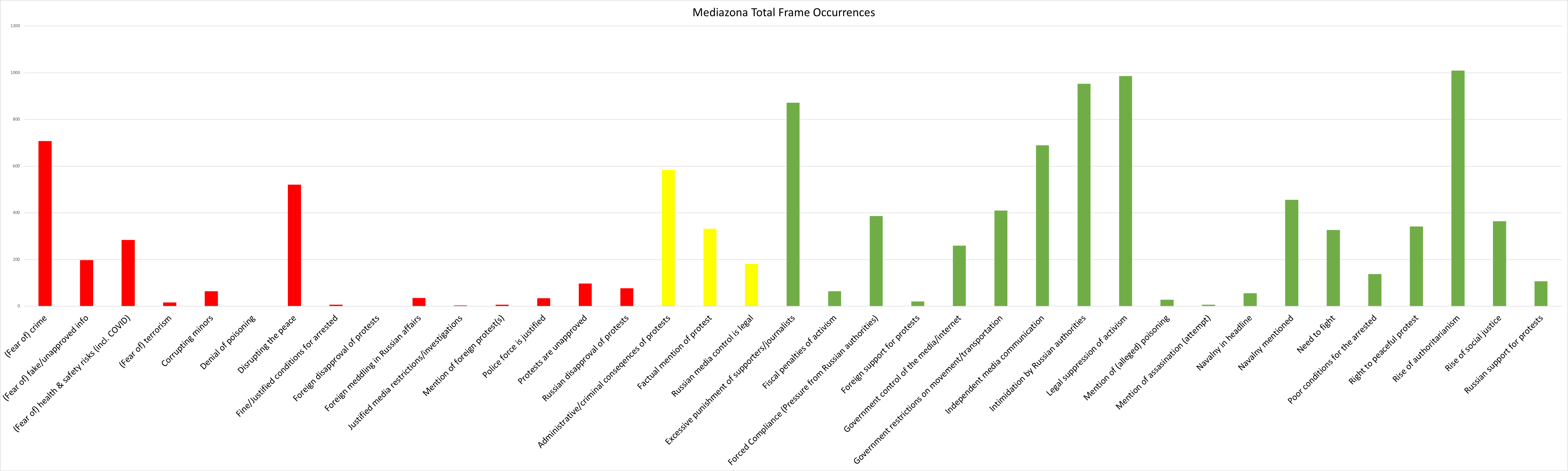
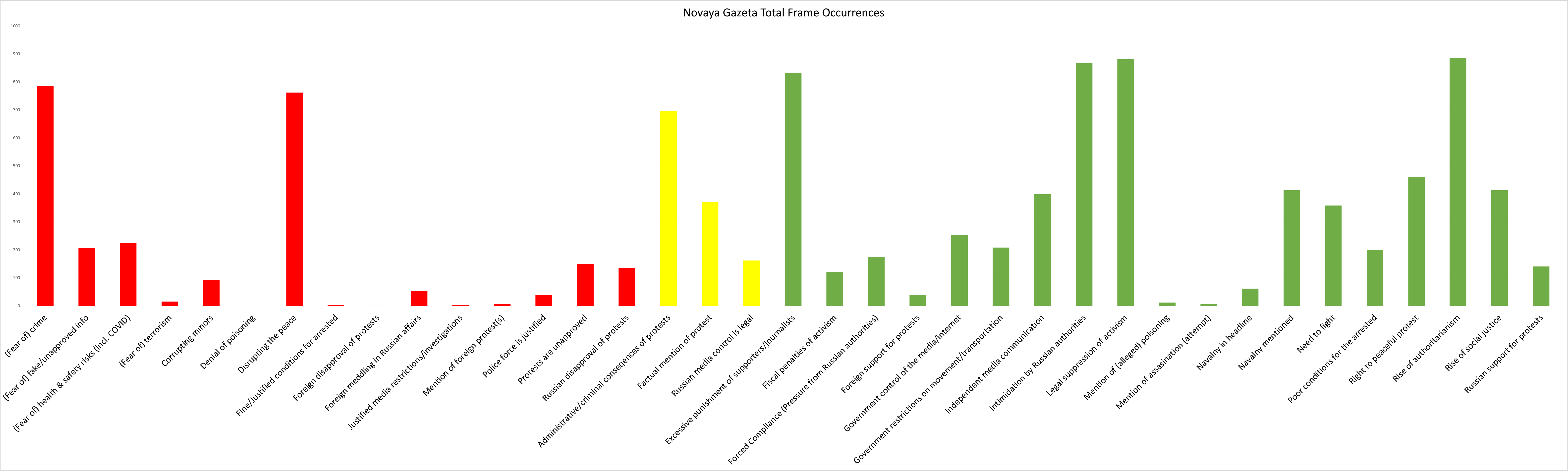
Moving on to the individual frame salience across the 9 media groups, the first obvious finding from clicking through these bar plots is the pattern of state-owned and state-controlled media groups employing significantly more Anti frames than any other frame type, with Kommersant being the only media group in these two categories to have employed a significant number of Pro frames. With the exception of Kommersant, the top 4 most frequently used frames for all the state-influenced media groups are a combination of Disrupting the peace, (Fear of) crime, Protests are unapproved, and Police force is justified, while Kommersant employed the Administrative/criminal consequences of protests frame far more than the others in this group.
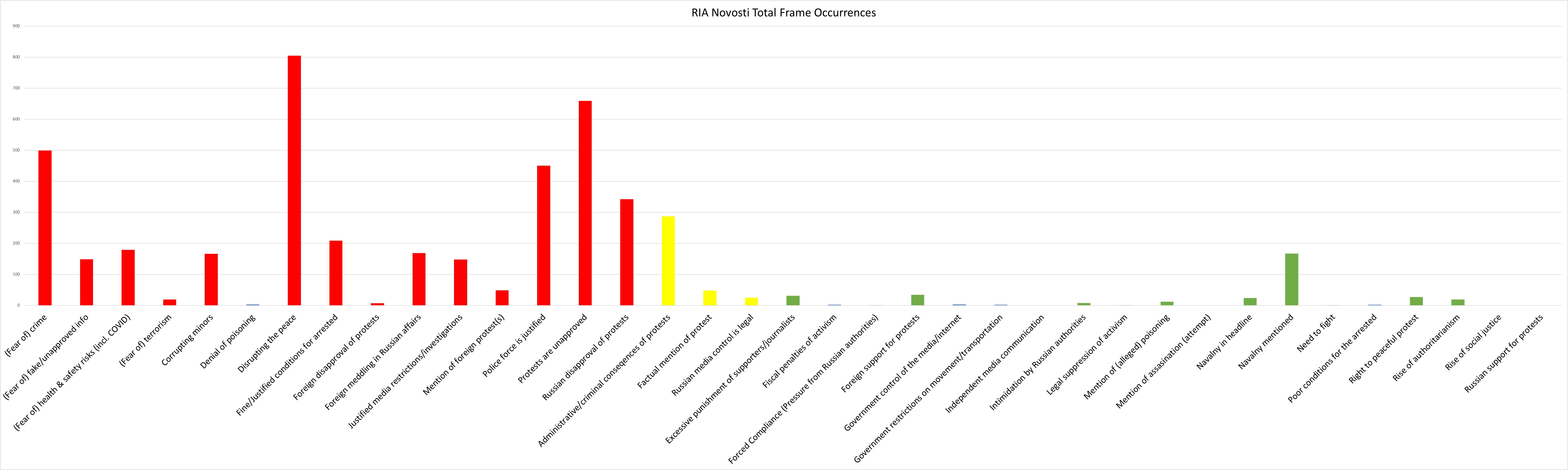
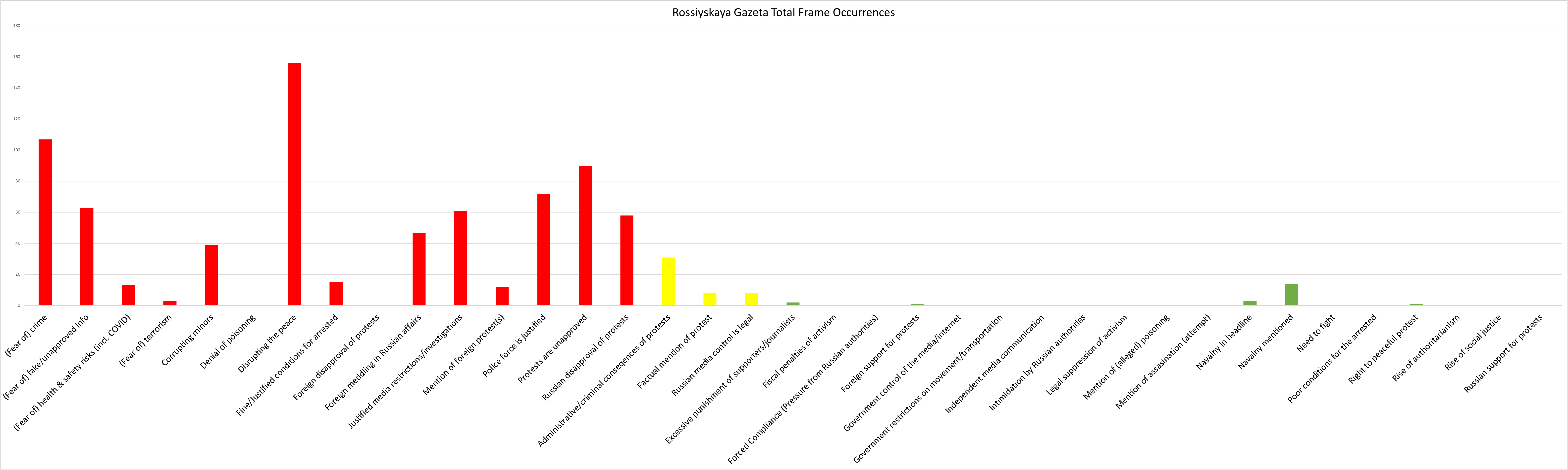
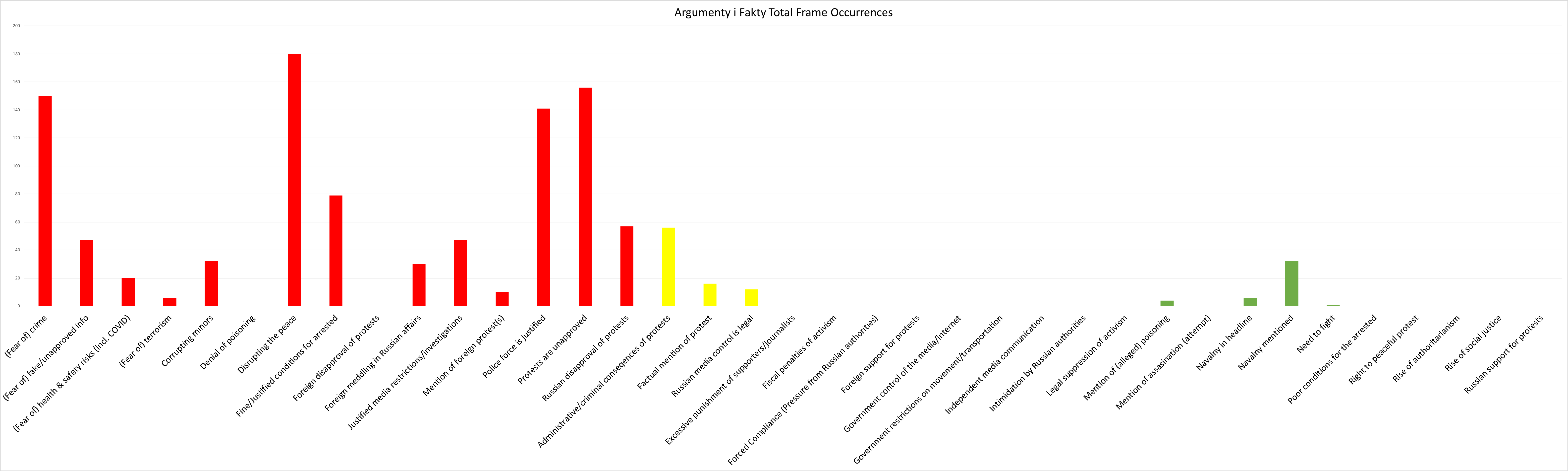
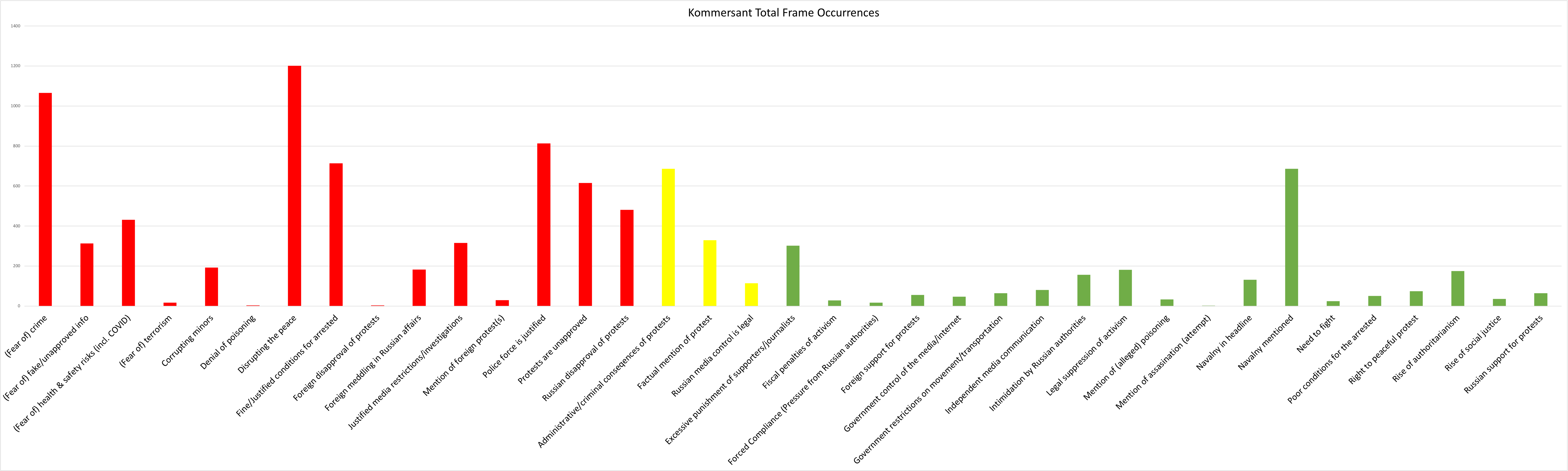
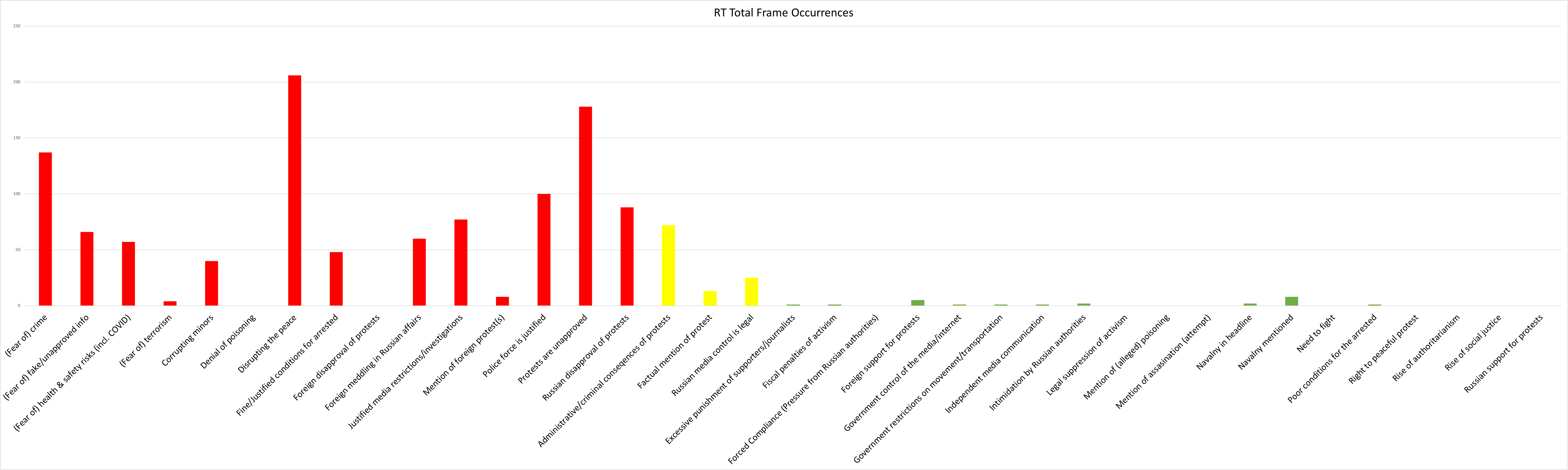
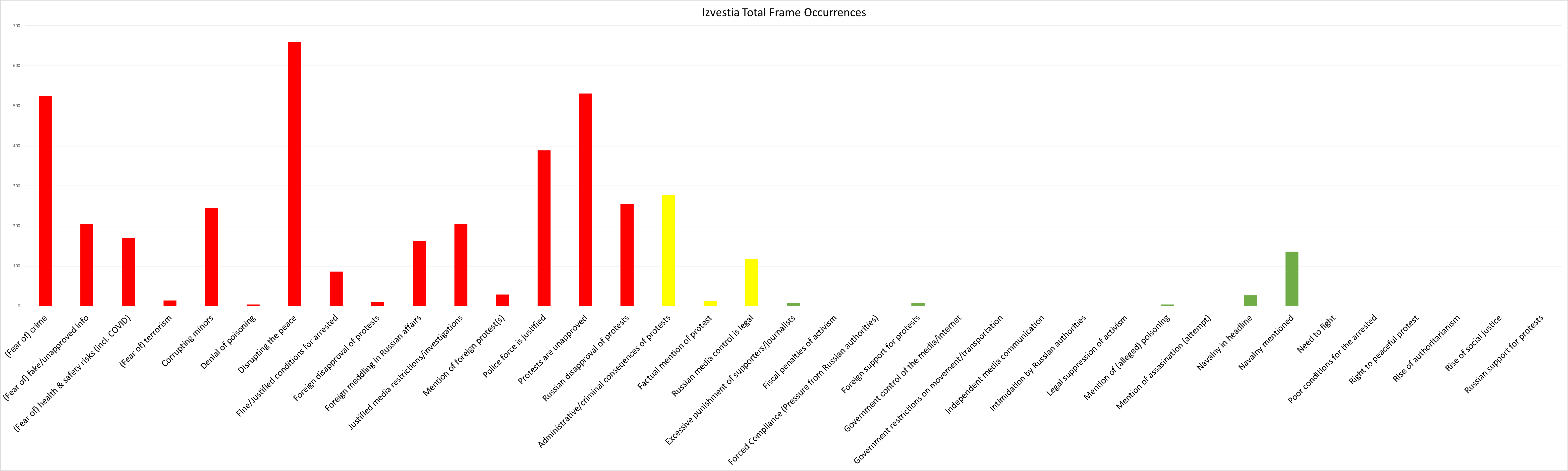
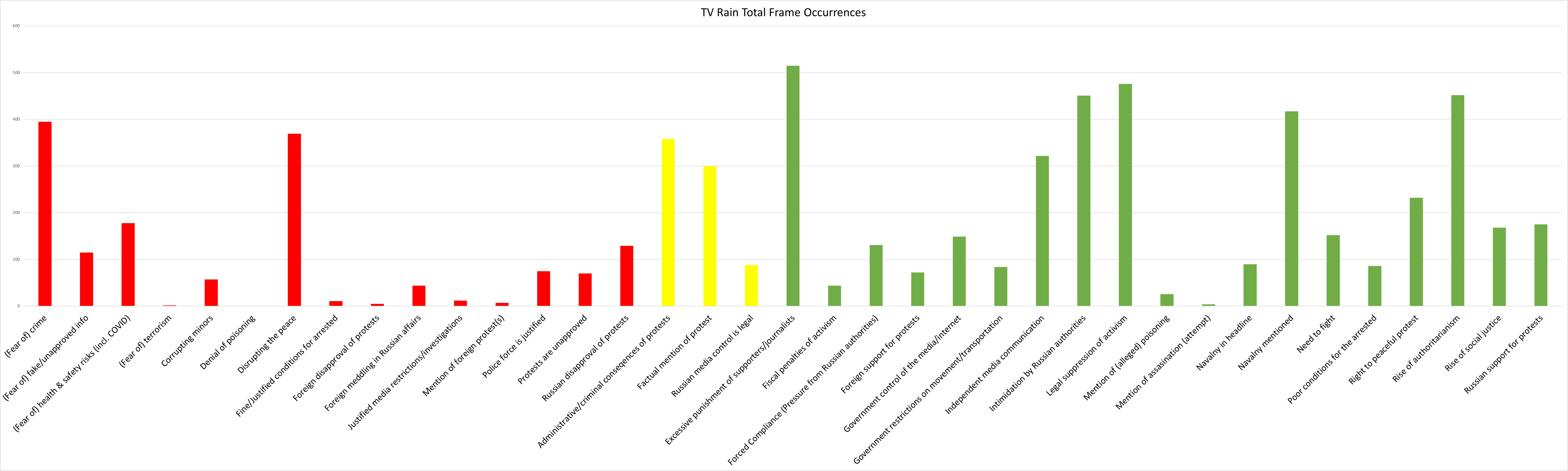
In contrast to the rest of its state-influenced peers, Kommersant frequently used the Excessive punishment of supporters/journalists frame, about as often as it employed the Justified media restrictions/investigations frame, implying that this news group covered the government response to various media information and events in a more balanced manner than, for example, their treatment of the social drive to protest. This is exemplified by Kommersant’s quite low usage of the Need to fight, Right to peaceful protest, and Rise of social justice frames, while Disrupting the peace, Protests are unapproved, (Fear of) crime, Fine/Justified conditions for arrested, and Administrative/criminal consequences of protests are the most frequently employed frames by the media group, indicating a tendency to support the government’s efforts to maintain order over the people’s efforts to protest.
The inclusion of the Navalny mentioned frame in the Pro frame type could be skewing some results, but the justification for this choice remains that the protests were largely understood as being anti-Putin or anti-corruption, and most of the mentions of Navalny are in the context of a pro-protest message, such as the mention of support for him when explaining the protests, as seen in figure 4. This choice was further justified upon the finding that state-influenced media mentioned Navalny far less in their protest coverage than independent media groups.

English description: short excerpt from article mentioning that mass protests in support of Navalny were held across Russia on the 23rd and 31st of January and the 2nd of February.
Overall, the state-owned and state-controlled media groups are remarkably similar in terms of their high usage of Anti frames, relatively low usage of Neutral frames, and very low usage of Pro frames, with the exception of Kommersant which offered slightly more balanced coverage. Notably, all of the state-influenced media groups mention Navalny and include him in at least some headlines, though both Rossiyskaya Gazeta and RT omit any mention of Navalny’s poisoning, even in the form of Denial of poisoning or any other questioning of the credibility of the attack.
All other state-influenced media groups mentioned the poisoning, though often in the form of acknowledging that Navalny had made an allegation that he was poisoned, rather than stating the poisoning as a fact. This allowed for many instances of the mentioning of poisoning with no denial of Russia’s involvement, as the mention of the poisoning in itself was presented skeptically. The independent media groups, by contrast, all mentioned the poisoning with no usage of the Denial of poisoning frame, and similarly all employed the Navalny mentioned and Navalny in headline frames on numerous occasions, while still keeping with the trend across all media groups to frequently use the (Fear of) crime and Disrupting the peace frames.
Interestingly, the independent media groups utilized the (Fear of) health & safety risks (incl. COVID) frame more often than their state-influenced counterparts, and it should be noted here that this frame encapsulated not only the fears of increased COVID infection rates, but also fears and instances of violence and bodily harm experienced at the protests by either protestors or police forces. Therefore, this implies that the independent media groups’ coverage focused more heavily on the health and safety risks of the protests than state-influenced protest coverage, which focused more heavily on the unlawfulness of the protests and the government-imposed consequences of protesting. This is a notable finding because one might assume that independent media groups would refrain from covering the protests with any Anti-protest frames, in order to garner support for Navalny and the protests in general, but the data reflects the reality that these independent news groups do cover the protests in a way that highlights the potential risks of participation, while also challenging the state’s use of force and intimidation against protestors.
Much like the state-influenced media groups, the independent media groups share the same top 4 most frequently used frames; a combination of Rise of authoritarianism, Legal suppression of activism, Intimidation by Russian authorities, and Excessive punishment of supporters/journalists. Clicking through the bar plots gives one a visual reference for the main difference between the independent media groups and those which are to any extent state-influenced, as the independent groups mostly rely on Pro frames, but also employ an almost equal frequency of some Anti frames, reflecting an editorial balance in terms of protest coverage. In practice, this means that an article from an independent news outlet would mention information that coincides with both Pro and Anti frames, and then continue to elaborate on more of the information that pertains to the Pro frame type. State-influenced groups, on the other hand, would mention information that almost entirely pertains to the Anti frame type, and then sprinkle in some sparse information, such as Navalny’s name, that would pertain to the Pro frame type.
The independent media groups also mirror each other in the frequency of their employment of the Neutral frames, with all 3 of these outlets using Administrative/criminal consequences of protests most often, then Factual mention of protest, followed by Russian media control is legal. The relatively high frequency of Neutral frame employment by independent media groups points to a more objective coverage by these outlets, when compared with the state-influenced media groups which employed significantly more Anti frames and significantly less Neutral frames in their coverage of the protests. Notably, however, the use of Neutral frames did visibly increase in the state-controlled media groups, especially Kommersant, as compared with the state-owned media groups.
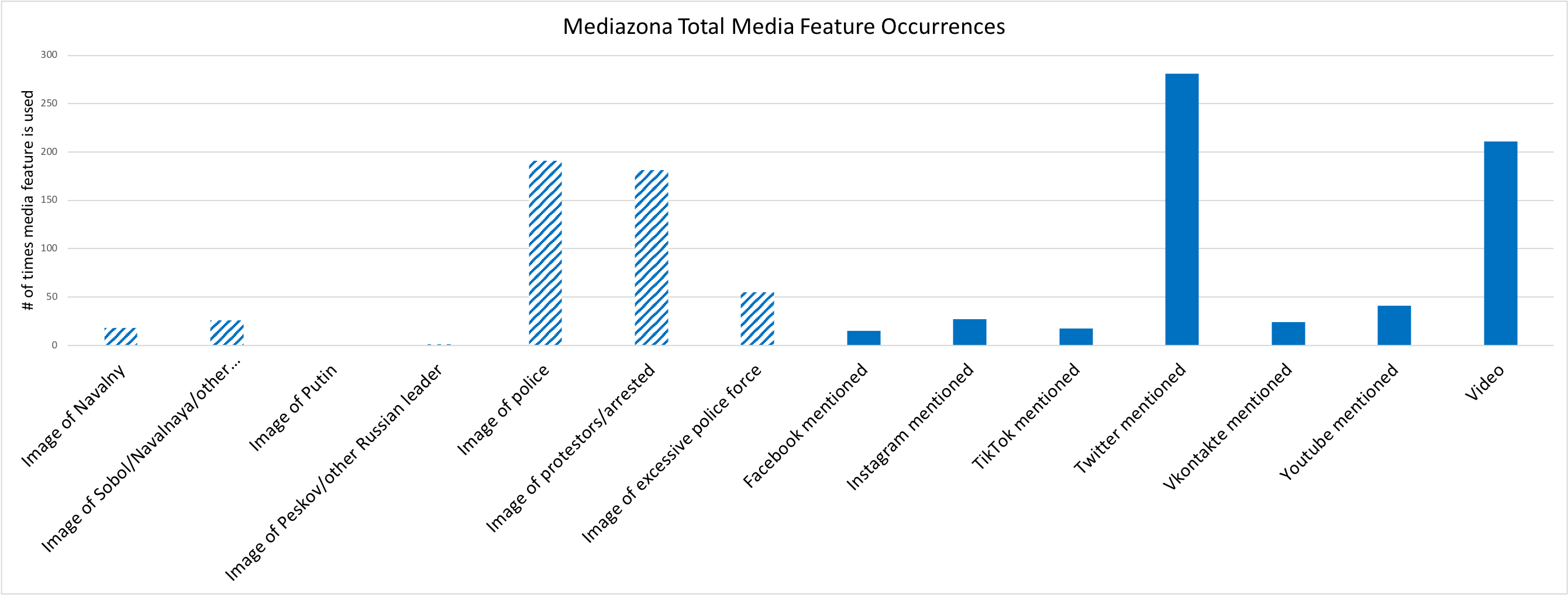
Turning now to the media features coded in each data set, the graphs above illustrate the total number of times each media feature was coded in each media group, where all images coded in the articles are depicted by an angled blue striped column, and non-image media features are depicted using a solid blue column. In the state-owned category, both RIA Novosti and Rossiyskaya Gazeta most frequently used images of police, protestors/arrested, and Peskov/other Russian leader to amplify their Anti-protest message, and also used some images of Navalny, which is somewhat surprising given the overall tone of the media groups. The scale on these bar plots is particularly important to notice, as RIA published over 50 images of protestors/arrested over the course of its 252 articles, whereas Rossiyskaya Gazeta and Argumenty I Fakty, with 42 and 68 total articles published respectively, published over 10 and over 30 images of protestors/arrested respectively. Evidently, Argumenty I Fakty published the highest number of images relative to the total number of articles published, and the same is true for this media group’s use of video in its articles.
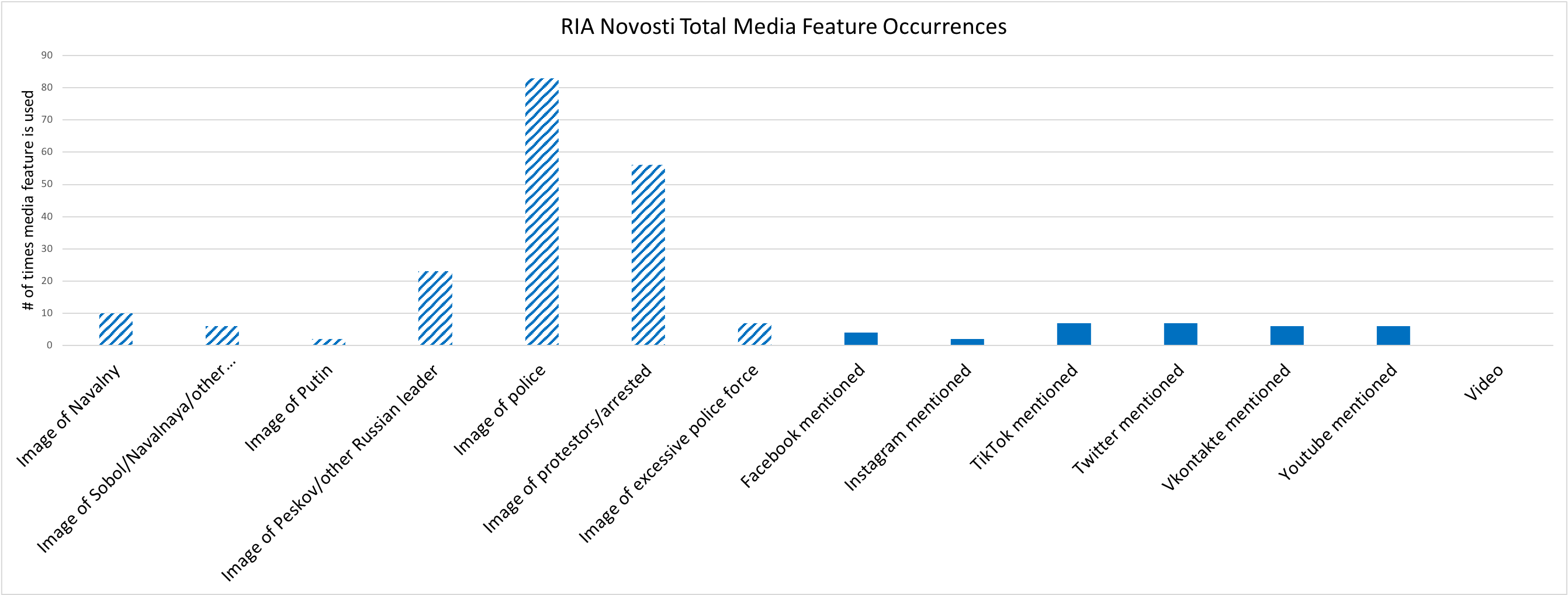
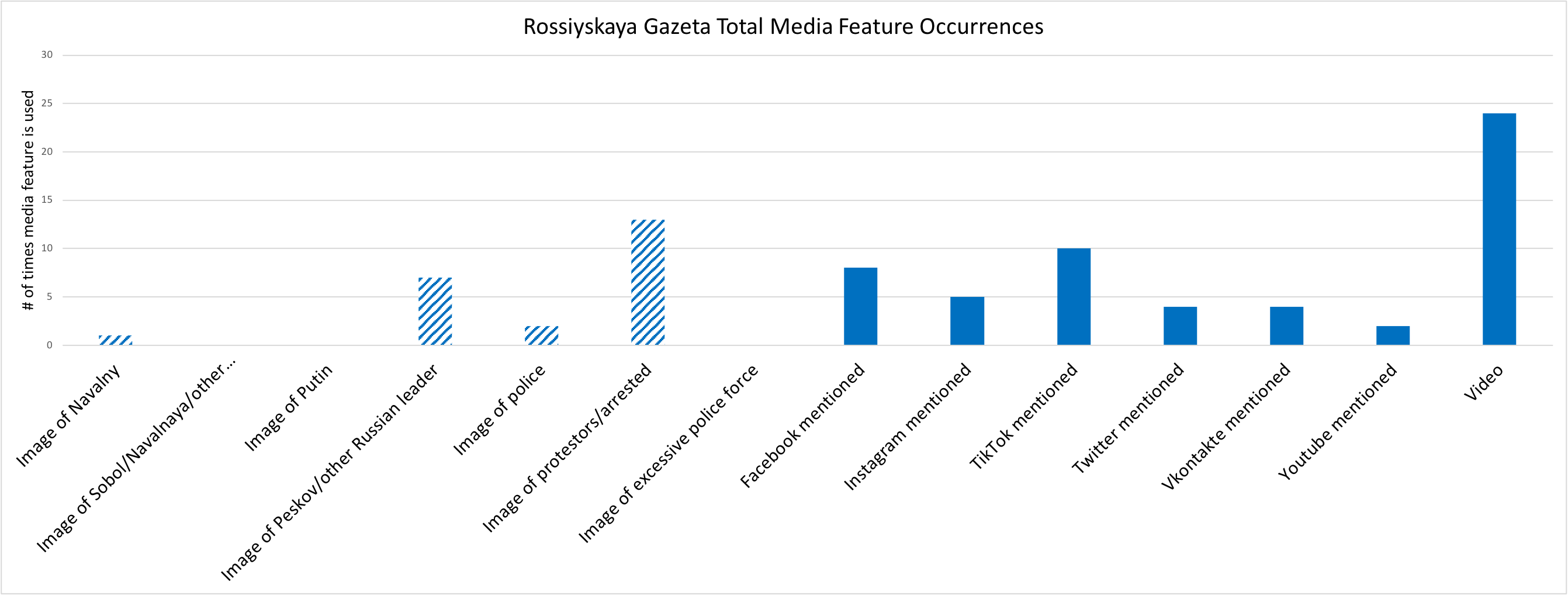
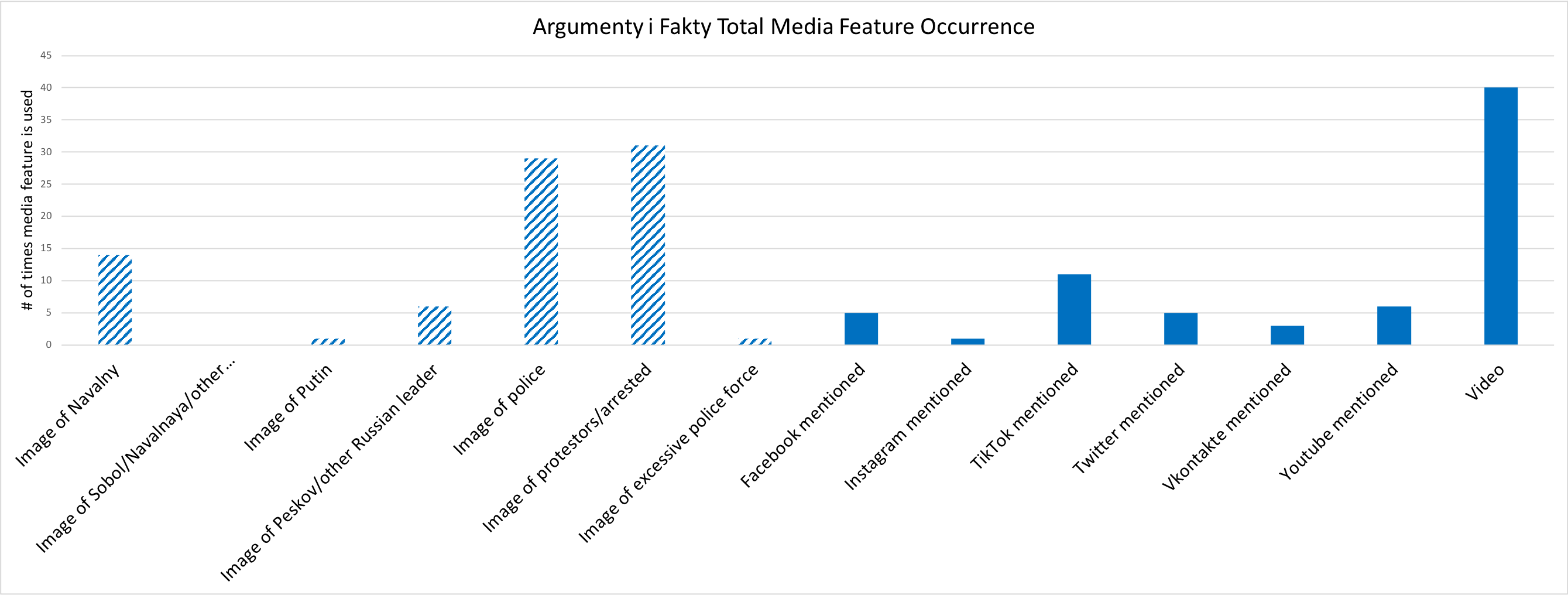
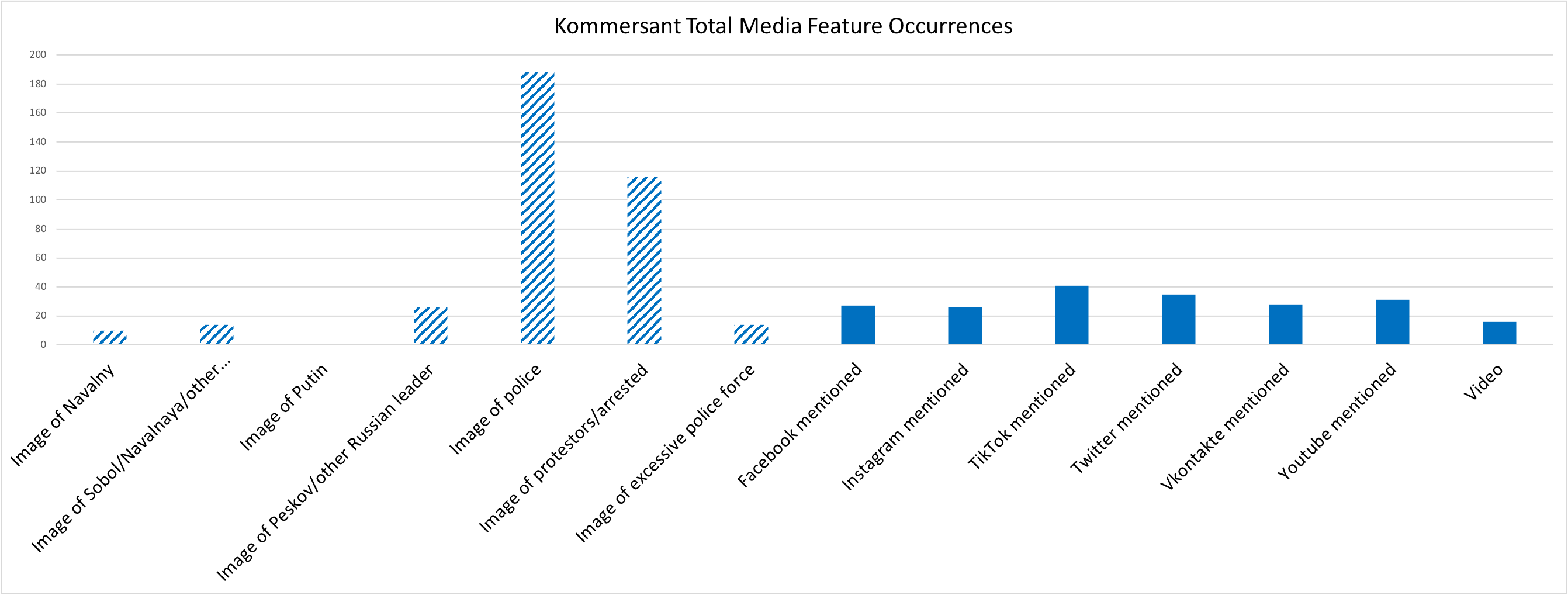
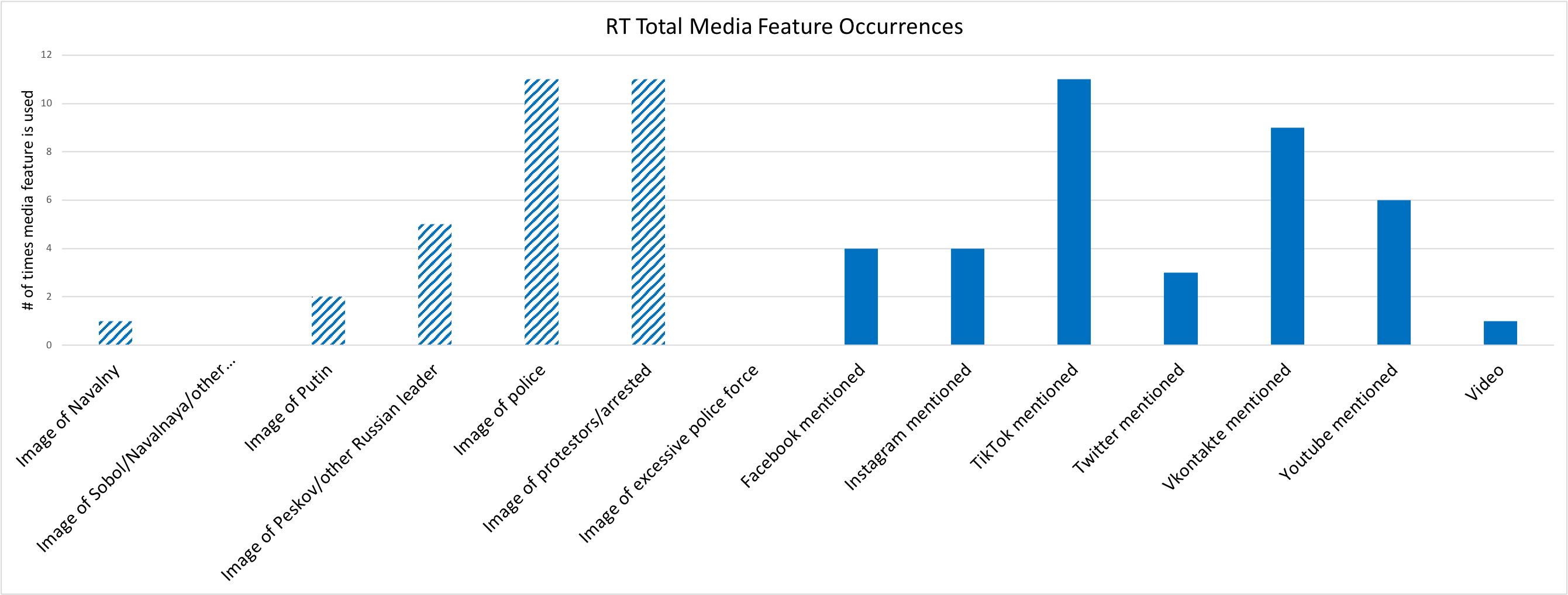
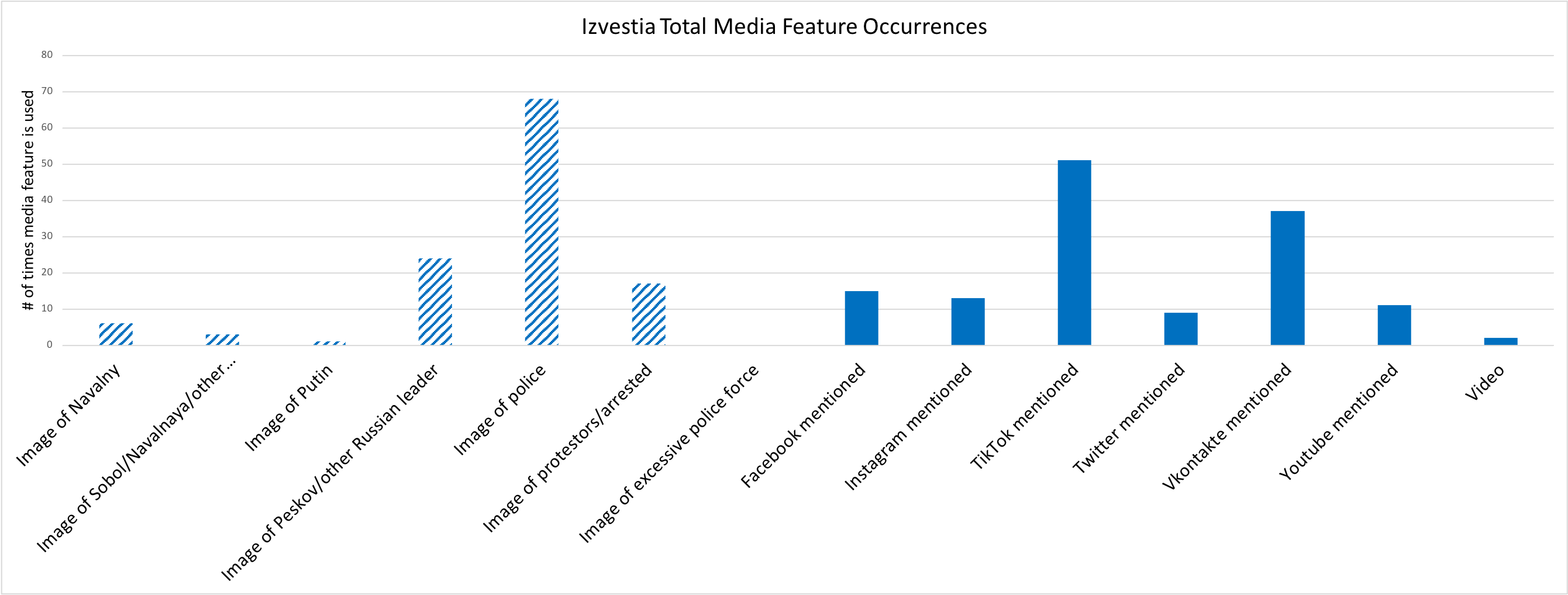
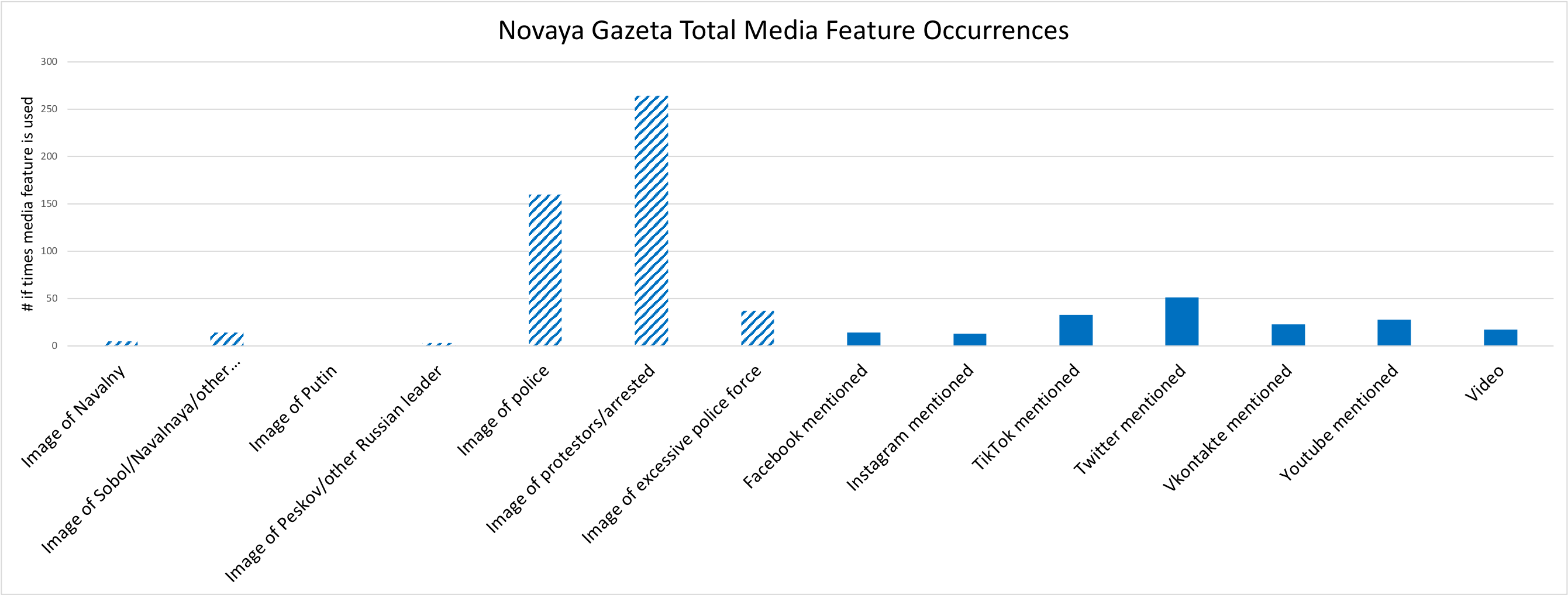
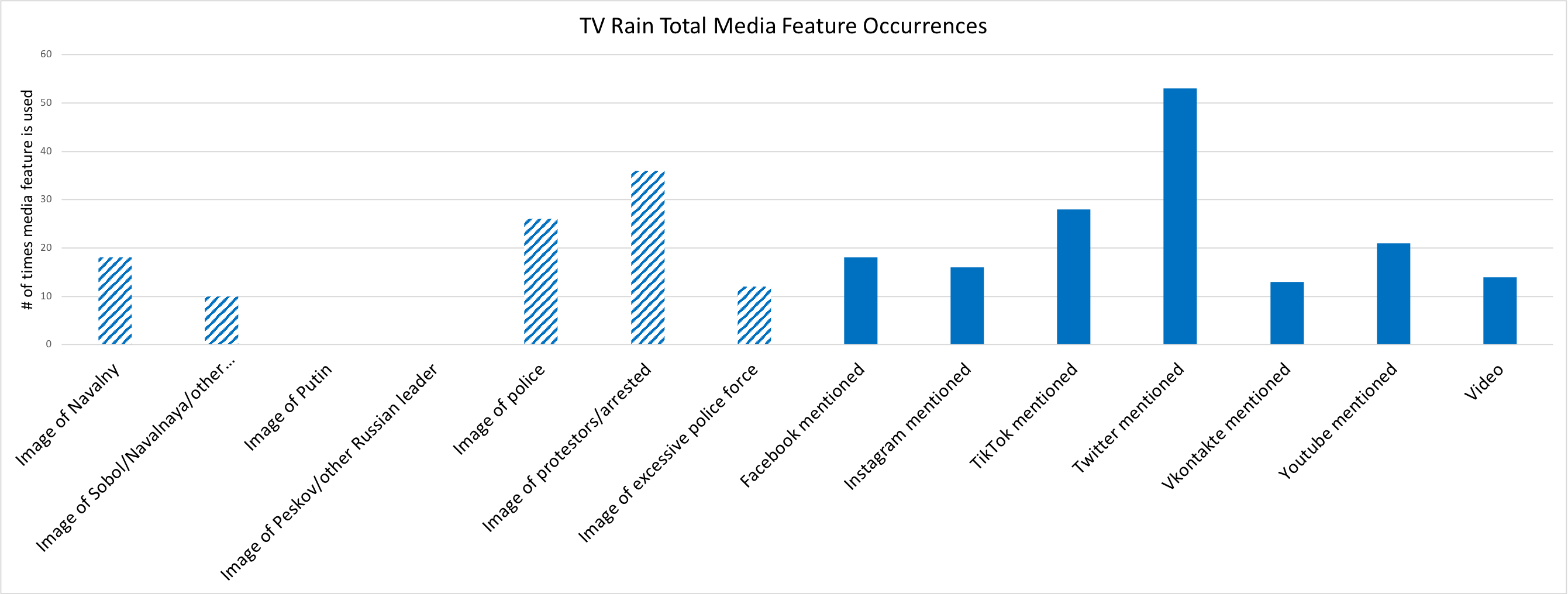
Though completely absent in RIA articles, both Argumenty I Fakty and Rossiyskaya Gazeta employed videos very frequently in their articles, mostly videos of protestors being aggressive or provoking police, or videos of police providing protection and care to those injured or otherwise in need of help. Notably, these videos did not include any depictions of excessive use of police force or other intimidation by the Russian authorities, and only depicted the government and its actors as helpful and trying to maintain order in the face of unlawful protestors. For example, a few videos published in many state-influenced media groups showed police setting up a tea booth, or helping a disabled person down the stairs, or simply showed protestors attacking and harming police.
Strikingly, a large number of videos showed protestors throwing snowballs at police, which was heavily mentioned in articles as a main example of aggression and violence from protestors, justifying the punishment of these protestors, often called provocateurs. Some of the arrested were also recorded apologizing for their actions, and these videos were repeatedly published in both state-owned and state-controlled media groups, while independent media groups mentioned in articles that these apologies were coerced or made under false pretenses that apologizing would help to lessen the severity of punishment for protestors’ crimes.
Furthermore, the non-image media features, except for the video code, were used almost exclusively in the context of the Russian media authorities punishing or warning various social media sites (Facebook, Instagram, TikTok, Twitter, Vkontakte, and YouTube) for publishing unapproved information on these sites that could incite people, especially minors, to join the protests. TikTok in particular was very frequently mentioned in state-influenced media groups, especially RT, in the context of Disrupting the peace with Fake/unapproved media information that is Corrupting minors and encouraging them to illegally protest, with many articles including TikTok in the headline to emphasize the fault of this social media platform. By contrast, while independent media groups also hardly mentioned any of the social media platforms except for when reporting that they had been punished or warned by the Russian media authorities, they frequently mentioned Twitter as a source of information for their news articles.
In particular, Mediazona and TV Rain heavily relied on Twitter posts from journalists and supporters of Navalny to inform them of the day’s events and the less publicized happenings unfolding over the course of the protests, including searches of Navalny’s supporters’ homes and other intimidation tactics by the Russian government. Finally, all state-influenced media groups, except for Argumenty I Fakty, used images of Putin or Peskov/other Russian leader more frequently than images of Navalny or Sobol/Navalnaya/other supporters, which coincides with the expectation that state-influenced media would frame the stories in a more government-focused manner than independent media, which would frame the stories in a more society-focused manner.
5.2 Article Types & Tones, Total Frame Salience, and Proportional Frame Salience
The following four groups of charts were made in RStudio after analyzing the data from the coded articles. The first group of charts demonstrates the types of articles published by each media group, and the colours used are only employed to make each article type visually distinct, with no relation to the tone or framing of the articles. These graphs illustrate that Society news stories are by far the most popular story type across all media groups. This is an important finding in that it shows uniformity across all media groups for the first time in the data, while all other measures of coverage and framing showed different levels of variation across media groups and ownership categories. Essentially, this informs the idea that all news groups, regardless of state influence, publish similar kinds of news stories when covering a specific topic, and that the journalistic choices which lead to such variation across news groups in terms of framing and coverage are largely made within the writing of the article text, rather than being predetermined by the article type.
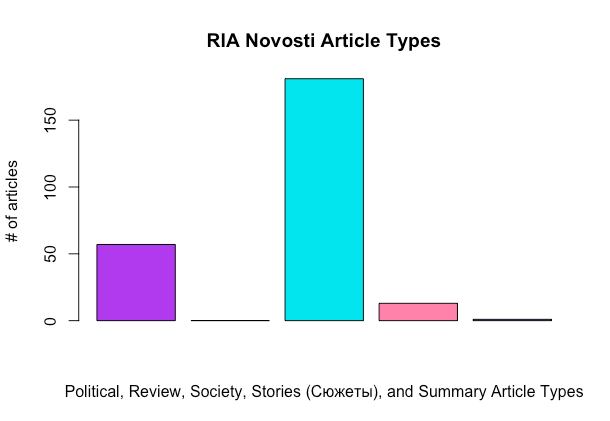


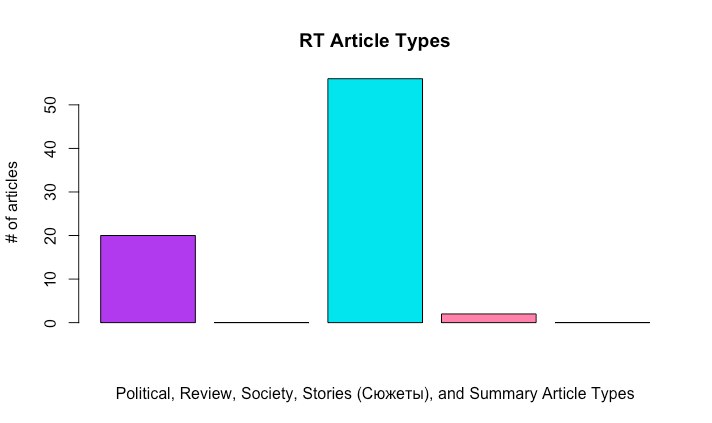

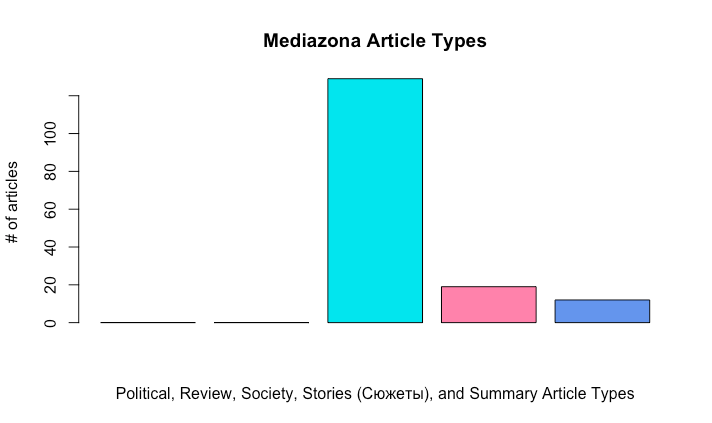

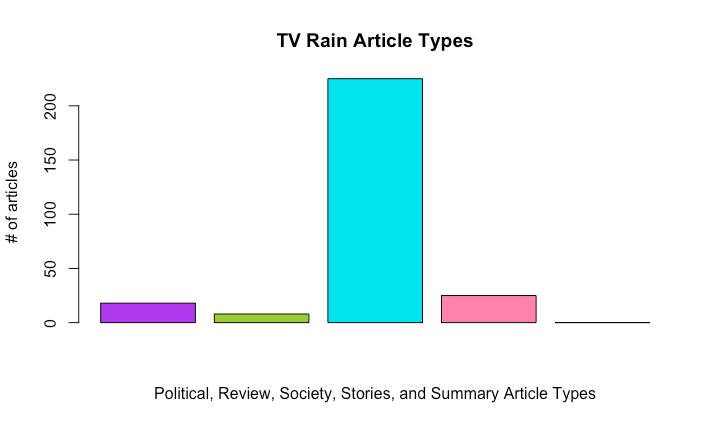
Furthermore, all state-influenced media groups publish Society and Political news most frequently, as opposed to independent media groups which most frequently publish Society news and Stories. This is a key finding as it demonstrates a switch in article type that is much more popular in independent news groups, and this could explain some of the increased Pro framing of the protests by these groups, as there is slightly more freedom in writing a story that surrounds one event than simply writing a society news update, which is what most of the articles across all media groups were. Story articles more often included interviews or quotes from people involved in the protests, and in this way the independent media groups were able to include more information that framed the protests in terms of the social drive to protest, without necessarily stating that the opinions expressed in the story were shared by that media group.
By contrast, the low number of Story articles in state-influenced media meant that writers had less opportunities to include any information that might contradict or challenge the dominant Anti tone of the articles, as most of the articles published by these media groups were between 1-5 pages, and consisted of short summaries or updates on the recent protests that only included basic information, such as the number of arrested and the fact that Navalny was in state custody. My own interpretation of this as the coder of these articles is that state-influenced media groups published fewer article types that would allow for greater journalistic freedom in framing of the protests, and that the main mechanism to convey ‘extra’ information in addition to the relaying of government information was the use of media features, particularly images, though this will be expanded upon further later on in the findings.
The Review of news sources story type was the least frequently used story type, and in state-influenced media (only Kommersant employed this story type) always denoted an article that reviewed international media information regarding the Russian protests. This was almost always linked to the frame of Foreign meddling in Russian affairs, and was chiefly used to show the hypocrisy of Western countries for condemning police crackdowns at the protests while behaving similarly when protests occur in their own countries. Finally, the Summary of day’s events story type was used across all media categories, but notably corresponded to extremely long articles in the independent media groups. For example, one such article by Mediazona was 100 pages long, as it provided a timestamped complete list of all the news surrounding the first protests throughout the entire day, and often relied on Twitter posts and other videos to update readers on all the events occurring throughout the day. Again, such long-form articles provide much more opportunity for journalistic freedom, as more controversial opinions are only presented via third-party Tweets or other social media features, and such long articles would not be the most widely read news articles on the media group’s website, affording them slightly more leeway.


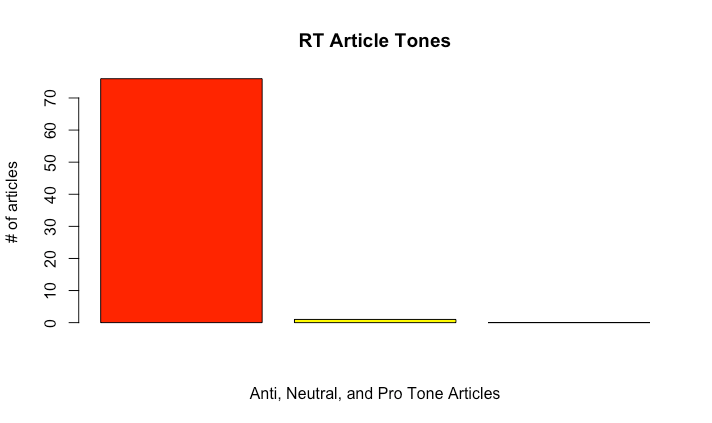




Turning now to the second group of graphs, these bar plots illustrate the overall tones of the articles published by each media group, and again here the difference in coverage becomes immediately evident when comparing state-influenced and independent media. All state-influenced media groups, with the slight exception of Kommersant, have almost entirely Anti tone articles making up their data sets, with a marginal inclusion of Neutral tone articles. On the other hand, independent news media groups similarly have an extreme majority of one tone – Pro, but these groups have a relatively higher proportion of non-dominant tone articles, in this case Anti tone articles, as well as a moderate amount of Neutral tone articles. This comparison demonstrates the difference in objective or neutral coverage that media groups are intended to maintain, and illustrates how state-influenced media is almost entirely dominated by the overall state-approved message that these media groups disseminate to the public, whereas independent media groups are less restrictive in terms of publishing articles that may contradict the overall dominant message that the media group is trying to project.


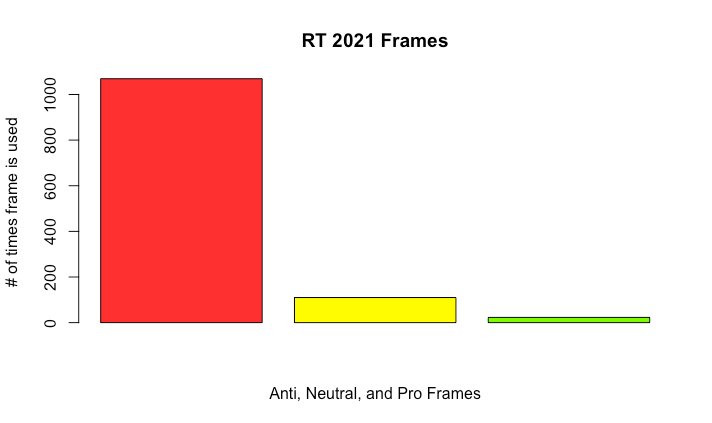
The left panel above presents bar plots of the total number of Pro, Anti, and Neutral frame types coded in each dataset, meaning every single instance of coding that corresponds to any of these three frame types is represented in these figures. The right panel above demonstrates the same information for each frame type, but divided by the total number of articles published in each data set, so as to provide the proportional frame type salience for each media group. All of the state-owned and state-controlled media groups, except Kommersant again, have the highest proportion of Anti frame type occurrences, then Neutral, and finally the lowest number of Pro frame type occurrences. Along with the aforementioned data explanations, this points to a strong divergence on the part of Kommersant from the standard pattern for state-influenced media groups.
Indeed, clicking through these two panels, one sees that Kommersant almost oppositely mirrors the independent media groups in terms of the proportion of Anti, Neutral, and Pro frame types. By this I mean that, while other state-influenced media groups have nearly only Anti frame type occurrences, with little Neutral and almost no Pro framing occurrences, Kommersant more closely follows the pattern of independent media groups in that it has a strong majority of dominant frame type occurrences, but also a significant amount of non-dominant frame type occurrences, and a moderate amount of Neutral frame type occurrences. Of course, in the case of Kommersant, the majority is still in the Anti frame type category, but it has a quite significant amount of Pro frame type occurrences, and a larger amount of Neutral frame type occurrences than any other state-influenced media group. This could imply that Kommersant operates as a more independent-type news media group in terms of its objectivity of coverage, though it clearly still subscribes to the state-approved framing expectations of major media sources.

The table above gives the proportional frame type salience for all media groups in this project, and crucially mathematically illustrates that state-influenced media groups are less objective than independent media groups. While both Mediazona and Novaya Gazeta have the highest proportional frame type saliences in the Pro frame type, they also have relatively high proportional frame type saliences in both the Anti and Neutral frame types, pointing to their increased level of journalistic objectivity and attempts at neutral coverage. On the other hand, while both the state-owned and state-controlled media categories have lower proportional frame type saliences than their independent counterparts, comparing for example the Pro frame type salience of Mediazona (46.12) with the Anti frame type salience of RIA Novosti (15.28), the relative proportional frame type saliences of the Neutral and Pro frame types are much lower and almost insignificant when compared to the dominant frame type salience. The pattern here is that state-influenced media groups frame the protests using significantly more Anti frame types than any other frame type. Here again, we see the divergence of Kommersant, as it has a relatively high level of Pro frame type salience and a moderate level of Neutral frame type salience, pointing to its deviation from the Anti frame type domination of state-influenced media groups.

The figure above portrays the net tone of all media groups, where a net tone of 0 would mean that 100% of the articles published fell under the Anti tone, and a net tone of 2 would mean that 100% of the articles published fell under the Pro tone. Net tone in this way is also a quantifiable measure of the objective coverage of a media group, as the closer it is to 1, the more balanced the coverage is, without being dominated by one or the other tone.
Evidently, this graph shows that only Izvestia and Rossiyskaya Gazeta reached a net tone of 0, meaning that these two media groups had essentially no objective coverage of the protests, and all of their published articles corresponded with the dominant tone of the state-influenced media groups. It is also telling that RT, a state-controlled but not state-owned media group, had an even lower net tone than state-owned RIA Novosti, implying that direct state ownership is not the only or even the most important mark of state-supportive media, or as Saltykovsky would call it “propaganda”. Here again we see the divergence of Kommersant from the rest of its state-influence peers, as it has the highest net tone of the group, more than six times larger than the next highest net tone, implying that it also has by far the most balanced and objective coverage of the protests among the group.
However, this graph also crucially illustrates that this record-breaking objectivity from Kommersant in the state-influenced media category is even less objective than the least objective of the independent media groups. Mathematically, all of the independent media group net tones are more than 0.175 less than 2, meaning they are all closer to the perfectly-objective net tone of 1 than Kommersant is with its net tone. Here it is important to note, however, that this elusive net tone of 1 would not necessarily mean that a media group is completely objective in its coverage and framing of the protests, but rather that, across all of its coverage of the protests, it published an equal number of stories that corresponded to both Pro and Anti tones. Of course, it cannot be claimed that any article published with either of these tones is objective, as this depends heavily on the content of the article itself, but this net tone measure allows for a quantification of the proportion of articles published under each tone, and examples where the net tone is 0 certainly point to a lack of objectivity by those media groups.
5.3 Pro and Anti Frame Type Salience Over Time
Next, the salience of Pro and Anti frame types over time will be discussed, with reference to the corresponding bar plots of each media group. These graphs illustrate the total number of occurrences of only the Pro and Anti frame types, as the data above has shown the insignificance of the Neutral frame type for most of the news groups. These graphs crucially plot the coded occurrences of these frame types over the course of the two months of protests, and will therefore be instrumental in evaluating the hypothesis that independent media framing of the protests became more negative after instances of state censorship or otherwise punishment of media actors.
Yet again, this group of graphs notably identifies Kommersant as an outlier within the state-influenced news media groups, as all the rest of the news outlets in this group display an extreme domination of the Anti frame type, and also all fall below 100 instances of coding for each date. By contrast, Kommersant not only includes a significant amount of Pro frame type occurrences, but even contradicts the Anti frame dominancy on February 1st by having more instances of Pro framing than Anti framing, and on February 2nd by having an equal amount of coding instances for both frame types. Furthermore, the scale of the Kommersant graph is much larger than the rest of its peers, reaching a maximum of around 170 coding instances in one day, even more than TV Rain which has a maximum of about 115. Like Kommersant, the TV Rain graph also includes one day on which the dominant frame type is overtaken by the non-dominant frame type, when on February 27th slightly more Anti frame type occurrences are coded than Pro frame type occurrences. This is likely due to increased coverage of the consequences of participation in the protests, as the actual events of the protests had long passed and so the focus of coverage now centered around the Russian government’s handling of the criminal and administrative consequences of the protests.
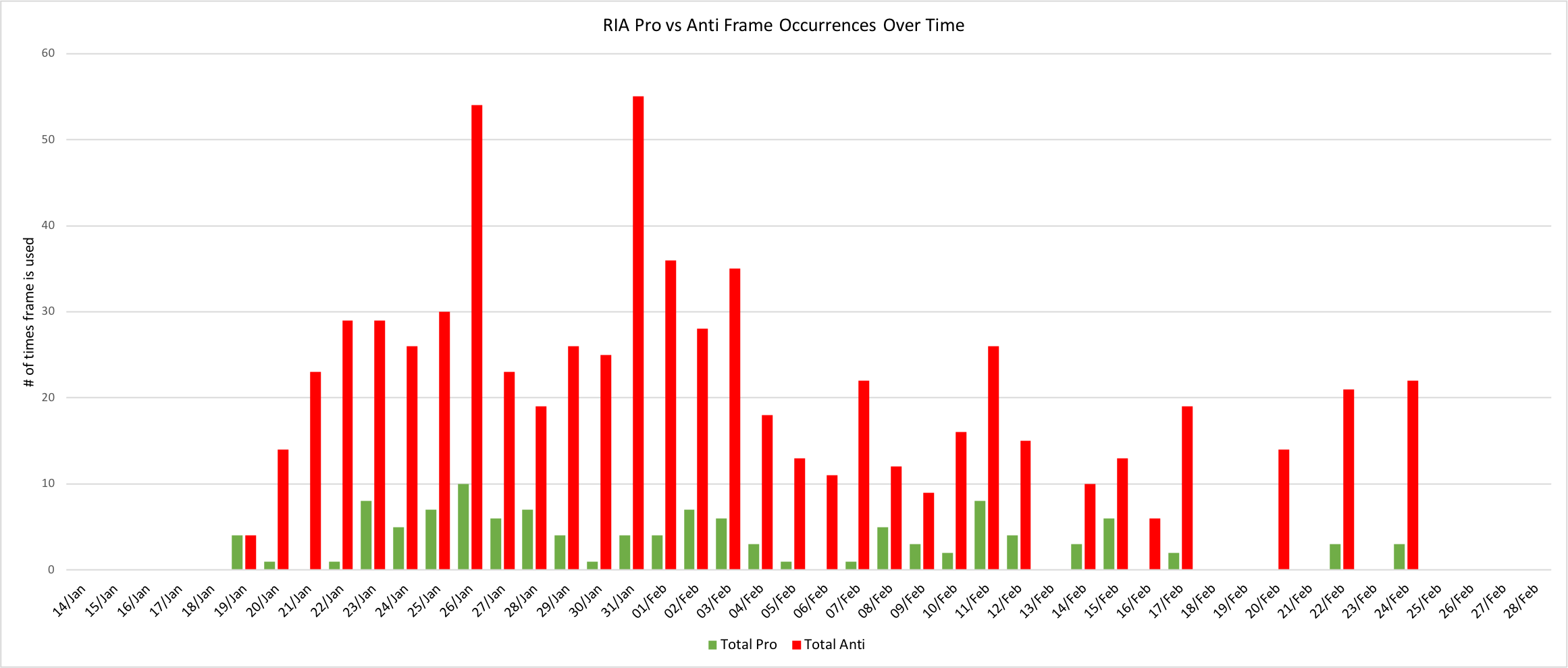
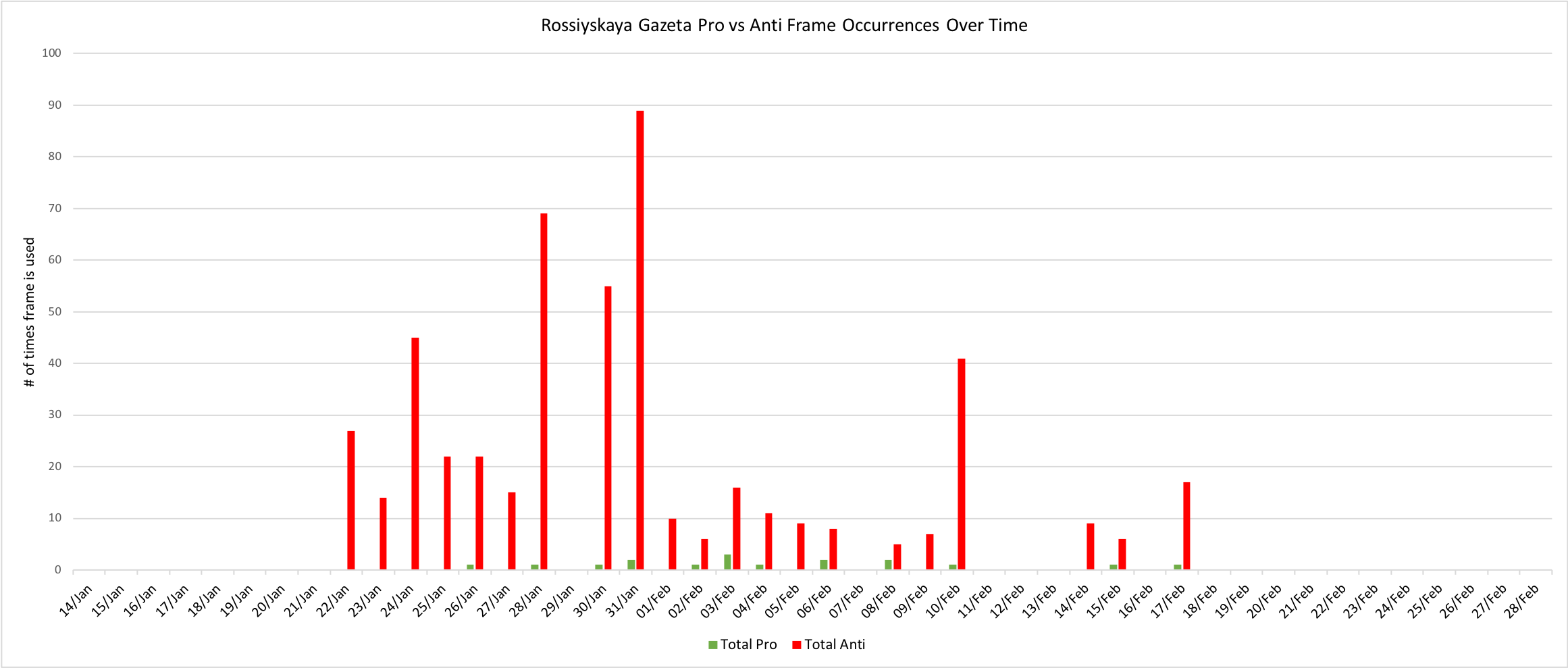
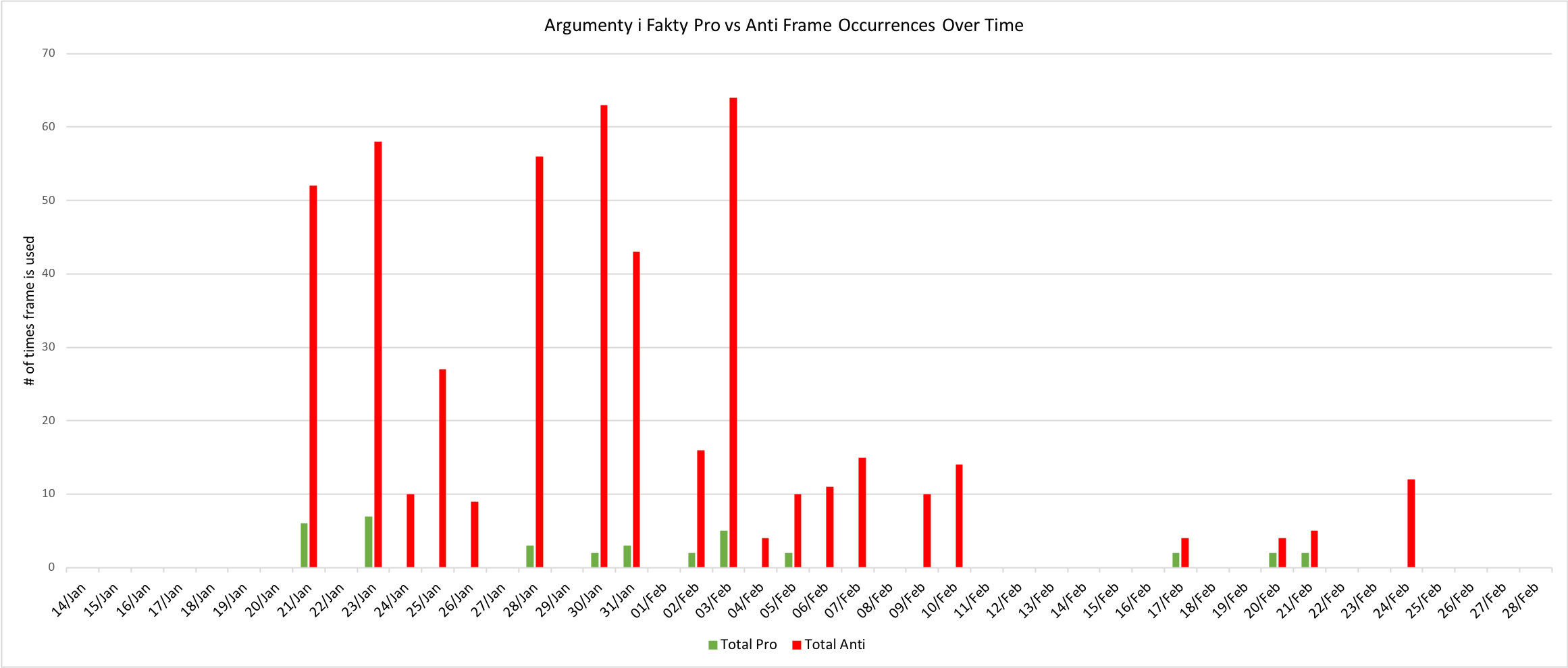
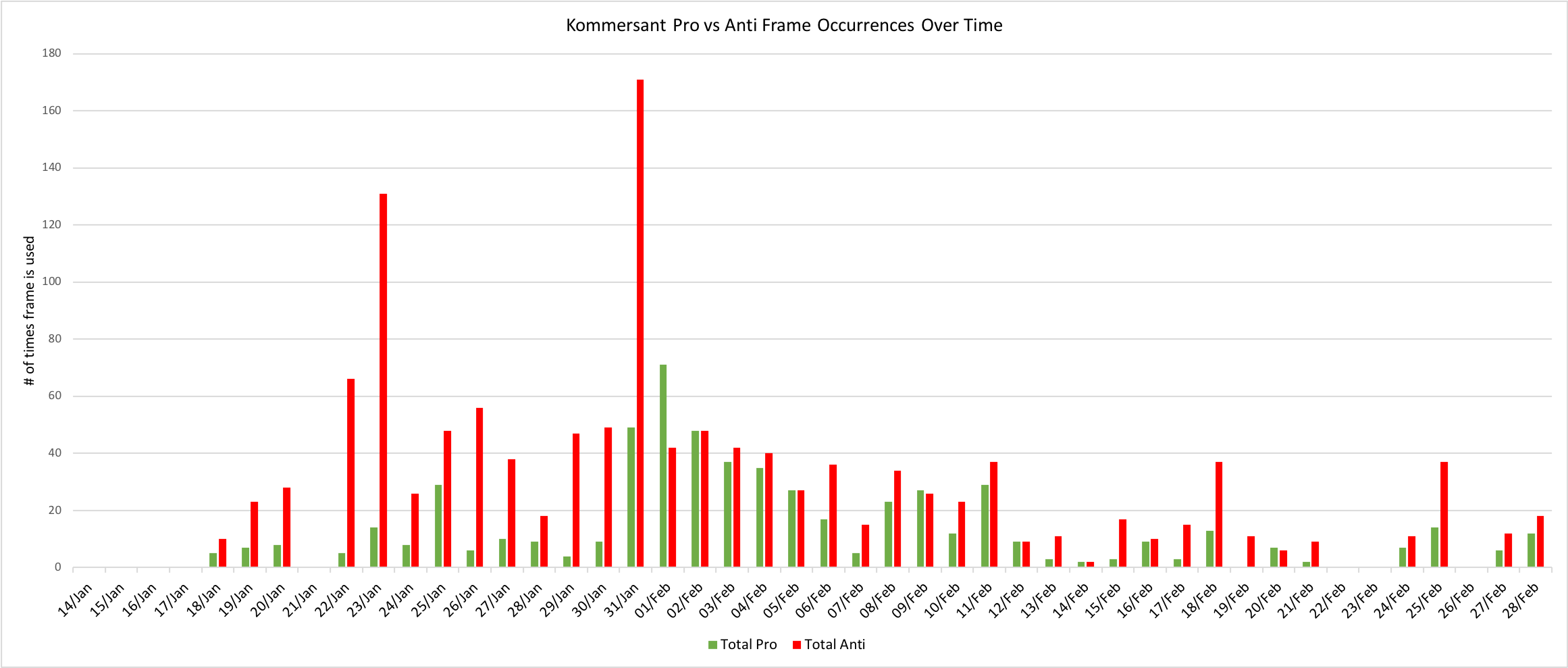
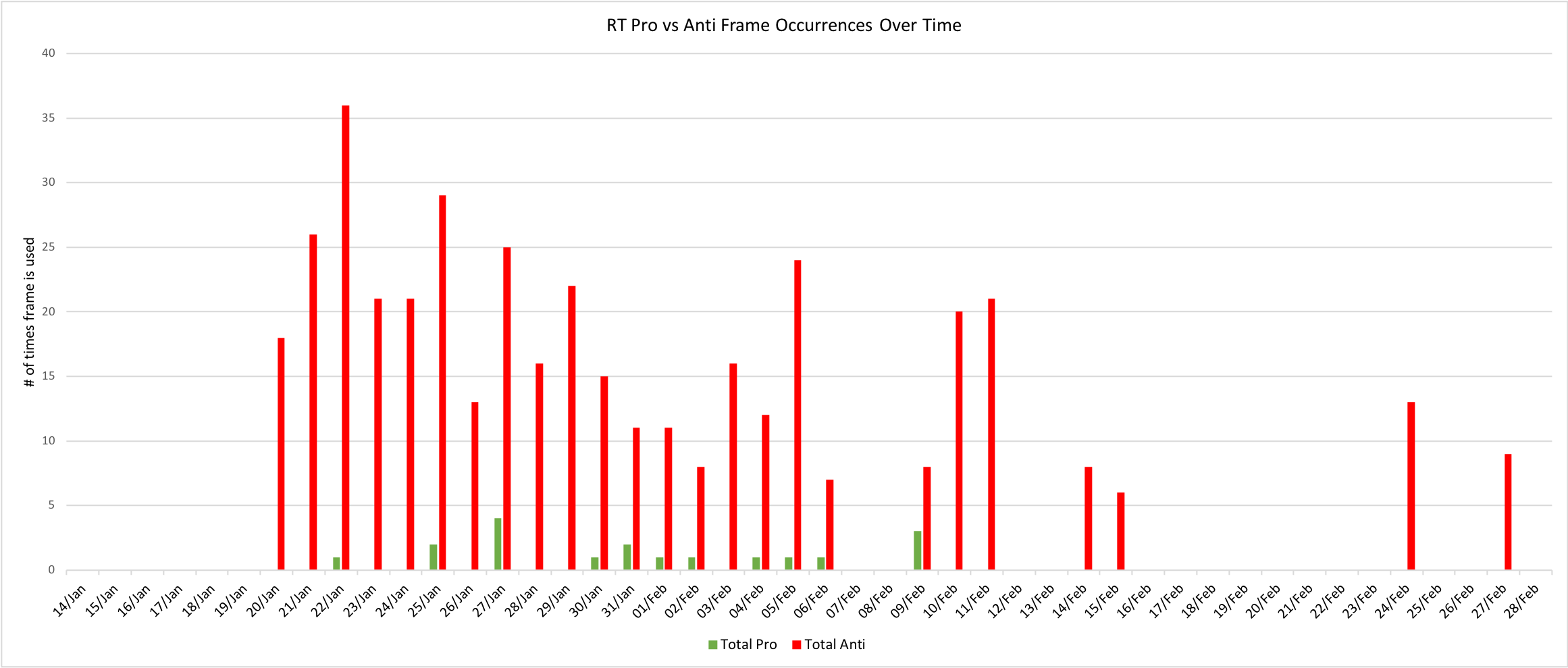
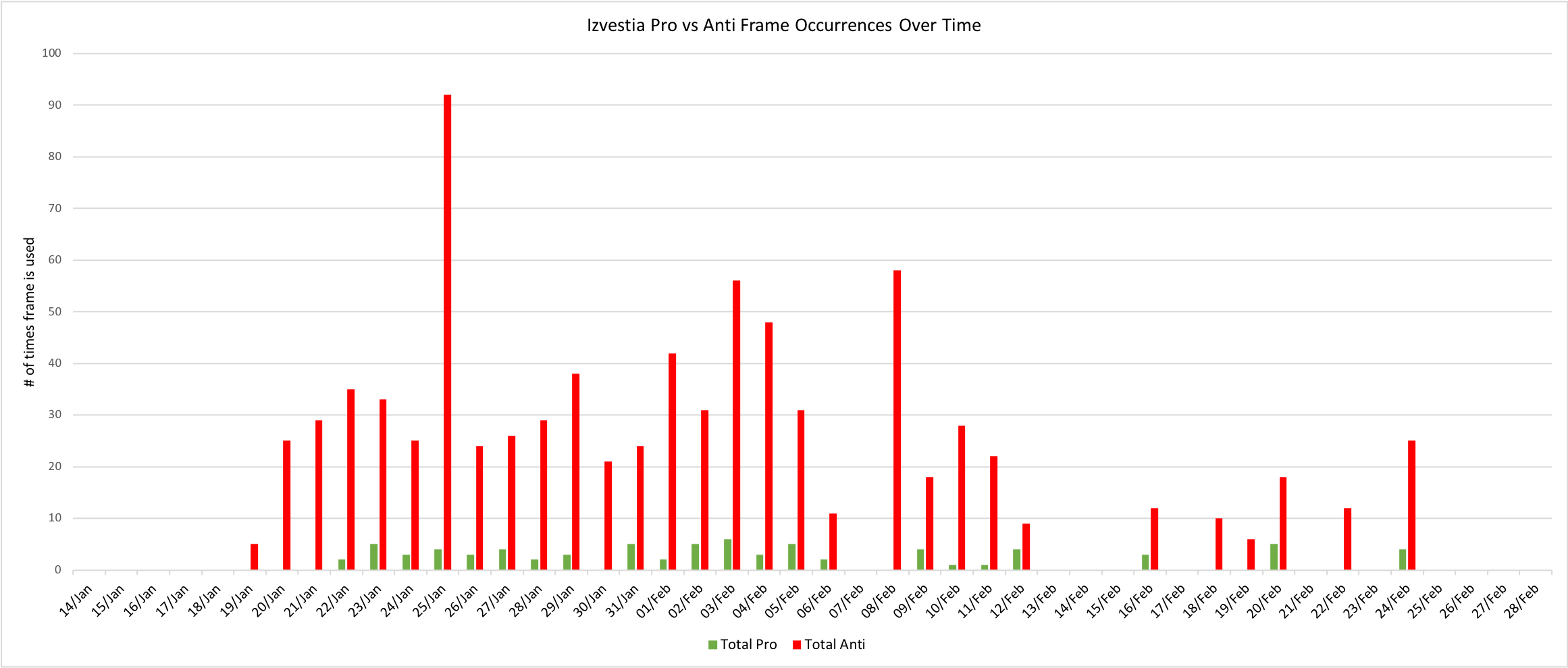
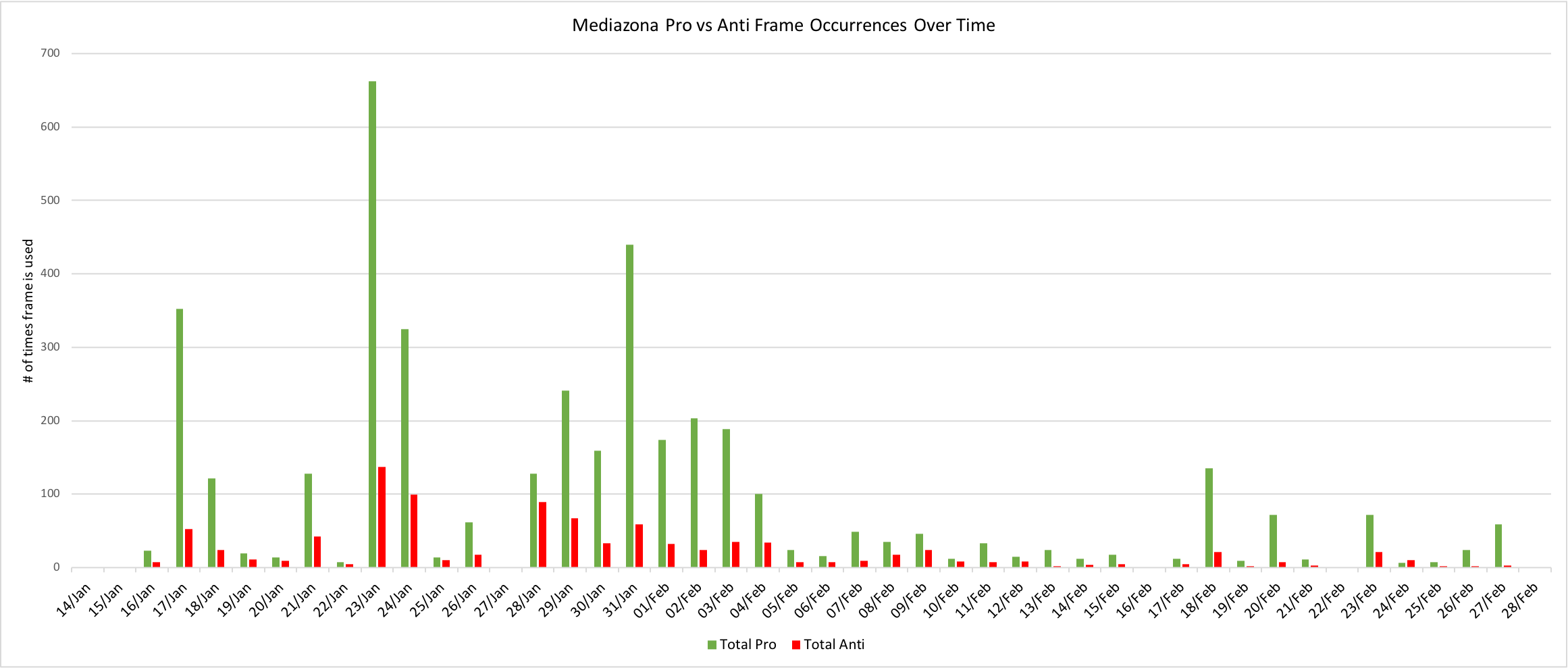
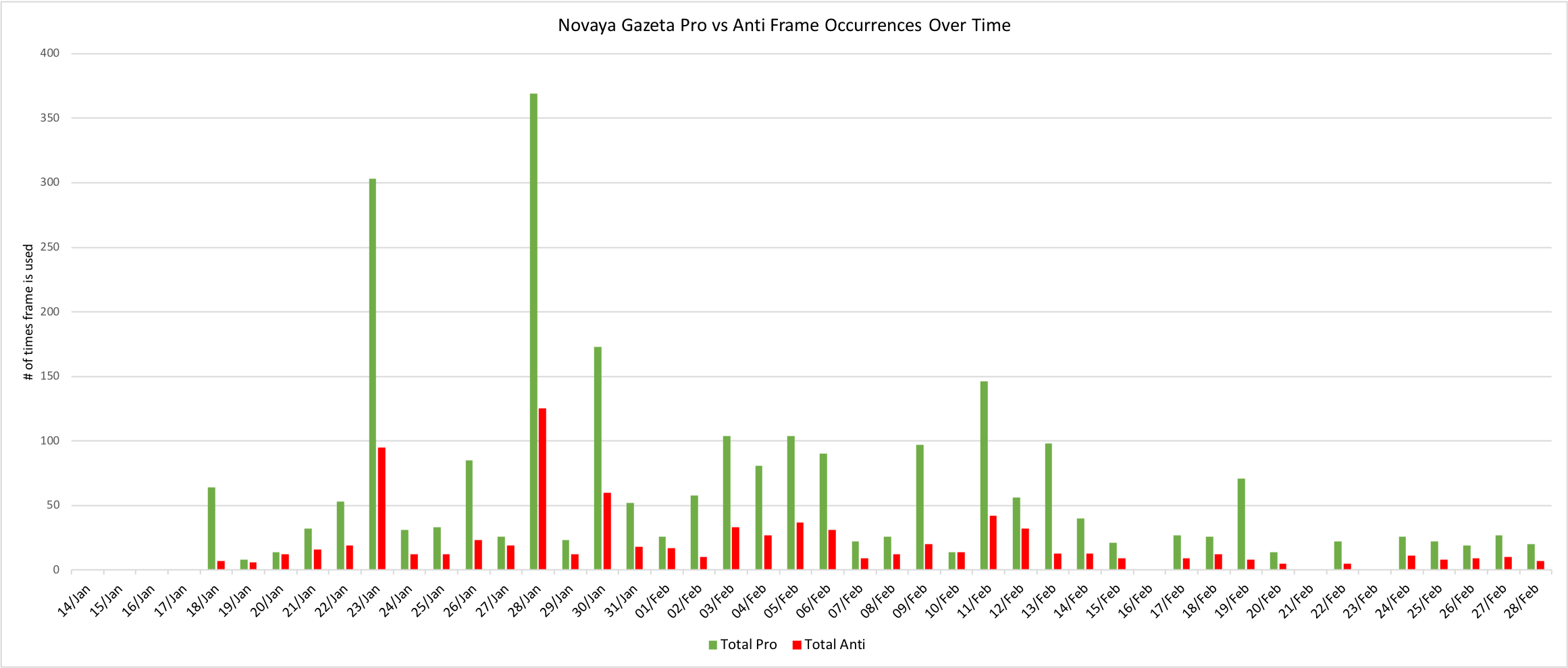
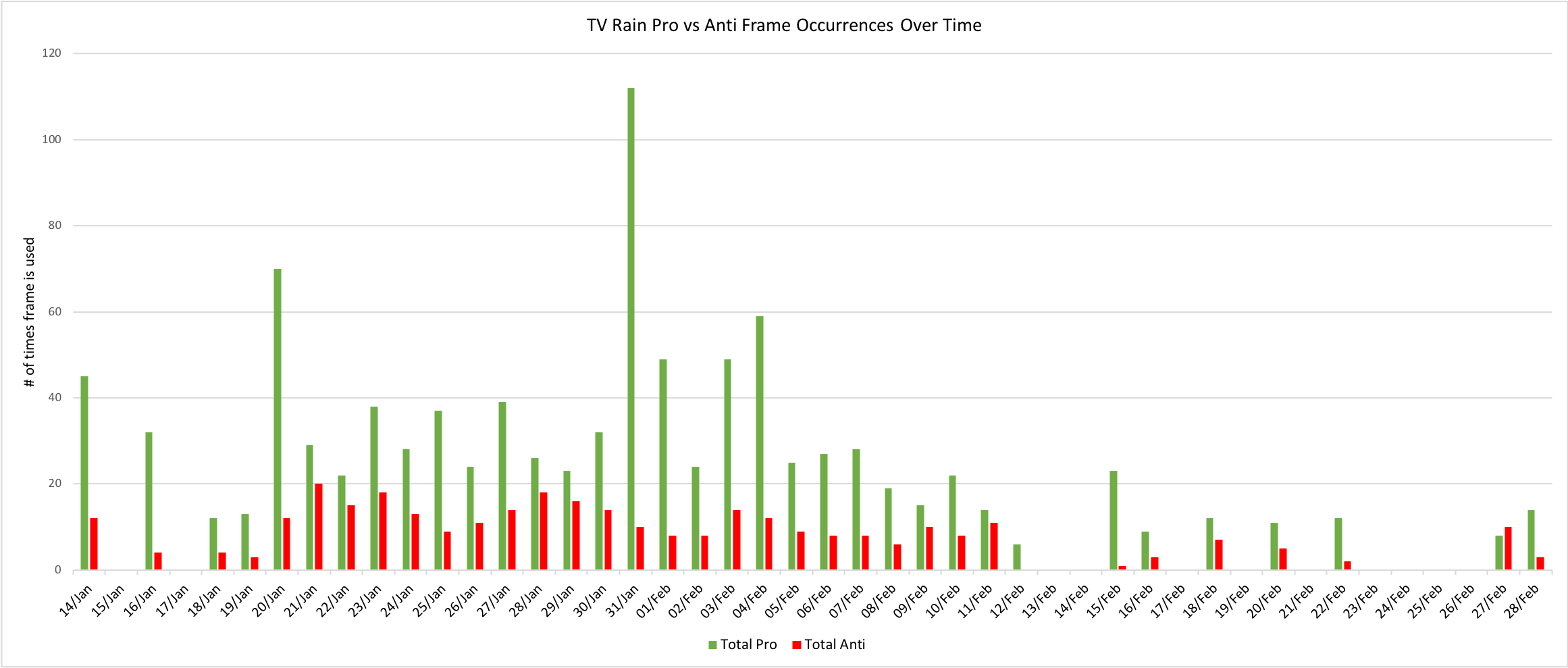
Interestingly, though the dates are not all entirely uniform, there is evidence of a pattern that both Pro and Anti frame types follow in these graphs. This pattern is almost a wave-like trend that corresponds with the dates of the protests on January 23 and 31, as well as February 2. For example, looking at the Anti frame type, one can see that this frame type is rising across all media groups from the first date of publication to the first day of the protests, and usually hits its first peak on the day of the first protest or a few days afterwards. The same pattern holds across the other days of the protests, with Anti frames reaching another peak at or around the 31st of January, then again around the 2nd of February. Then there is a final peak hit around the 10th of February, though this varies slightly more across media groups, as this was around the time that the Russian authorities were preparing for another unsanctioned protest, when in fact Navalny’s supporters had not been planning anything that time. The Pro frame type also follows a similar wave-like pattern where use of the frame type increases until its first peak around January 23, then decreases again until the next peak around the 30th or 31st of January, and again around the February 2nd protests. These vague trends seem to point to the obvious fact that news media is reliant upon news-worthy events to publish articles, as the days with the most occurrences of coding were around the days of protests.
Another important finding from this collection of graphs is that independent news groups started to cover the protests earlier than state-owned media groups, with TV Rain publishing the first article of the entire dataset on January 14th, and the last one on February 28th. By contrast, the earliest article published by state-owned media groups was on the 19th of January by RIA Novosti, and the last article was published February 24th. In fact, the shortest span for any media group covering the protests belongs to Rossiyskaya Gazeta, which covered the protests only from January 22nd to the 17th of February. This points to the less extensive coverage of the protests by Russian state-owned media, and could be interpreted as manifesting a desire to ‘move on’ from the topic of the protests. Furthermore, the final few days of publishing almost entirely consisted of updates on arrests and other administrative punishments for participants and supporters of the protests, thus explaining the high Anti frame type usage.
In order to evaluate the hypothesis of this project that independent media sources covered the protests more negatively following instances of state censorship and punishment of media actors, it is first necessary to outline the key instances of such interventions. The first instance of state intervention in the media that is relevant to this project occurred on January 20th when the RosKomNadzor (RKN), the Federal Service for Supervision of Communications, Information Technology, and Mass Media, demanded that TikTok delete any posts which included calls to protest. That same day, the RKN also issued the same demand for VKontakte, but specifically cited fears of these unapproved calls to protest enticing minors to participate. Though these social media platforms are not strictly news media groups, it is important to note when they are punished and censored, as these platforms are popular spaces for discussion of news events, and crackdowns on these groups impacts the general atmosphere and understanding of approved content in the Russian media sphere. On the next day, the Prosecutor-General of Russia demanded restrictions on access to sites which publish calls to protest, and on that same day, Sergei Smirnov, editor-in-chief of Mediazona, was first warned against participating in the protests.
Looking at the Mediazona graph, there is a drop in Anti frame usage from the 21st to the 22nd, which could reflect fears that the news groups could be a target for state censorship, but this is not very likely considering the much higher levels of Anti frame usage between January 23rd and February 4th. The TV Rain graph similarly displays a drop in Anti frame usage between the 21st and 22nd, though these drops could also be explained by the lesser number of coded occurrences on those days, and can therefore not be marked as significant with relation to evaluating the hypothesis. Interestingly, the Novaya Gazeta graph shows that, while Anti frame occurrences rose only slightly between these two dates, Pro frame usage increased much more, indicating that the state interventions up to January 22nd did not have much effect on the framing of the protests by independent media groups.
On the 22nd of January the RKN made YouTube, VKontakte, and TikTok delete all calls to protest on their platforms, and on the same day, the federal Investigative Committee opened a criminal case over the alluring of minors to protest via unapproved media. The first instance of state intervention in news media occurred on January 23rd, the first day of protests, when Novaya Gazeta was forced by the RKN to delete an article it had published about “titushki” or provocateurs which aim at attacking and engaging protestors. As this was also the first day of the protests, many journalists covering the protests across Russia were arrested, and many gave quotes claiming to have been treated roughly and unfairly, and even having been abused by police officers. Many journalists who made such public allegations were later called to the police to discuss their claims of being beaten by the police, including reporters from Novaya Gazeta. Also on the first day of protests, police came to an apartment where many TV Rain journalists were located, turned off the electricity, and climbed on to the roof, as well as arrested one of the media group’s journalists for supposedly intentionally ruining his passport.
Looking now at the difference between January 22nd and 23rd on the independent media graphs, one sees an immediate increase in both Pro and Anti frame occurrences, which could be largely explained by the fact that the 23rd was the first day of the protests. For both Mediazona and Novaya Gazeta this day represents the first spike in Anti frame occurrences, whereas TV Rain’s first and highest Anti frame spike was on January 21st, correlating more closely with negative coverage of the pressures from Russian authorities to censor social media platforms. It could be argued that the increase in Pro and Anti frames in the first two graphs is only due to the coverage of the protests on that day, but the deviation of TV Rain from this pattern implies that other factors influenced these media groups’ decisions to cover the protests more extensively on the 23rd. Aside from TV Rain, the graphs of the other two media groups illustrate that the date of the highest Pro frame spike corresponds with the date of the highest Anti frame spike. This indicates that the proportional framing of the protests with Pro and Anti frames did not vary for these media groups as much as the extent of the coverage, in terms of the number of articles published and number of coded occurrences. Therefore, while it cannot be stated that Anti frame occurrences increased on the 23rd due in part to state interventions in the media, it is clear that the events of that day lead to more extensive coverage of the protests using both Anti and Pro frames.
On the 26th, the Kremlin press secretary Dmitry Peskov explained the beating of journalists at the first protest by the confusion caused by an aggressive crowd of protestors and an inability of the police to distinguish angry attackers from professional journalists. Though this is not an act of censorship, it is an endorsement of the poor treatment of journalists by the highest-ranking press secretary in Russia, and could have far-reaching implications on the atmosphere of the Russian media environment. Interestingly, on the same day, a state-run television channel “Rossiya 1” censored itself when showing the video of the now infamous instance where a police officer violently kicked a woman in the stomach for approaching him with a question. The channel censored itself by cutting out the moment that the kick lands, perhaps setting an example for the rest of the media sphere to curb its coverage of police brutality at the protests. On the 27th, Sergei Smirnov was again approached by police, who this time searched his home and took his hard drive and some books, warning him not to participate in the upcoming protest. The same day, the RKN threatened all major social media platforms operating within the country with fines from 800 thousand up to 4 million rubles for not deleting posts and videos that promote the protests to minors.
The lack of state interventions between the 24th and 27th of January is mirrored in the graphs through a low frequency of Anti frame code occurrences on these days, with the exception of Mediazona, which still had quite a high number of Anti frame occurrences on the 24th, perhaps indicating a continuation of coverage from the 23rd. Nevertheless, the dip in Anti frame occurrences over these days could point to a general decrease in anti-protest coverage on this day, but this is immediately refuted by glancing at the state-influenced graphs which show a relatively high number of Anti frame occurrences over these days. This divergence in Anti frame usage over the days when there was no significant state intervention in the media supports the original hypothesis that negative coverage would increase after intervention, as it demonstrates that when there is a lack of news related to state censorship or punishment of media actors, Anti frame usage decreases considerably. This explains the low level of Anti frame usage over this period, particularly given the high level of Anti frame usage by state-influenced media groups at the same time, as independent media groups would not generally employ Anti frames in covering the protests, except when relaying information directly from the Russian authorities (including information on state interventions), or when discussing crimes committed at the protests or the fact that they are unapproved.
On the 28th, police came to the house of a journalist in Syktyvkar and charged him with participating in the unlawful protest, claiming that he did not have proper media identification, though he asserts that he had a professional journalistic assignment that he showed to police with no effect on their decision to arrest him. Over the course of the day, many journalists were contacted by Russian authorities, including a Moscow journalist for “Radio Svoboda” who was called for questioning about his participation in the protests and later released after being given a summons for further questioning. He was charged with violating the sanitary-epidemiological rules, a protocol which was used very frequently to target, isolate, and punish supporters of Navalny and journalists. On the 29th, Russian authorities arrested a journalist in Kursk for 48 hours for allegedly organizing and promoting the protests on the internet, and the next day saw a myriad of similar arrests which often had no substantial bases. This includes stories of police arriving at media offices and informing head editors of media groups that they have been identified as organizers of the protests and that they are being arrested for Disrupting the peace, while the accused editors deny any involvement in the organization and promotion of the protests. Furthermore, this was the same day that Smirnov was arrested outside of his home while walking with his five-year old son, and the same day that police came to the homes of journalists who had covered the previous protest, including some journalists from TV Rain.
The graphs of the independent news groups depict that on the 28th, Anti frame occurrences in Mediazona increased significantly, particularly in proportion to the Pro frame occurrences on that day. Compared with the rest of the Mediazona graph, this shows an outlier in that Anti frame usage is proportionally higher when compared to Pro frame usage on every other date on which the code occurrences exceed 100 for at least one of the frame types. Essentially this means that on every day that Mediazona was extensively covering the protests, they employed Pro frames far more frequently than on the 28th, when Anti frame usage reached nearly 75% the level of Pro frame usage. This could indicate that Mediazona employed such a high proportion of Anti frames on this day because of state interventions in the media, including the questioning and summoning of journalists who were covering the protest. The other graphs in the independent media category support this same finding, given that Novaya Gazeta experiences its highest level of Anti frame occurrences on this day, and that on the TV Rain graph this date is represented as the highest point of the second ‘wave’ of Anti frame usage. Here though, there is some hesitation as to whether the findings support the hypothesis that independent media groups would cover the protests more negatively after instances of state intervention, as the extremely high usage of Anti frames on the 28th indicates a strong reaction to the punishment of media actors, but the decrease in Anti frame usage over the 29th and 30th contests this conclusion. While Anti frame usage in Mediazona gradually and significantly decreased over these days, TV Rain usage only decreased slightly, and Novaya Gazeta Anti frame usage plummeted from the 28th to 29th and then increased significantly again on the 30th. It is therefore difficult to draw any conclusions about the impact that state intervention had on these days, as each media group employed Anti frames differently, and if state interventions had any effect on framing, the effect was short lived.
The case of Smirnov’s arrest is one of the most striking examples of media intimidation by Russian authorities, as many journalists recognize the dangers to their careers if they contradict the government, but criminal consequences and involvement of family members can certainly motivate one to think twice before drawing attention to oneself by publishing, or even retweeting, unapproved media. A similar feeling of uneasiness follows from the frequent arrival of police at the registered addresses of journalists in attempts to search the premises or contact the individual, as these registered addresses are often homes where grandparents or other relatives live, leading to these relatives having to inform the journalists that they are being searched by the police. Exactly such a story unfolded on January 31st for one TV Rain journalist whose grandparents had to relay the message that police were looking to contact him. On the same day, the RKN demanded the deletion and blocking of any information that “exaggerated” the number of protestors, as well as any “fakes” concerning police brutality at the protests. As this was the second day of protests, many journalists were again arrested while fulfilling their journalistic responsibilities, often regardless of their press identifications, though they were mostly released the same day after having protocols drawn against them.
The second day of protests on the 31st of January is represented in both the Mediazona and TV Rain graphs by a significant spike in Pro frame usage, the highest occurrence of Pro frames in TV Rain. Notably, however, this spike is accompanied by a proportional decrease in Anti frame usage. While the previous few days displayed a pattern of decreasing Anti frame usage in both of these graphs, the 31st is characterized by a much more extreme difference between the frequency of Pro and Anti frame usage, implying that on this day coverage of the protests was not only significantly increased, but also suddenly much more positive in relation to the total number of coded occurrences. Again, the noticeable rise in total frame usage can be attributed to the fact that this was a protest day and there were many significant news-worthy events occurring, but it is important to note that, when compared with the first day of protests on the 23rd, not only the total usage of Pro frames, but also the proportional usage of Pro frames is much higher on the 31st than on the 23rd.
This could imply that state interventions and punishments of media actors do not have a significant effect on the framing of the protests by independent media groups, because if these media groups were significantly affected, it is expected that they would frame the protests more negatively over time in order to conform to the pressures of Russian state media control. However, the graphs of the independent media groups so far demonstrate the opposite, that as time continues, Anti frame usage generally goes down, though there are some contradictory spikes that could be correlated with state interventions, such as on the 23rd and 28th of January. Additionally, the fact that the graph of Novaya Gazeta shows the 30th as the date with the third most occurrences of the Anti frame, while the 31st displays relatively low Pro and Anti frames, indicates that the correlation of any state intervention or punishment of media actors with a particular change in framing cannot be directly or explicitly calculated, particularly because news groups tend to publish articles at varying times and dates, depending on each media group’s editorial methods and standards.
The same pattern of arresting accredited journalists which characterized the second protest was repeated at the third protest on February 2nd, this time including a correspondent of “Otkrytye Media” who had a protocol drawn against him for breaking the rules of meeting at the protest, despite the fact that he was wearing a bright “Press” vest and showed his professional assignment to cover the protests. On the 3rd, Smirnov was arrested for 25 days, the same day that a Novaya Gazeta journalist was sentenced to 14 days after a 10-minute hearing. On the 8th, however, Smirnov’s arrest was shortened from 25 to 15 days, the same day that police came to the home of a Novosibirsk journalist wanting to talk to her about her participation in the protests she was covering.
Comparing the graphs around the dates of the 2nd and 3rd of February, a moderate pattern emerges among the independent media groups in that Anti frame occurrences increase from the 2nd to the following day. Compared to the previous protest day, coverage on the 2nd was much less extensive, and Anti frame usage was marginally higher relative to Pro frame usage. This could be interpreted as supporting the hypothesis, especially given the high number of journalists arrested on this day, which could be expected to influence the level of pressure to conform to Russian state media standards that media groups and journalists feel. This expectation is further supported by the increase in Anti frame occurrences from the 2nd to the 3rd, and an increase in Anti frame proportional salience from the 3rd to the 4th, visible in the Mediazona and Novaya Gazeta graphs. This could be representational of the fact that news groups cover events at varying times and dates, as many of the articles published on the 3rd and 4th referenced events which occurred at previous protests and over the recent past in general. This is again one of the reasons why drawing conclusions about the explicit correlations between government punishment of media actors and changes in media framing is extremely difficult, as one must consider the changes in framing for several days after the state’s interventional event. However, such interventions occurred almost every day for a period of several weeks, therefore weakening the direct connection between such events and any changes in coverage or framing.
What can be stated is that, as time progressed, and especially after the final protest, independent media framing of the protests employed Anti frames far less frequently than they had before and during the protests. Furthermore, the level of Anti frame usage relative to Pro frame usage also decreased quite significantly after the final protest. This finding in fact contradicts the hypothesis that Anti framing would increase after state interventions, as the majority of state punishments of media actors occurred after the protests. According to the hypothesis, one would expect Anti framing to increase following the protests if the media group felt pressured to self-censor and conform to the dominant Anti framing that characterizes state-influenced media groups. The fact that Anti framing actually decreases over time for the independent media groups largely discredits the notion that state punishments of media actors influences them to comply with state media expectations, and indeed supports the contradictory idea that state interventions in the media are significantly correlated with an increase in Pro framing, which could be explained by an increased feeling of persecution and a need to fight for the freedom of press and protection of journalists.
On the 10th of February, Smirnov complained about poor conditions in his cell, with extreme temperatures leaving him overheated in the day and freezing at night, and he was eventually transferred to a medical unit when his blood pressure spiked, after which he was again returned to a regular cell. This is certainly not evidence of brutality on the part of the police, but it is a perfect example of the serious dangers facing anyone who challenges the Russian government, as health and safety is not a guarantee once involved in the Russian criminal system. Between the 11th and 14th of February, the RKN demanded at least three media groups to delete articles about the upcoming flashlight protests in support of Navalny, including Meduza and an internet journal called “Spektr”, which the RKN blocked the website of in retaliation. On the 15th, TV Rain journalists were called to the Ministry of Foreign Affairs (MVD) over their publication of a story about abuse of those arrested at the protests in Russian jails. The next day, a Novaya Gazeta journalist had a protocol drawn against him, as well as against the media group, over the publishing of “fake” information about “titushki”, leaving the journalist with a fine of up to 100 thousand rubles and the news group with a fine of up to 500 thousand rubles. Finally, on the 18th of February, Smirnov was freed from arrest, marking the final significant state intervention in the Russian media sphere relevant to this project.
The poor health of Smirnov is almost certainly highly correlated with the data represented around the 10th to 12th of February in the independent media graphs, as this was one of the most highly reported stories at the time, given that the main protests had already ended and most news was focused on the Russian government’s handling of the criminal and administrative punishment of protestors and supporters. Interestingly, the Mediazona graph shows a relatively low number of coded instances around these dates, while the other two graphs depict a large number of Pro frame occurrences, as well as a high proportional salience of Anti frames to Pro frames on the 12th for Novaya Gazeta and the 11th for TV Rain.
This high proportion of Anti framing could also be linked to the increased media restrictions and consequences for publishing information about the upcoming flashlight protest on the 14th, since many articles detailing such restrictions and consequences only provided basic information on the accusations from the Russian government and the fear-based framing which the government uses to promote its regulations of the media and public. This finding does support the hypothesis, as it demonstrates a higher proportion of Anti framing after the state intervenes in the media sphere. However, this is slightly deceptive, as the use of Anti frames in the aforementioned manner does not necessarily convey an overall tone that is anti-protest, but rather simply reprints the anti-protest tone of the government, while refraining from projecting any tone that could be attributed to the media group, whether supportive or critical of the government, leaving readers to form their own opinions.
The final dates which could correlate to state interventions in the media sphere are depicted in the independent media graphs around the 15th, 19th, and 27th of February. The 15th is represented on the TV Rain graph as the final Pro frame spike over the period of data collection, and this can be relatively closely linked to the fact that journalists from this media group were summoned to the MVD as a direct result of publishing an article about the protests that the government considered to be unapproved and harmful to the media sphere. The extent of coverage may be partially explained by the flashlight protests in support of Navalny that occurred on the 14th, especially considering the complete lack of any articles published by TV Rain on the 13th and 14th. It is unsurprising, therefore, that the 15th corresponds with a very high frequency of Pro framing for this media group, but this same level of frequency is not mirrored in the other two independent media group graphs.
While Novaya Gazeta does have a moderate number of Pro frame occurrences on that date, Mediazona has very few, which could indicate that the state intervention so heavily covered by TV Rain was not largely consequential to the coverage of either of the other independent media groups. This again would seem to contradict the hypothesis that state intervention pressures media groups to conform and increase Anti framing, as neither the punishment of TV Rain nor Novaya Gazeta journalists resulted in higher frequencies of Anti framing. On the 18th, when Smirnov was freed, the TV Rain graph does depict a relatively high Anti frame salience when compared to previous dates. However, this can again be explained by the fact that many articles published around these dates simply relayed Russian state information, which heavily employs Anti frames, in a relatively neutral manner. Both the graphs for Mediazona and Novaya Gazeta illustrate the high frequency of Pro framing around the 18th, signifying the final spike in Pro frame occurrences for the period of data collection.
If the hypothesis were to be confirmed by these findings, one would expect that the arrest of the editor-in-chief of Mediazona would result in a significant increase in Anti framing, or at least a significant decrease in Pro framing, but instead there are no noticeable changes in the framing of the protests by the media group, except that they were covered more extensively around the actual days of protests, which again can be expected and is not likely affected by state interventions or punishments of media actors. Therefore, though there are some outliers and many factors to consider in assessing the hypothesis that state intervention led to an increase in Anti framing by independent media groups, the majority of the findings contradict this hypothesis and instead support the claim that state intervention had little effect on independent media framing, save for perhaps a moderate impact which actually decreased the frequency of Anti coding and increased the salience of Pro coding.
5.4 Frequencies of Codes, Code Maps, and Word Clouds (MAXQDA Visuals)
Moving now to the frequencies of codes in each media group, this collection of figures was created in MAXQDA as one of the visual tools for data analysis, and depicts the percentage of articles in each media group in which each code is employed. For example, for RIA Novosti, Disrupting the peace was coded in 97.6% of all articles published, and so on. These graphs visualize the usage of dominant and non-dominant frame types, but also provide additional details including the exact codes which are most popular in each dataset, as well as including the codes for media features.
Starting with the state-owned category, the first obvious finding is that RIA Novosti employs more Pro frames than its counterparts, and that, while the most frequently used Pro codes in both Argumenty I Fakty and Rossiyskaya Gazeta are Navalny mentioned and Navalny in headline, RIA Novosti most frequently employed Foreign support for protests, Excessive punishment for supporters/journalists, and Right to peaceful protest after the most frequently coded Pro frame Navalny is mentioned. Furthermore, even more Pro frames are coded in the RIA Novosti articles, though at a very low frequency, indicating a slight deviation from the domination of Anti frames across state-owned media groups. Additionally, the increased use of media features by both Rossiyskaya Gazeta and Argumenty I Fakty is visually evident from clicking through the figures, as well as the finding that RIA Novosti framed the protests in a more diverse manner than its two counterparts, seeing as it included a not insignificant number of Pro frames to contribute to its Anti-dominant coverage of the protests.


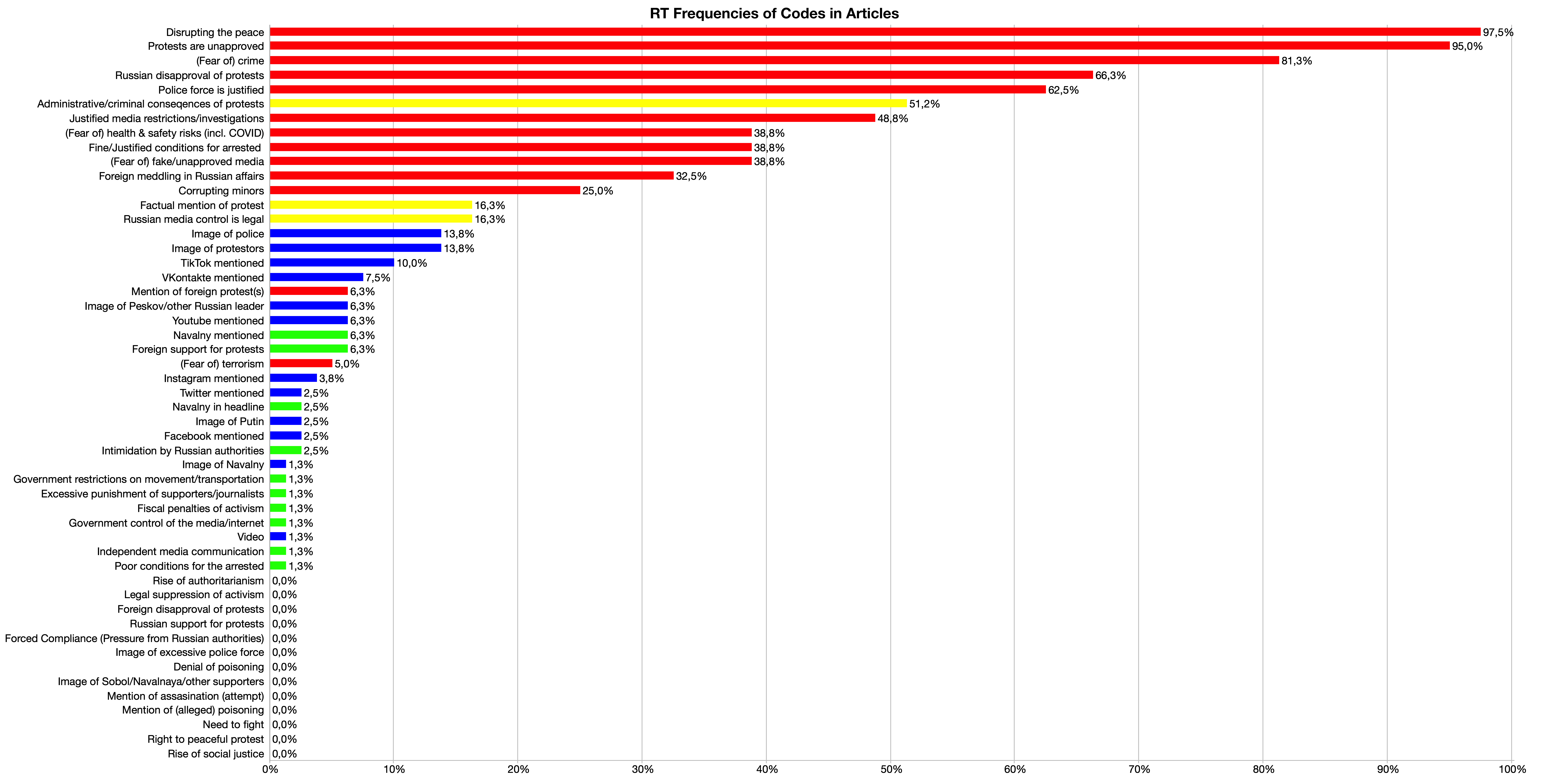


Looking at the state-controlled media group graphs, RT and Izvestia more or less closely follow the pattern laid out by the state-owned category, and most closely resemble the graphs of Rossiyskaya Gazeta and Argumenty I Fakty. Here again we see the divergence of Kommersant in that it largely corresponds to the same pattern, but crucially includes quite a few Pro frames, which contradicts the pattern for state-influenced media framing. In fact, the Kommersant figure depicts 15 Anti frames and 19 Pro frames, though of course the Anti frames are coded much more frequently than the Pro frames. Regardless, the fact that Kommersant frames the protests using a larger range of Pro frames than Anti frames points to some efforts at journalistic objectivity or at least diversity of coverage, especially when compared to the state-owned media groups which have extremely low diversity of coverage.
Another interesting finding from these graphs is the high frequency of coding images in state-influenced media groups, with RIA Novosti (32.9%), Argumenty I Fakty (39.7%), Kommersant (38.8%), and Izvestia (37.4%) all having quite high frequencies of coding images of the police, much higher than any other media feature code frequency in any of the other media groups. This could indicate a heavy reliance on media features such as images of the police in order to convey certain ideas and messages that are more subtextual or contextual than is written in the article. For example, the high frequency of using images of the police could be one journalistic choice that writers feel they have more liberty in, as an image can be interpreted in various ways based on one’s own preconceptions and beliefs.
Though I was unable to speak to any Russian journalists about their own experiences with self-censorship and other journalistic choices, one possibility is that journalists who may be sympathetic to the protests could use more images of the police to convey a subtextual message about the rise of authoritarianism or the unfair crackdown on protestors. However, it could just as easily be said that a journalist’s choice to use such an image has no further agenda than simply depicting the protests as they were or offering a visual aid to accompany the story. The quantitative data I have gathered is not sufficient in order to make a judgement of the use of media features such as images in order to subtly combat self-censorship, but this is absolutely a key field of research for the future of media studies.
In the independent media category, it is interesting that the most frequently coded frame in Mediazona is an Anti frame, but this can be explained by the instances in which this code was employed. This frame was used to code not only information that would highlight the fear from Russians and Russian authorities of crime occurring at the protests, but also any instances of crime as defined by the Russian government. This means the code was used each time there was news about anyone being arrested or otherwise punished for their role in the protests. Clearly, not every time that this frame was coded corresponded to an anti-protest message, but nevertheless it denotes the negative consequences of participating in the protests.
Overall, the Mediazona graph visually appears to be well-balanced in terms of its depictions of Pro, Neutral and Anti frames, as well as the media features, supporting the earlier finding that Mediazona is the most objective of all the media groups analyzed based on its net tone. In line with this, Mediazona also has the most frequent usages of all three of the Neutral frames, though the other two independent media groups also have extremely high frequencies of all the Neutral frames, higher than any of the other media groups, again pointing to the increased objectivity of coverage by the independent media category. Finally, Novaya Gazeta and TV Rain are the only two media groups to have a Pro frame as the most frequently coded frame in their respective datasets. However, the closeness of Anti frames, being coded in over 80% of articles for both of these media groups, again indicates the diversity of coverage by these independent media groups, as well as their attempts at objectivity in framing the protests.
Furthermore, another exciting function of MAXQDA is the option to create “Code Maps”, which allow for visual representation of the intersection of codes in various ways, of which I chose the intersection of codes within the same documents. The size of the dot on the code map corresponds to the frequency of the frame, and the thickness of the line between frames represents the frequency with which these two frames are coded together within the same document. The code maps vary in terms of the minimum frequency of frame intersections for the creation of a line, due to the difference in article numbers and frame occurrences. I manually selected the minimum frequencies for these code intersection lines for each media group, based on the visual complexity of the maps, in order to avoid messy and unhelpful data visualization. The distance between two frames indicates the frequency with which they are coded together, and those which are very frequently coded together are visualized on the map in the form of clusters.
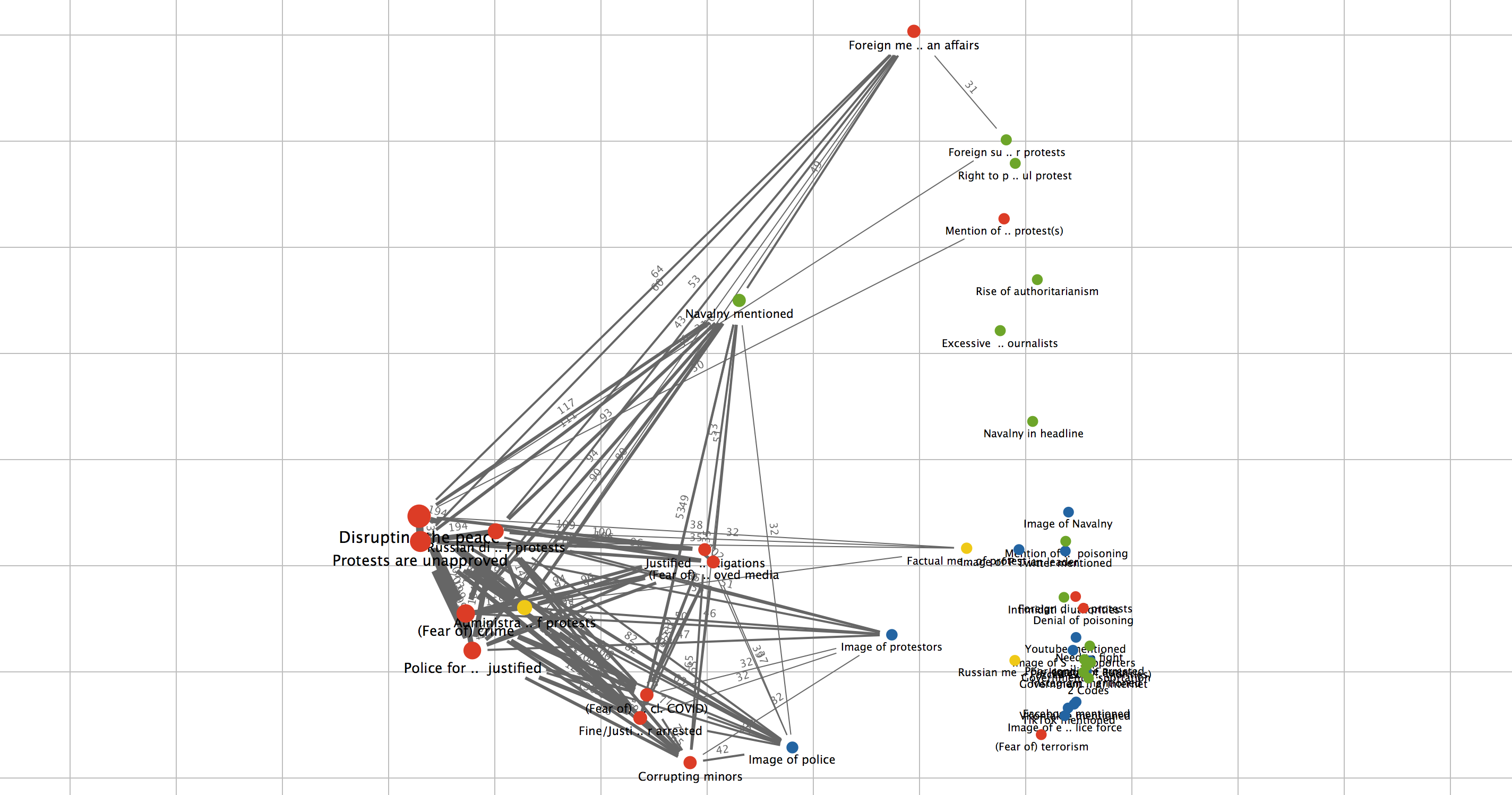
RIA Novosti Code Map of Frame Occurrences Within the Same Document (30 Min. Frequency) 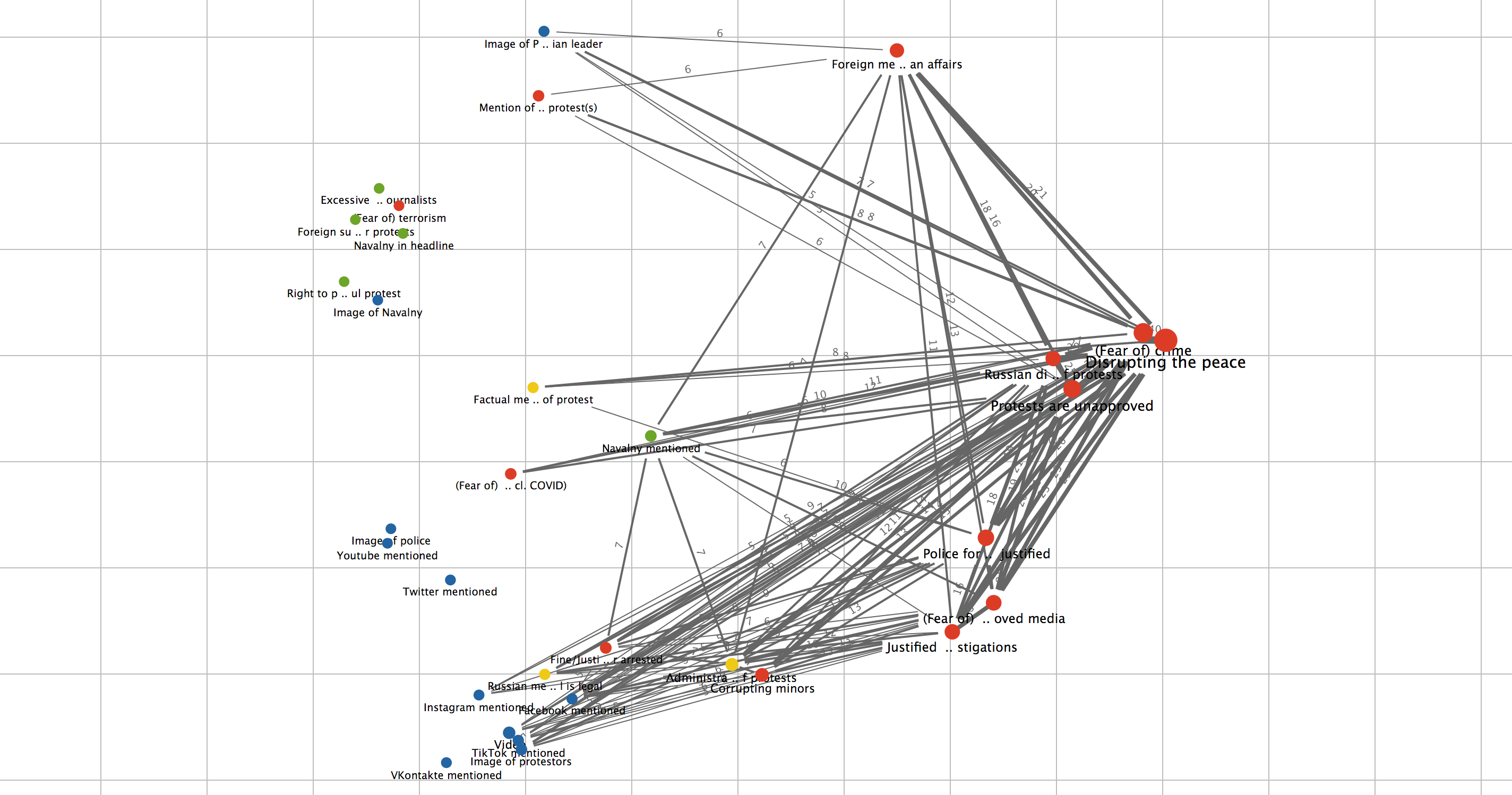
Rossiyskaya Gazeta Code Map of Frame Occurrences Within the Same Document (5 Min. Frequency) 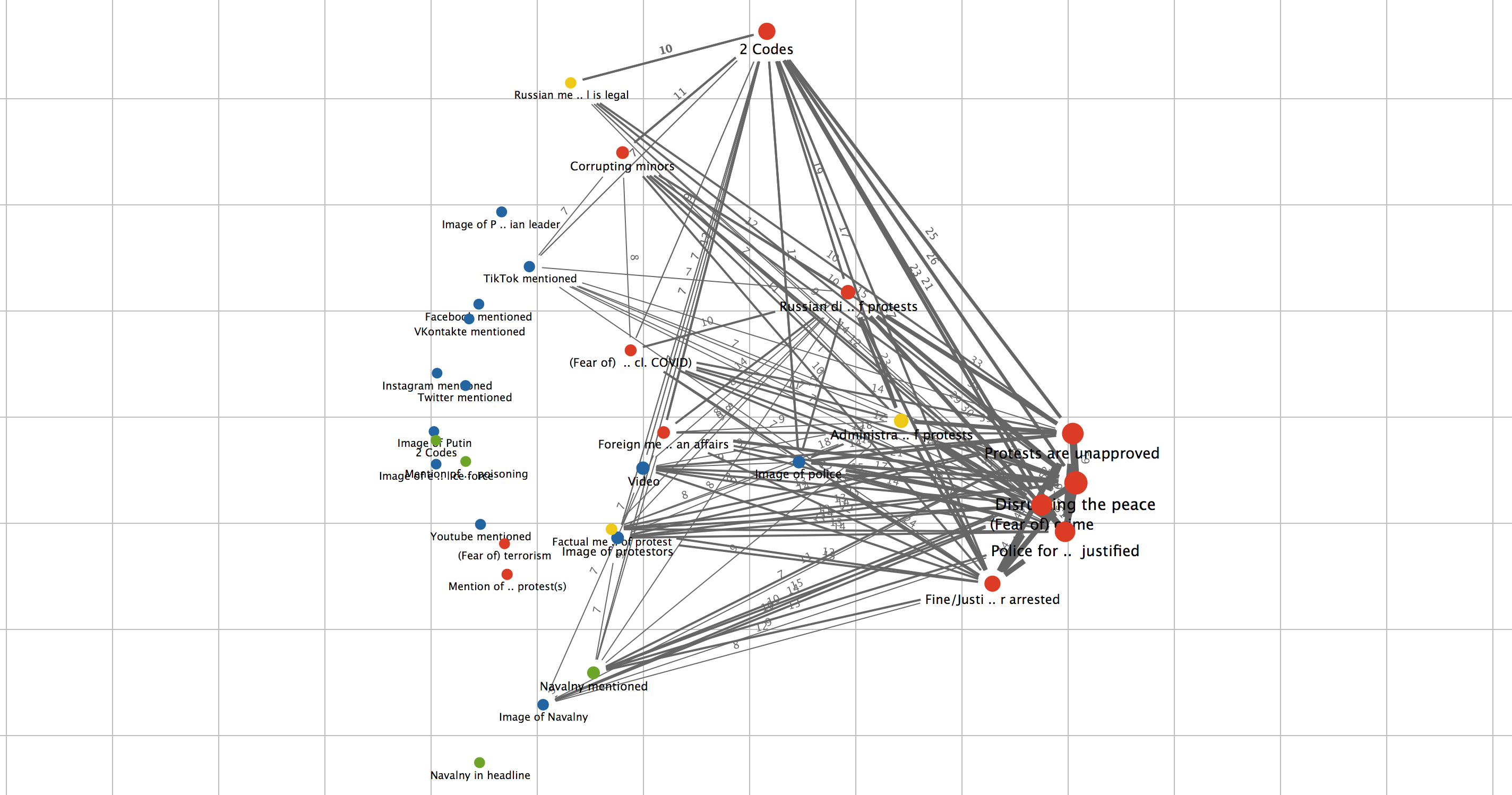
Argumenty i Fakty Code Map of Frame Occurrences Within the Same Document (7 Min. Frequency) 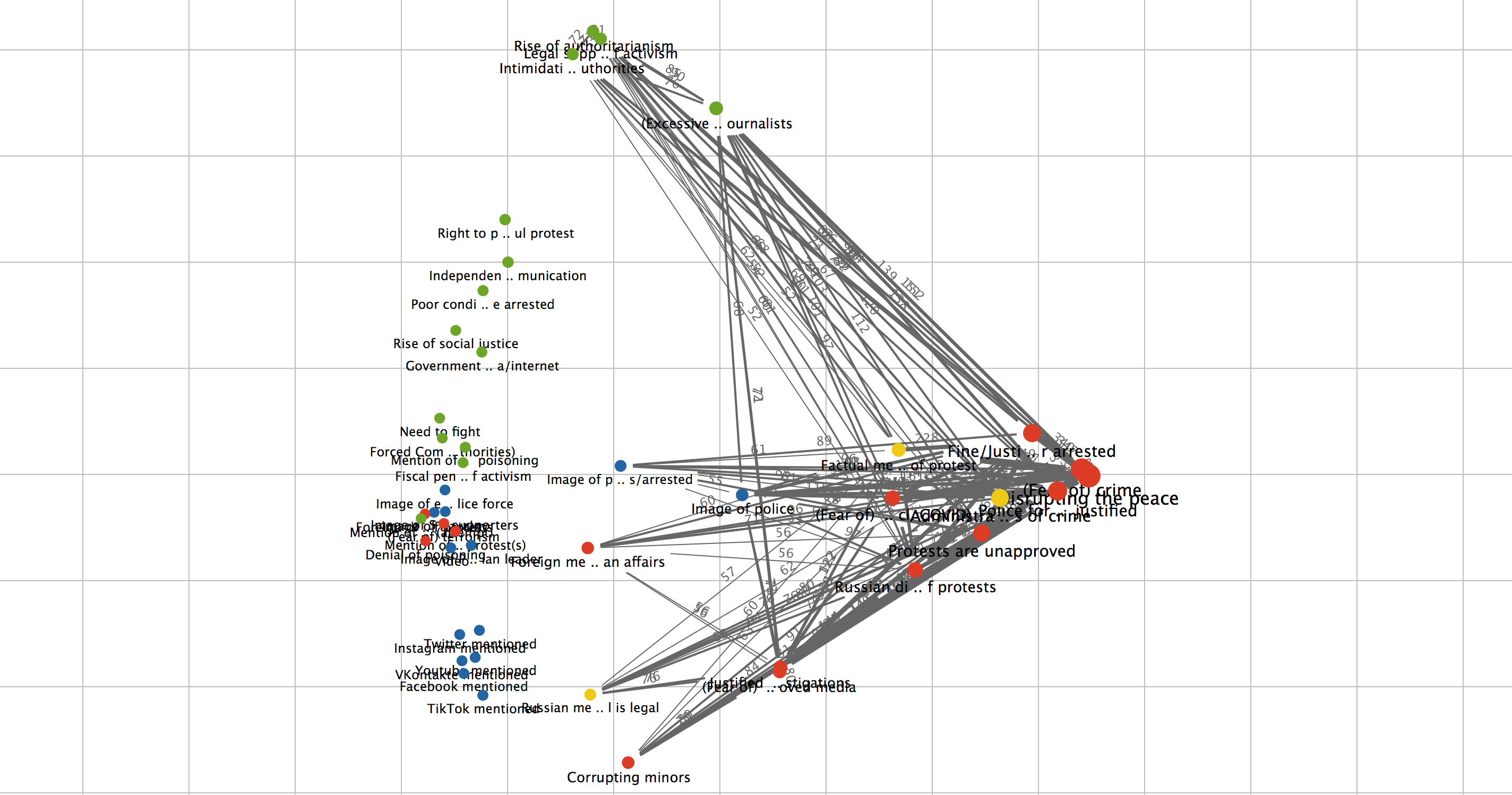
Kommersant Code Map of Frame Occurrences Within the Same Document (50 Min. Frequency) 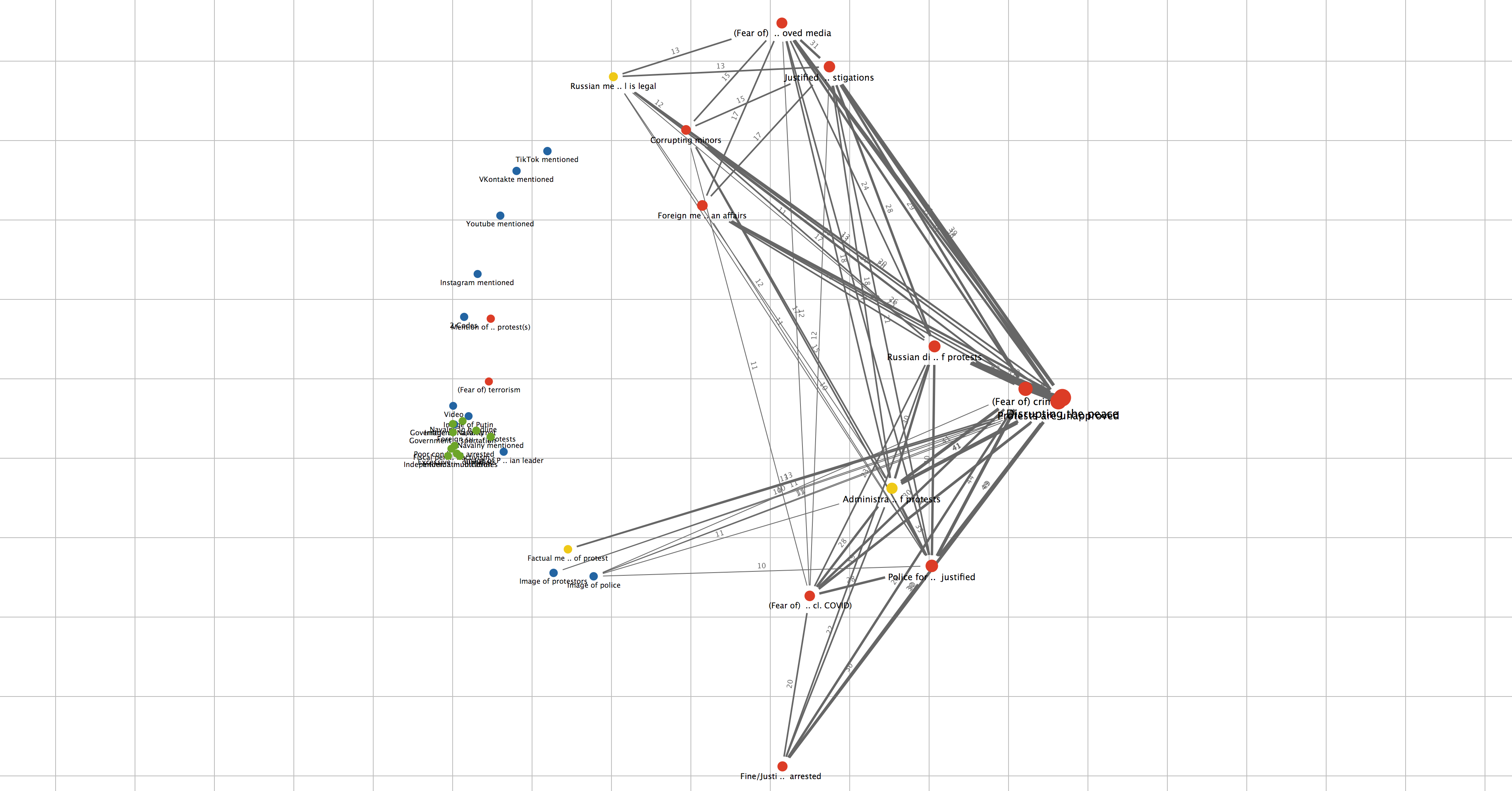
RT Code Map of Frame Occurrences Within the Same Document (10 Min. Frequency) 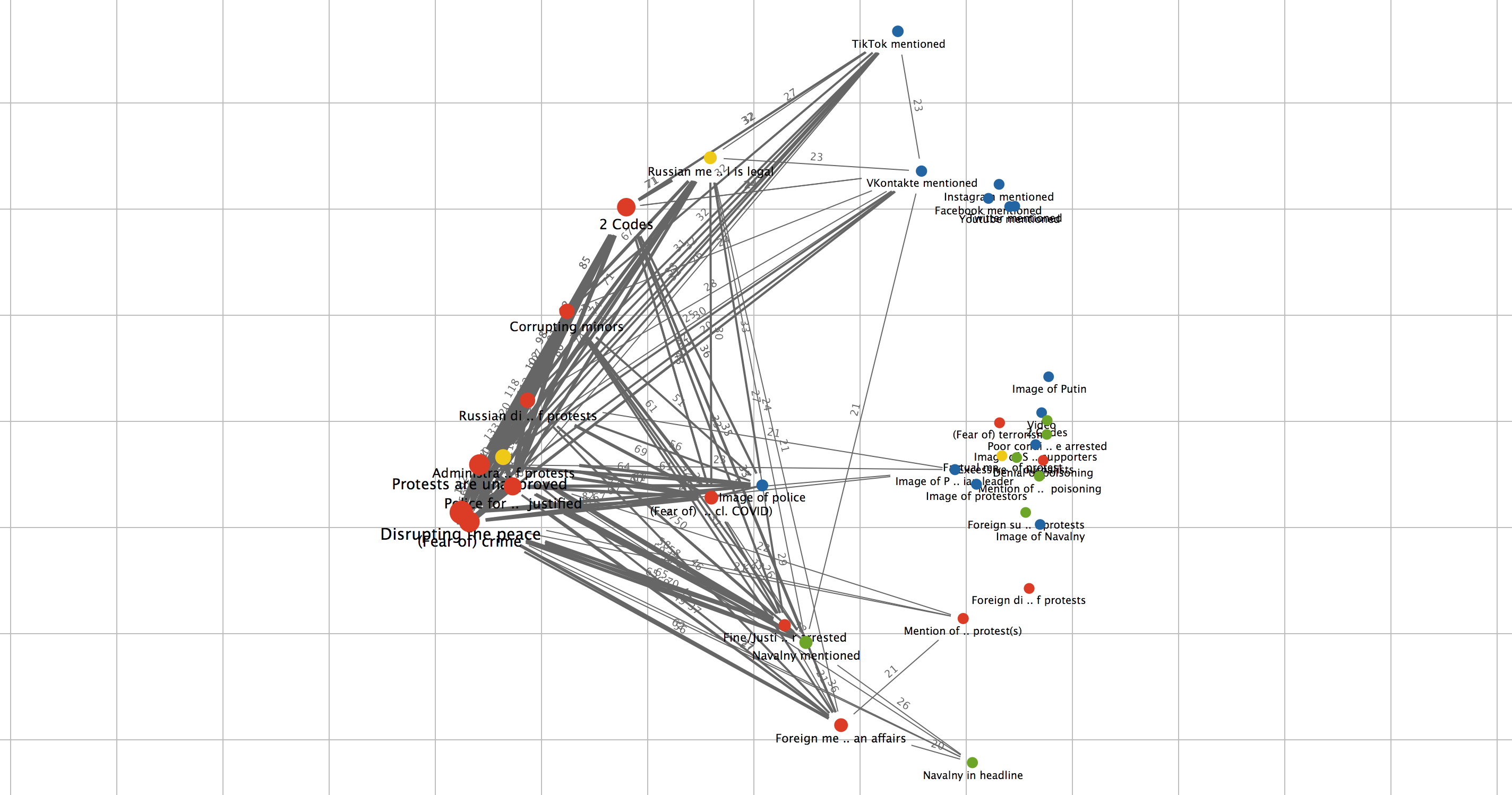
Izvestia Code Map of Frame Occurrences Within the Same Document (20 Min. Frequency) 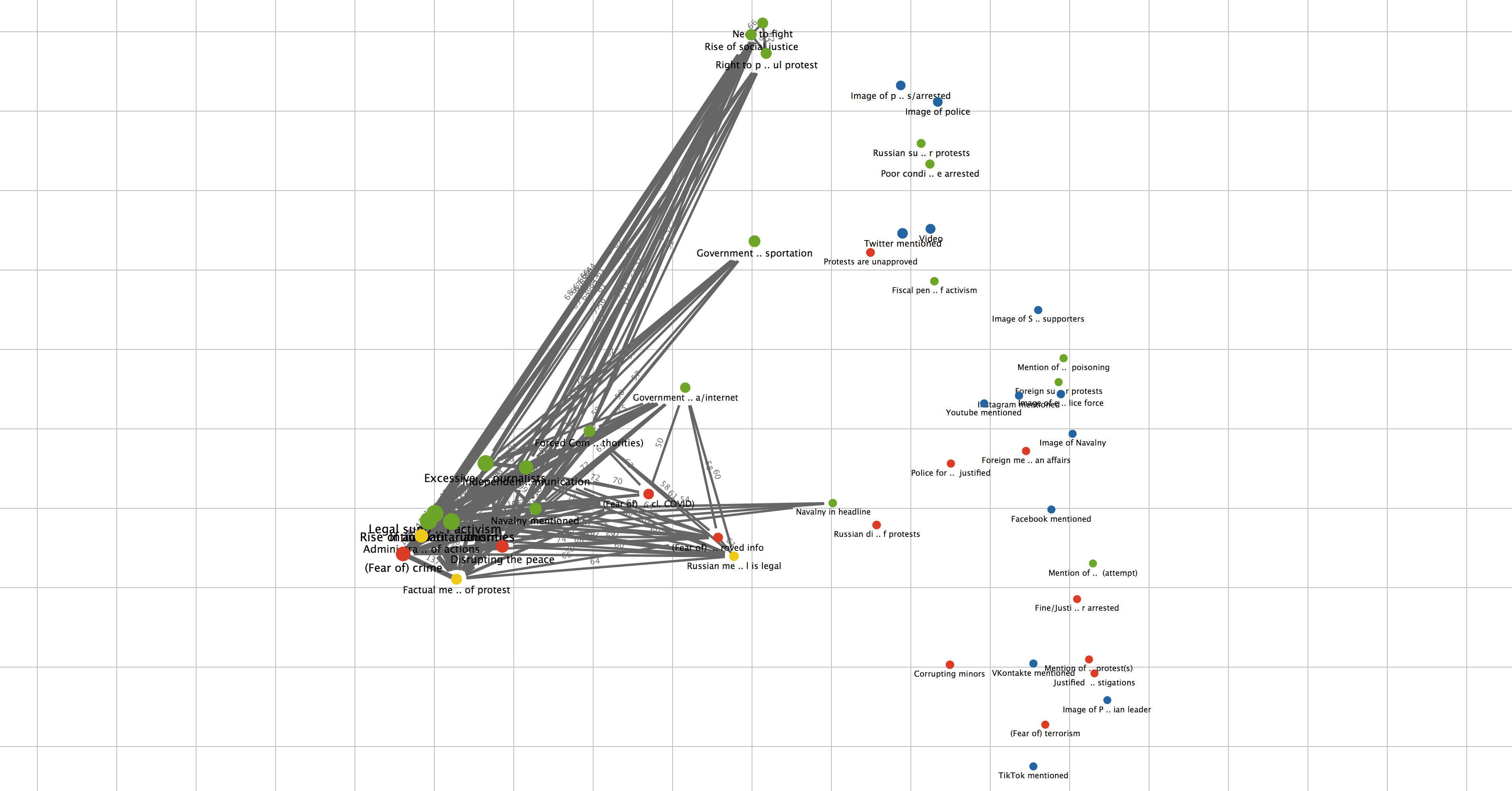
Mediazona Code Map of Frame Occurrences Within the Same Document (50 Min. Frequency) 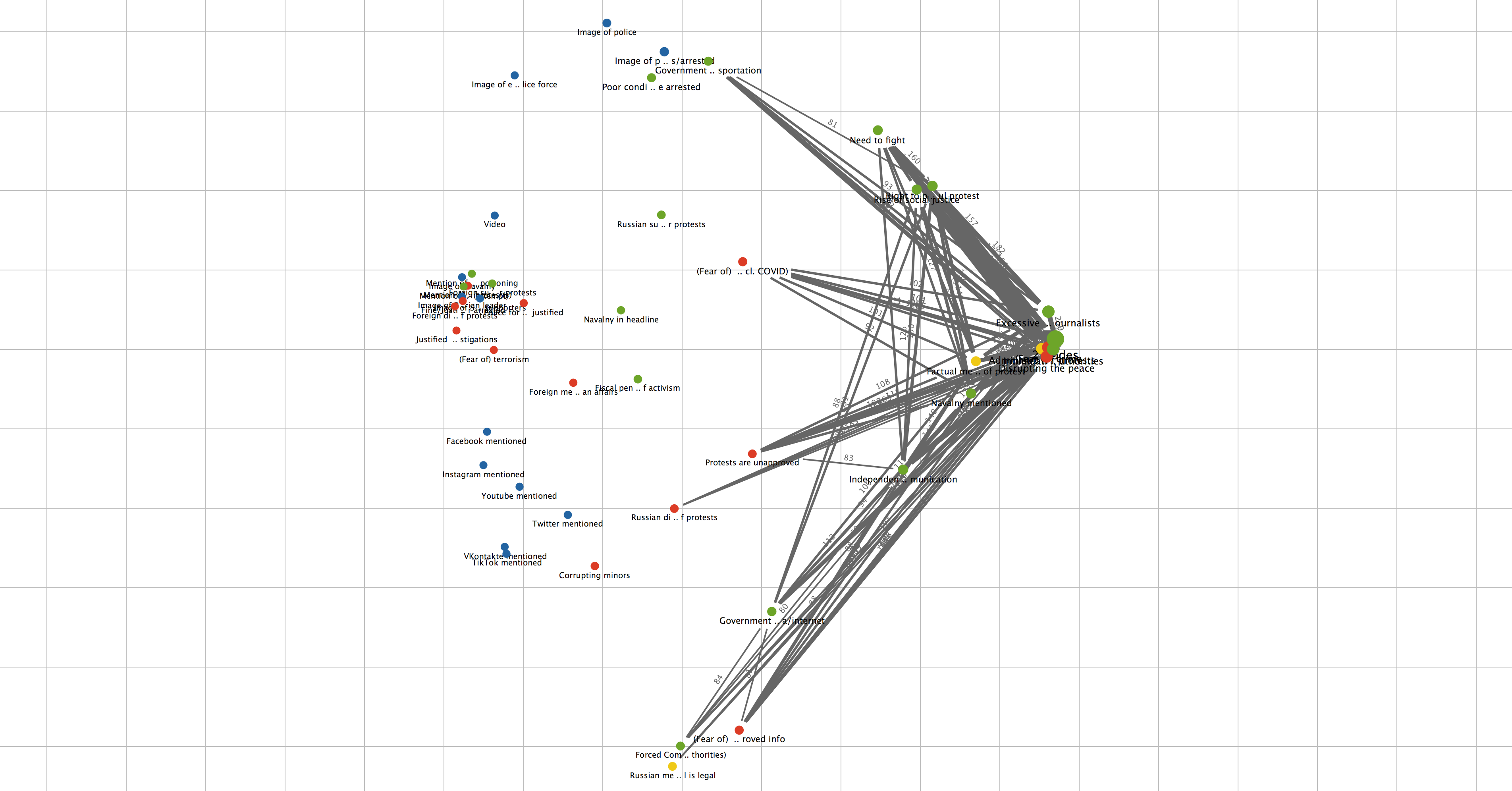
Novaya Gazeta Code Map of Frame Occurrences Within the Same Document (80 Min. Frequency) 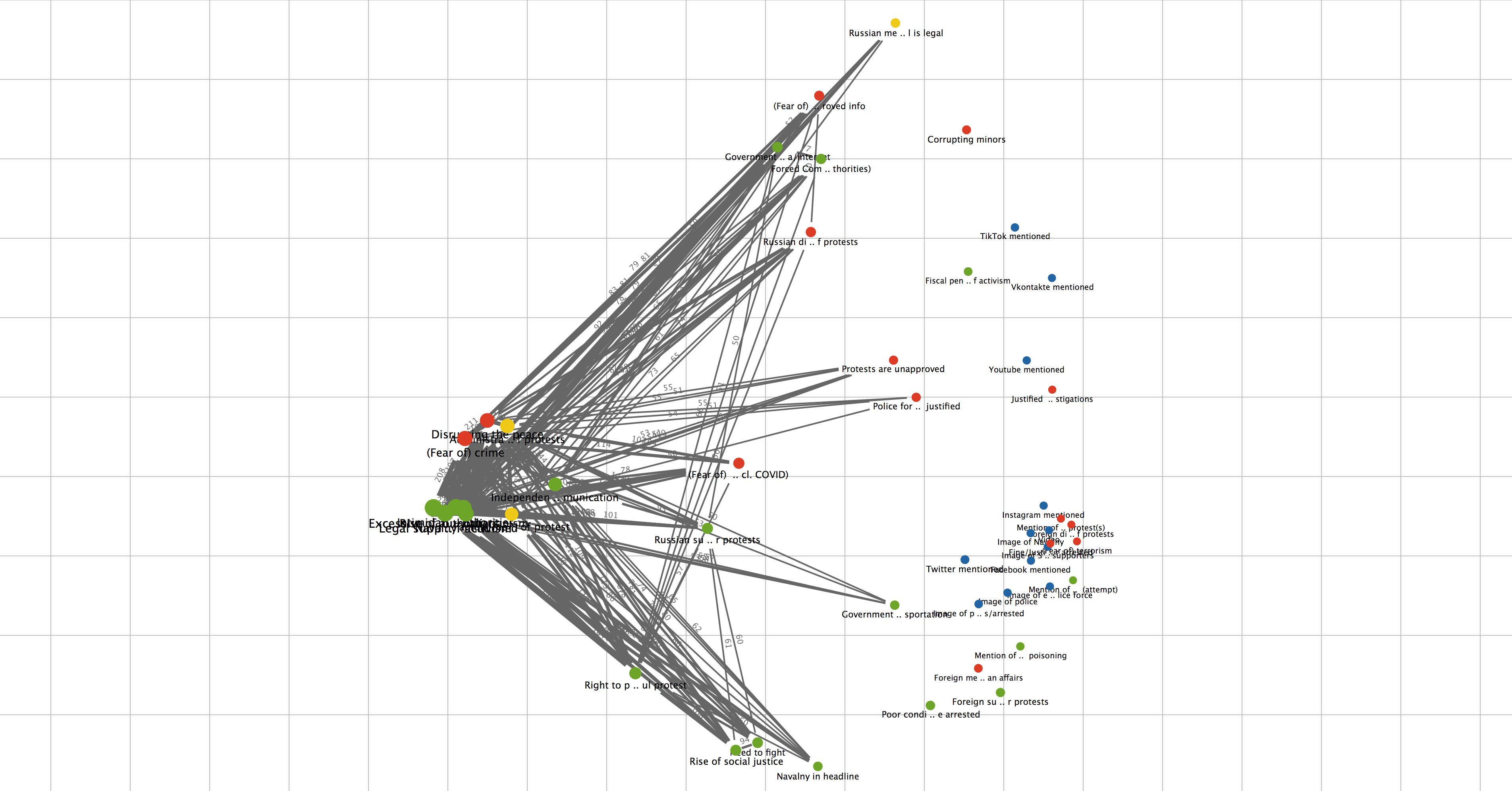
TV Rain Code Map of Frame Occurrences Within the Same Document (50 Min. Frequency)
Beginning with the RIA Novosti code map, the minimum frequency of code occurrences within the same document is 30 in order to create a line between two codes. The first noticeable finding is that RIA Novosti clusters almost all of the Anti frames closely together, except for Foreign meddling in Russian affairs, Mention of foreign protest(s) and (Fear of) terrorism. This means that an article from this news group would provide a large range of Anti frames when covering the protests, while offering very few counterpoints with Pro frames. In line with this, the most frequently used Pro frame in this media group is Navalny mentioned, which as noted before is not indicative of a pro-protest message, but rather simply the acknowledgement of Navalny as one cause of the protests.
This code map also tells us that RIA Novosti very often appends its Anti frames with the Neutral frame Administrative/criminal consequences of protests, and that it frequently employs the media features of image of protestors and image of police. The small cluster of Pro frames in the bottom righthand corner of the map furthermore informs us that, while these frames are not very often used in tandem with the most frequently used Anti frames, they are all very frequently employed alongside one another, so that if Need to fight is employed, it is highly likely that the other Pro frames in this cluster, such as Government restrictions on movement/transportation, will be coded together with it. This points to an increased diversity of coverage on behalf of RIA Novosti, but given the low intersection of this Pro cluster with the most dominant Anti frames, the objectivity of this news group is relatively low.
The code map for Rossiyskaya Gazeta depicts lines between frames if they have been coded within the same document at least 5 times, since this dataset is much smaller and has far fewer instances of coding. Similar to the last code map, this one illustrates a large cluster of Anti frames, which indicate that these are the most frequently used codes. Here, the only connection to a Pro frame is that of Navalny mentioned, again pointing to a lack of range in coverage of the protests, and a heavy reliance on the dominant Anti frame type. In contrast to the last map, this one shows connections from the most frequently used codes to each of the Neutral frames, implying that this media group’s coverage of the protests is slightly more objective than that of RIA Novosti, however, the extremely low level of Pro frames coded in this media group contradicts that conclusion. Furthermore, it is interesting that (Fear of) health & safety risks (incl. COVID) is positioned so far from the rest of the Anti frame cluster, and additionally that the (Fear of) terrorism frame is clustered with a variety of Pro frames including the Excessive punishment of supporters/journalists and Right to peaceful protest. This could be explained by the low frequency of all of these frames, and their low levels of intersection with the dominant Anti frames which characterize the state-owned media category.
The code map of the final state-owned media group, Argumenty I Fakty, shows lines between two frames with a minimum frequency of 7 intersections between codes within the same document. The two codes at the top of the map are (Fear of) fake/unapproved media and Justified media restrictions/investigations, which are highly correlated with the rest of the Anti frames except for (Fear of) terrorism and Mention of foreign protest(s), similar to the past two code maps. Both this map and the previous one exhibit a high correlation between the dominant Anti frames and some of the media features, namely Video, Image of police, Image of protestors, Image of Navalny, and TikTok mentioned. This indicates a heavy reliance on these media features, though this does not inform us of whether these media features were used in order to fortify or undermine the Anti frames which already dominate the state-owned category. Together with the lack of connection to any Pro frame except for the obligatory Navalny mentioned, this leads to the conclusion that Argumenty I Fakty covers the protests with a lack of objectivity, and is instead entrenched in Anti framing.
Moving on to the state-controlled category, the Kommersant code map displays lines between frames when the minimum frequency of the intersections of these codes is 50, given the very high number of articles and the large number of coded instances in the dataset. Here the divergence of Kommersant from the expected pattern of state-influenced media groups becomes abundantly clear, as the Anti cluster is heavily linked to the Pro cluster at the top of the map, unlike in previous code maps where Anti frames were not correlated with any Pro frame other than Navalny in mentioned. Furthermore, the Pro frame Excessive punishment of supporters/journalists is directly and heavily linked to the Anti frames (Fear of) fake/unapproved media and Justified media restrictions/investigations, implying that often when the first frame is employed, the following two are likely to be coded in the same article.
In practice this means that, for example, an article could mention government punishment of a journalist at the protests, and in the same article mention the dangers of information that is unapproved by the Russian government as well as the acknowledgement that such a punishment was justified. Overall, this code map demonstrates that, while Kommersant did employ many more Pro frames than other state-influenced media groups, and much more frequently in tandem with its dominant Anti frames, the high frequency of intersections within the Anti frame type still allocate the media group as state-supportive, though significantly more objective than others in the state-influenced media category.
The code map for RT shows lines between two frames if the frequency of intersections between them in the same document is at least 10, and this is one of the tallest maps at 10 squares, meaning that the codes represented in this map are not very often coded within the same document. Clearly, this map exemplifies the Anti frame correlations that typify the state-influenced media category, and in fact the Anti cluster is only connected to the three Neutral frames and two of the media features, while neglecting any of the Pro frames. Unique to this map is the distance between many of the most dominant Anti codes, meaning that some of these Anti frames are often used together, such as Disrupting the peace and (Fear of) crime, but that these are less often coded in tandem with Anti frames from the other small clusters, such as Corrupting minors or Fine/Justified conditions for the arrested. Nevertheless, the complete domination of Anti frames over Pro frames, as well as the small unlinked cluster of Pro frames, point to the lack of objectivity as well as diversity of coverage on the part of RT.
The final code map of the state-controlled media category, that of Izvestia, includes lines between frames when the frequency of intersections between those codes is at least 20. This figure again closely follows the expected pattern of state-influenced media groups in which the Anti cluster is closely interlinked within itself and with some of the media features. This map further illustrates that the dominant Anti frames are heavily intersected with the Neutral frames of Administrative/criminal consequences of protests and Russian media control is legal, as well as with the Pro frames of Navalny mentioned and Navalny in headline. Interestingly, the Pro cluster at the right of the map is overlapped with a media features cluster, meaning that when articles from this media group employ media features, they often also include these Pro frames, but that these instances were not often linked with the dominant Anti frame cluster.
Turning now to the independent news group category, the code map for Mediazona displays lines between codes when the frequency of intersections between the codes is at least 50, given the high number of articles in this dataset, as well as the very high number of code occurrences. Here, unlike in previous maps, the Pro cluster and Anti cluster are not only heavily linked together, but also closely situated together on the map. This means that when one of the Pro frames in the cluster is used, it is highly likely that the other Pro frames in that cluster, as well as the Anti frames in the connected cluster, will be employed as well. Here as well, the three Neutral frames are heavily and closely linked with the dominant cluster, however, the dominant cluster here crucially does not correspond to only one frame type, but rather includes Pro, Anti, and Neutral frames. The media features are less clustered here than in previous maps, meaning that they are most often coded individually, and most often coded alongside the nearby codes on the map, for example Twitter mentioned and Protests are unapproved.
The Novaya Gazeta code map displays lines between codes if they intersect within the same document a minimum of 80 times, given the very high number of coding instances in this dataset, as well as the high number of articles published. This map similarly illustrates the close proximity of most Pro frames, though notably excluding a link to Navalny in headline, which was often linked with Anti frames in the state-influenced media groups. Clearly, the Pro cluster is heavily correlated within itself, but also to the most dominant Anti frames already discussed above, as well as all three of the Neutral frames, which are perhaps most deeply and closely situated within the dominant cluster in this map, which again does not correspond to one frame type, but rather includes Pro, Anti, and Neutral frames.
Finally, the TV Rain code map presents a line between codes if the minimum number of intersections between codes within the same document is 50. Along with the RT code map, this is the tallest map, which again indicates the distance between codes in terms of the lack of intersections of codes within the same document. Essentially this means that dominant codes are often coded individually or in small clusters, and less often the codes situated farther away, such as Russian media control is legal, are also included in these coding instances. Here again, all three of the Neutral frames are included in the dominant cluster, along with both Pro and Anti frames, pointing to the increased level of diversity of coverage as well as attempts at objectivity by TV Rain. The media features are also largely clustered, likely due to the fact that most mentions of social media platforms were made in the context of Russian media authorities punishing or warning these platforms against publishing and promoting unapproved media.
Here again, the interviews with Russian media actors could have informed much of the interpretation of these code maps, as well as the other data presented above, but in the face of a lack of such interviews, my own conclusions and interpretations were presented. I highly recommend to any future researchers to prioritize speaking with Russian media actors in order to gain insights into their own journalistic choices and experiences with self-censorship and objectivity in the Russian media sphere.
The final figures created from the data analysis are the word clouds presented above, which depict the 9 most frequently used words in each media group. In order to streamline these figures, I manually edited the ‘stop list’ of words that were used more frequently but were not illustrative of the coverage and framing of the protests. Examples of these omitted words include “in”, “on”, and “this” («в», «на», «это»), which would provide very little insight into the framing and coverage of the protests if included in the word clouds. In the figures, the size of the word corresponds to the frequency with which it was used, so the largest word is the most frequent of the top 9, and the smallest word is the least frequent.
РИА Новости – Облако слов | RIA Novosti – Word cloud 
Российская Газета – Облако слов | Rossiyskaya Gazeta – Word cloud 
Аргументы и Факты – Облако слов | Argumenty i Fakty – Word cloud 
Коммерсантъ – Облако слов | Kommersant – Word cloud 
РТ – Облако слов | RT – Word cloud 
Известия – Облако слов | Izvestia – Word cloud 
Медиазона – Облако слов | Mediazona – Word cloud 
Новая Газета – Облако слов | Novaya Gazeta – Word cloud 
Телеканал Дождь – Облако слов | TV Rain – Word cloud
One of main findings from these figures is that all media groups except for RT mention Navalny in their word clouds, and that the independent media groups include his name is the top 2 most frequently used words. The state-influenced word clouds, excluding RT and Kommersant, show that Navalny is mentioned in the top 4-8 most frequently used words, while the Kommersant figure shows that Navalny is named in the 2nd most frequently used word in the media group. Furthermore, Kommersant’s is one of two word clouds, and the only one within the state-influenced group, to frequently mention Navalny’s first name: Alexei (the other being TV Rain). This yet again indicates that Kommersant acts as an outlier within the state-influenced media group, and that it reflects more closely the patterns of framing identified in independent media groups, which focus on covering the protests in a way that highlights social, rather than political, issues.
On the other hand, RT also shows itself to be an outlier compared with the other state-influenced media groups because it does not mention Navalny within its top 9 most frequently words. Instead, RT is one of only 2 media groups to include the USA in its word cloud, alongside Rossiyskaya Gazeta. Furthermore, only the word clouds of Rossiyskaya Gazeta, RT, and Izvestia depict multiple words strongly connoted with Anti framing of the protests, namely “unapproved” “unlawful” or “unsanctioned”, and “children” or “minors”. This could indicate a strategy by the Russian government to fortify Anti framing more strongly in state-influenced media groups, rather than in state-owned groups, to popularize the belief that the strongest anti-protest opinions are expressed by ‘independent’ news groups, which are in fact strongly influenced by state control, as opposed to government-owned media groups.
The state-owned media groups’ word clouds illustrate the frequent framing of the protests in factual terms which focus on the actions of government and police forces, frequently using names of police organs as well as the negatively connoted words mentioned above. Notably, the Argumenty I Fakty word cloud shows that two of the most frequently used words are synonyms for protest, and that one of the most frequently used words is “politics”, alongside Rossiyskaya Gazeta’s “power”, demonstrating the focus on government and politics that characterizes Russian state-owned media framing of the protests. In line with the earlier identification of RT as an outlier that more strongly corresponds to state-owned media patterns, the word cloud for this media group also depicts the same two synonyms for protest, as well as the ministry of foreign affairs.
In stark contrast to this, the independent media group word clouds are populated by words connoted with Pro framing of the protest, including “support”, “arrested”, and “court”. While the last two may not explicitly seem linked to Pro framing, they were most frequently used in the context of explaining that a supporter of Navalny or journalist had been arrested while peacefully protesting or doing their journalistic duties, or that a court had punished someone for attending or organizing the protests. Looking back at the Kommersant word cloud, “support” is the 5th most frequently used word, following the notion that this media group subscribes more to the independent media style framing of the protests. This is further supported by the fact that the most popular word in this media group is “photo”, reflecting the finding that Kommersant employed an extremely high usage of photos in its articles, which as mentioned could be indicative of an attempt to increase the objectivity of coverage, allowing readers to draw their own conclusions based on the photographic evidence. The remaining discussion in the Findings section focuses on the relevant and insightful information gathered from the interview with Saltykovsky, connecting these insights to the major findings discussed above.
5.5 Interview Insights
As stated in the methodology, I was able to draw from one interview I had conducted before starting the quantitative data analysis with a Russian media actor who also has experience working in Western media spheres such as the US and Canada. On December 4, 2020 I spoke with Dmitry Saltykovsky, a Moscow-based roving journalist and producer who has produced and reported a myriad of international and domestic short and long form news stories.
His coverage includes international and domestic politics, wars and revolutions, and major events, especially in the ex-USSR region, and he has collaborated with media professionals from renowned programs including Reuters, Vice, and BBC World. For the purpose of this project, I was hoping to interview media actors who solely worked in the Russian media sphere, as isolation within this media sphere can greatly impact the journalistic opportunities available to media actors, as well as their own understandings of the level of press freedom and their personal safety working in-country. However, given the lack of interviews conducted with such media actors, I rely on this interview to provide some insights into the operations of the Russian media sphere and the journalistic choices that may be made by Russian media actors. The interview can be viewed here.
Most notably, he told me that, in his view, the biggest issue facing Russian journalism over the past 10 years is self-censorship. In his words “journalism in Russia does not exist”, because it is not actively developing as any creative specialty should be. According to Saltykovsky, Russian journalists practice self-censorship out of fear, knowing that they have few options for work if they choose to speak out against the government, especially if they work for a pro-government news group. This notion is reflected in the hypothesis that independent news groups would increase Anti framing of the protests after state interventions, as the fear of being the next media group or journalist to be punished would increase self-censorship.
Furthermore, Saltykovsky explained that fear is a prevailing condition not only of the Russian media sphere, but of the Russian people in general, and that this historical generational fear helps to prevent journalists from including any information that might be considered ‘extra’ or otherwise unapproved or undesired by the Russian government. He also referred to Kremlin-approved media as “Russian propaganda”, and explained that state-influenced media is mostly based off of a duality of fear and patriotism, which still works quite well in remote regions of Russia where people still mainly watch television and do not seek their own information on the internet.
This propagandistic tone based on fear and patriotism was clearly evident to me as a coder when analyzing all the articles, as most of the stories from state-influenced media groups tended to highlight the potential risks of the protests, promoting a fear of the protests and the risks they carry. This tone of fear was often combined with a focus on the disapproval of the protests by Russian authorities and the simultaneous victimization of Russia by other foreign leaders and authorities which disapprove of the use of force to police protests, leading to concerns over Russia’s perceived political sovereignty in the face of international criticism. One truly incredible example of propagandistic framing using the combination of fear and patriotism was the reporting that the MVD tweeted a meme warning against participation in the protests. The meme not only ridiculed protestors for feeling powerful by disrupting the peace, but also justified the actions of the police as the authorities who rightfully punish criminals who break the law of meeting.

English description – MVD Tweet warns citizens who are planning to participate in the unapproved protests that they will face criminal consequences. Meme shows the big dog representing protestors who disrupt the public peace in crowds, and the small dog representing protestors who later apologize once in police custody.
The fact that this type of propagandistic media is promoted on television and the internet means that the government essentially has control over the majority of the information that people in remote regions of Russia have access to, as all television channels are at least somewhat state-influenced, and high-speed internet access in these regions is often faulty and patchy. In response to this lack of diversity across the most accessible news platforms, Saltykovsky highlighted the importance of individuals accumulating news and information from a variety of sources, including domestic and international media groups, and forming their own opinions, rather than subscribing to the leading narratives from popular sources that may be influenced by certain interest groups, particularly the Russian government.
The fear that Saltykovsky identified as being generational and pervasive in Russia informs the quantitative findings that coverage and framing of the protests was very similar and Anti-dominant across all state-influenced media groups, since any deviations from the Russian state-sanctioned media expectations for media groups could be very risky. A journalist who has no experience working outside of the country would be quite limited in their freedom of speech if they work for a state-influenced media group which punishes the inclusion of ‘extra’ information not approved by the government. These journalists would furthermore face a difficult time finding work at a government-influenced news group once they have been punished for publishing the wrong information, and as Saltykovsky explained, there are very few options for journalists who want to work for independent media groups.
Saltykovsky emphasized that independent news groups are extremely rare in the Russian media sphere, and that he does not even consider TV Rain to be a relevant independent news group anymore, after the turmoil that it experienced when it was removed from television and had its advertisers “turn their backs on them”. He explains this lack of relevant independent news groups in the Russian media sphere by the fact that “all the rules of the game are written, you either play by those rules or” you as a journalist are inclined to join an out-of-country media group such as Real Time in Prague or the BBC Russian Desk just to make a living. Of course, not all journalists are prepared to make the life choice of joining a foreign news group, and this helps to inform the pressures journalists must feel when faced with the choice of including an extra sentence or two that might be risky and result in the need to find work in another country, or stick to the status quo and refrain from making the journalistic choices that would likely not even be questioned by independent media groups.
For example, one particularly striking pattern of journalistic diction that I noticed while coding the articles was that state-influenced media referred to Navalny as a blogger the vast majority of the times he was mentioned. By contrast, the independent media groups tended to describe him as a political actor who also published information on his YouTube channel. This subtle difference in descriptions is quite telling of the very different perspectives on Navalny that state-influenced and independent media groups project to their readers, as describing him as a blogger largely discredits his political involvement and persecution, relegating him to the status of a random internet personality who happened to be poisoned. Though unconfirmed through interviews with Russian media actors, I suspect that this is one of the clearest examples of state-influenced media sticking to the status quo of state-approved media expectations, whereas independent media exercises more freedom of speech in mentioning his political past as well as his promotion of social movement via the internet. This finding, however, contradicts the hypothesis, in that it demonstrates the lack of any impact on independent media framing after instances of state intervention.
Saltykovsky essentially explained to me that living and working as a media actor only in Russia leaves one with very few options, as well as heightened risks to one’s personal safety and quality of life, as Russian media actors are highly aware of the deaths and arrests of independent media actors that have occurred over the past decade. Crucially, these “few” options leave the door open for the Russian government to deny any claims that Russia does not have a free media, as independent news outlets do exist, though they are often targeted by government media restrictions and denied by advertisers.
Evidence of this strategy was abundant in the quantitative findings, including in the arrest of Sergei Smirnov, the editor-in-chief of Mediazona, over a retweet of a joke, demonstrating that independent news media groups and journalists face higher and harsher risks than other media actors that conform to pro-government stances. This popular tactic was already demonstrated in the removal from television of independent news groups like TV Rain and earlier with the dissolution of NTV. This is clearly a key mechanism keeping the current Russian media sphere so dominated by self-censorship, as the consequences of contradicting the Kremlin are widely understood, if not often explicitly stated.
However, given the analysis of the quantitative data presented above, it is not clear that these instances of state intervention in the Russian media sphere altered the framing of the protests by independent media groups, thus discrediting the hypothesis. One of the main examples of this lack of impact on coverage is the fact that Novaya Gazeta chose to reprint all of Mediazona’s articles for 25 days after its editor-in-chief was arrested, in solidarity with the independent news group and in protest of the Russian authorities’ punishment of journalists. Therefore, it could be extrapolated that such interventions might be intended to intimidate independent journalists, but that they instead serve to motivate independent news groups to fortify their promotion of narratives which counter the ones disseminated by state-influenced media.
Finally, Saltykovsky described the current Russian media sphere as being in “a state of anticipation and despair” and explained that many people in the larger cities across Russia do understand the lack of press freedom but simply accept the present as it is, unwilling to sacrifice their careers or lifestyles to confront the Russian government. This is likely the key mechanism keeping non-government pro-Kremlin media (state-controlled) groups so supportive of the government, as they are implicitly restricted by fear in the topics they can cover and the framing of certain subjects. Saltykovsky further emphasized that not only in Russia, but internationally, journalism is currently experiencing a low, far removed from its peak at the height of the 24-hour live news cycle, and has changed immensely since then, particularly with the rise of citizen journalism.
Conclusion
Overall, the combination of quantitative and qualitative data discussed above points to a strong pattern of state-influenced media being characterized by basic informative coverage that relies on government sources and largely excludes any additional journalistic viewpoints expressed by the media group. By contrast, independent media groups are less restricted by fears of repercussions to their careers, though the interview provided the insight that some journalists may still practice self-censorship for fear of being arrested or otherwise intimidated by Russian authorities.
Analysis of the data demonstrated that, contrary to the hypothesis, instances of state intervention in the Russian media sphere were not significantly linked to increases in Anti framing of the protests by independent media groups. In fact, there were instances when such interventions were followed by increased Pro framing or increased coverage of the protests, such as when Novaya Gazeta reprinted Mediazona articles for 25 days following the arrest of Mediazona’s editor-in-chief Sergei Smirnov. Contrary to the hypothesis, these findings promote a conclusion that state intervention and efforts to censor the Russian media sphere can either have little effect or can actually increase the resolution of independent media groups to offer narratives divergent from the expectations of Russian state-approved media.
Perhaps one of the main takeaways of this project is that it can be very difficult to identify patterns in coverage and framing across state-influenced media groups, as they are essentially ‘wild cards’ in terms of the actual extent of state influence to which they are exposed. For instance, the quantitative data found a significant trend of Anti framing of the protests across all state-influenced media groups, with a noticeable deviation from this pattern exhibited by Kommersant, a state-influenced group. Furthermore, while Kommersant could be described as leaning more towards the framing patterns identified in independent media groups than the other media groups in the state-influenced category, RT could be described as leaning even more strongly towards Anti framing than some of the state-owned media groups analyzed.
The main takeaway from the interview was the confirmation of the idea that self-censorship represents the lasting aftermath of Russian generational oppression and fear mongering through censorship and state control of the media, and that while explicit censorship has largely dissipated in the Russian media sphere, the same cannot be said for state influence over the media. The clearest example of this lies in the formation of the Russia Today (RT) news channel in 2005 (Julia Ioffe 2010). This channel, as supported by the quantitative findings, essentially works as a soft power tool for the Kremlin, framing Putin’s political acts in the most favourable light, and fueling the flames of conflict in its coverage of US and international news. RT is recognized in Russia and internationally as an important media voice “verging between straight news and conspiracy theories”, and this is reflected in the quantitative data (“Margarita Simonyan” 2017).
In line with these qualitative findings, the quantitative data that characterize RT as a media group include that it is more closely reflective of the state-owned category than the state-controlled category, particularly with regard to its net tone, which is lower than two of the three state-owned media groups. On the other hand, the quantitative findings of Kommersant are more closely reflective of the diversity of coverage and level of objectivity in independent media groups. Kommersant also had the highest net tone of the state-influenced media groups, and was almost constantly identified as an outlier within this category. This indicates that the difference in coverage and framing of state-owned and state-controlled media groups cannot be determined by simply ascertaining the level of state ownership of the media group.
Instead, it points to the potential of state-influenced media groups to present themselves as independent while still conforming to the general pattern of Anti frame dominance, and therefore offering more balanced, but still incomplete and state-influenced, information to its readers under the guise of objectivity. This is perhaps the most important conclusion of this project, demonstrating the salience of state-influenced, particularly state-controlled, media that benefits Russian political and social interests through coverage and framing of issues such as the recent protests. The real danger of this does not lie in the fact that these state-influenced media groups exist, but rather that they often purport to be independent, giving readers a false sense of objectivity of coverage, and having the potential to skew the public’s understanding of recent events.
Furthermore, the existence of these state-controlled media groups acts to crowd out the market for news, especially on restricted mediums like television where state control is a prerequisite for access to airing. Additionally, the Russian government often classifies independent media and political groups, such as the ACF, as foreign agents, forcing news articles that mention them to note this classification as well, which automatically adds a frame of Foreign meddling in Russian affairs to any article that mentions these groups. This might, for example, push a journalist to avoid mentioning the ACF because they do not wish to include such a frame in their article, therefore exhibiting a type of encouraged self-censorship. Of course, no such rule applies to informing readers of state-controlled media that the information they are reading has been influenced by the agenda of the Russian government. This indicates a clear bias on the part of the Russian government, as well as an unwillingness to promote or even allow a truly free press, a fact that is made even clearer when considering the consolidation of various media groups into the hands of Putin’s allies, alongside the increased internet and media restrictions that allow the state to remove any unapproved media, as well as punish those who do not remove unapproved media.
In conclusion, this project has demonstrated that Russian state influence over media groups is very active and serves to create a status quo of conformism to the media expectations of the Russian government, leading to the coverage of the protests by state-influenced media groups being heavily dominated by Anti framing. However, the hypothesis of the project, that Anti framing of the protests would increase in independent media groups following instances of state punishment of media actors, was discredited by the data presented. In fact, a slight trend of increased Pro framing and coverage of the protests was identified among independent media groups after such instances, indicating a solidarity-based motivation on the part of these media groups to protest the punishment of media actors. This project also found that the many state-controlled groups, those which are not directly or publicly owned by the government but remain influenced by the government in some capacity, are more difficult to predict in terms of their framing of issues such as the recent protests. While some of these groups, such as Kommersant, tend to cover the protests in a more objective manner than state-owned groups, others, like RT, tend to exhibit even less objective and more pro-Kremlin framing of topics that are relevant to the Russian state.
The crucial implication of this finding is that it can be very difficult for the average reader to identify whether a particular media group, especially a state-influenced media group, is controlled or impacted by the agenda of the Russian government. This can lead to citizens being misinformed about the objectivity of the information they are reading, and thinking that they are receiving unbiased and balanced news about a particular topic when in reality they are being exposed to various materials that have all to some extent been influenced by the Russian state’s agenda and media expectations. Such a fear is only exacerbated by the fact that the 3 independent media groups explored in this project are among a very small number of independent media groups operating within the Russian media sphere, representing an extreme minority in Russia. The insight from the interview which identifies self-censorship as an active tool employed by journalists further contributes to the “anticipation and despair” that currently characterizes the Russian media sphere.
Given the clear and persistent attempts at media control by the Russian government, I am tempted to slightly edit Saltykovsky’s claim that “journalism in Russia does not exist”. Instead, I prefer to conclude with the assertion that, while Russian journalism is currently experiencing a stalemate, exemplified by the fact that independent media is limited and often targeted by the Russian government, the persistence of existing independent groups, and their unwillingness to conform to Russian government pressures and expectations of the media, signify hope for the future changes that Saltykovsky deems necessary in order to save the Russian media sphere from its own government.
Works Cited
Abbott, Jason, and John Wagner Givens. 2015. “Strategic Censorship in a Hybrid Authoritarian Regime? Differential Bias in Malaysia’s Online and Print Media.” Journal of East Asian Studies 15 (3): 455–78. https://doi.org/10.1017/S1598240800009140.
AFP. 2021. “Navalny in ‘Strong’ Pain, Team Fears for His Life: Lawyer.” The Moscow Times, March 25, 2021, sec. news. https://www.themoscowtimes.com/2021/03/25/navalny-in-strong-pain-team-fears-for-his-life-lawyer-a73370.
Baker, Peter. 2001. “Blacked Out.” American Journalism Review, June 2001. https://ajrarchive.org/article.asp?id=178&id=178.
Baker, Sinéad. 2021. “Protesters in Russia Trolled Putin with Golden Toilet Brushes, Mocking the Extravagant Wealth He Is Accused of Hiding by Jailed Foe Alexei Navalny.” Business Insider, February 1, 2021. https://www.businessinsider.com/russia-protesters-troll-putin-gold-toilet-brushes-2021-2.
BBC News. 2021. “Alexei Navalny: Russia’s Vociferous Putin Critic,” March 1, 2021, sec. Europe. https://www.bbc.com/news/world-europe-16057045.
Brand Analytics. 2021. “Рейтинг медиаресурсов.” 2021. https://br-analytics.ru/mediatrends/media/.
CBS News. 2020. “Russian Opposition Leader Alexei Navalny Is out of Coma and Responsive after Suspected Poisoning, Hospital Says,” September 8, 2020. https://www.cbsnews.com/news/alexei-navalny-russian-opposition-leader-out-of-coma-suspected-poisoning/.
Deloitte. 2020. “Media Consumption in Russia – 2020.” Deloitte CIS Research Center, Moscow.
Dixon, Robyn. 2003. “Russian Satirist in Search of a Stage.” Los Angeles Times, October 28, 2003. https://www.latimes.com/archives/la-xpm-2003-oct-28-et-dixon28-story.html.
Dzialoshinskii, Iosif. 2001. “What Future Awaits the Russian Press?” In Russia’s Fate Through Russian Eyes, 1st ed., 10. Routledge. https://www.taylorfrancis.com/chapters/future-awaits-russian-press-iosif-dzialoshinskii/e/10.4324/9780429305252-19.
Federal State Statistics Service. 2010. “Coverage by TV Broadcasting.” http://www.gks.ru/bgd/regl/b10_12/IssWWW.exe/Stg/d02/19-08.htm.
Felson, Jacob, Amy Adamczyk, and Christopher Thomas. 2019. “How and Why Have Attitudes about Cannabis Legalization Changed so Much?” Social Science Research 78 (February): 12–27. https://doi.org/10.1016/j.ssresearch.2018.12.011.
Human Rights Watch. 2020. “Russia: Growing Internet Isolation, Control, Censorship.” Human Rights Watch, June 18, 2020. https://www.hrw.org/news/2020/06/18/russia-growing-internet-isolation-control-censorship.
Julia Ioffe. 2010. “What Is Russia Today?” Columbia Journalism Review, October. https://www.cjr.org/feature/what_is_russia_today.php.
Khurshudyan, Isabelle, and Robyn Dixon. 2021. “Russia Cracks down on Navalny Protests, Locking down City Centers and Arresting Thousands.” Washington Post, January 31, 2021. https://www.washingtonpost.com/world/europe/russia-navalny-protests-putin/2021/01/31/c96ff86c-5ffb-11eb-a177-7765f29a9524_story.html.
Khvostunova, Olga. 2013. “A Brief History of the Russian Media.” December 6, 2013. https://www.interpretermag.com/a-brief-history-of-the-russian-media/.
Kim, Hwalbin, and Sei-Hill Kim. 2018. “Framing Marijuana: How U.S. Newspapers Frame Marijuana Legalization Stories (1995–2014).” Preventive Medicine Reports 11 (September): 196–201. https://doi.org/10.1016/j.pmedr.2018.07.003.
Lancaster, Kari, Caitlin E. Hughes, Bridget Spicer, and Paul Dillon. 2011. “Illicit Drugs and the Media: Models of Media Effects for Use in Drug Policy Research.” Drug and Alcohol Review 30 (4): 397–402. https://doi.org/10.1111/j.1465-3362.2010.00239.x.
Lankina, Tomila, and Kohei Watanabe. 2017. “‘Russian Spring’ or ‘Spring Betrayal’? The Media as a Mirror of Putin’s Evolving Strategy in Ukraine.” Europe-Asia Studies 69 (10): 1526–56. https://doi.org/10.1080/09668136.2017.1397603.
Levada Center, Левада-Центр. 2021. “Социальные сети в России.” https://www.levada.ru/2021/02/23/sotsialnye-seti-v-rossii/.
“Margarita Simonyan.” 2017. Forbes. 2017. https://www.forbes.com/profile/margarita-simonyan/.
McGinty, Emma E., Hillary Samples, Sachini N. Bandara, Brendan Saloner, Marcus A. Bachhuber, and Colleen L. Barry. 2016. “The Emerging Public Discourse on State Legalization of Marijuana for Recreational Use in the US: Analysis of News Media Coverage, 2010–2014.” Preventive Medicine 90 (September): 114–20. https://doi.org/10.1016/j.ypmed.2016.06.040.
Meduza. 2021. “Moscow Court Sentences Prominent Independent Journalist Sergey Smirnov to 25 Days in Jail,” February 3, 2021. https://meduza.io/en/news/2021/02/03/moscow-court-hands-25-day-jail-sentence-prominent-independent-journalist-sergey-smirnov.
Nimmo, Ben. 2018. “Question That: RT’s Military Mission.” Atlantic Council’s Digital Forensic Research Lab. https://medium.com/dfrlab/question-that-rts-military-mission-4c4bd9f72c88.
Osborn, Polina Nikolskaya, Andrew. 2021. “Kremlin Critic Alexei Navalny Loses Jail Appeal, Is Fined for Slander.” Reuters, February 20, 2021. https://www.reuters.com/article/uk-russia-politics-navalny-idUSKBN2AK09E.
Pankin, Alexei. 2004. “Gusinsky Ruling Leads to a Slippery Slope.” The Moscow Times, May 25, 2004. https://web.archive.org/web/20151117050751/http://www.themoscowtimes.com/opinion/article/gusinsky-ruling-leads-to-a-slippery-slope/230809.html.
Rakhmetov, Baurzhan. 2021. “The Putin Regime Will Never Tire of Imposing Internet Control: Developments in Digital Legislation in Russia.” Council on Foreign Relations (blog). February 22, 2021. https://www.cfr.org/blog/putin-regime-will-never-tire-imposing-internet-control-developments-digital-legislation-russia.
Ralph, Kaylen. 2013. “The Evolution of Russian Media.” Artifacts Journal, University of Missouri, no. 8 (May). https://artifactsjournal.missouri.edu/2013/05/the-evolution-of-russian-media/.
Reuters. 2021. “Russia Puts Navalny’s Ally under House Arrest Ahead of Protest,” January 29, 2021. https://www.reuters.com/article/us-russia-politics-nava-idUSKBN29Y2H0.
Reuters. 2021. “Amnesty International Says Russia May Be Slowly Killing Navalny,” April 6, 2021. https://www.reuters.com/article/us-rights-amnesty-idUSKBN2BT31F.
Schimpfössl, Elisabeth, and Ilya Yablokov. 2020. “Post-Socialist Self-Censorship: Russia, Hungary and Latvia.” European Journal of Communication 35 (1): 29–45. https://doi.org/10.1177/0267323119897797.
Shenderovich, Viktor, and Josefine Olsen. 2008. “Tales From Hoffman.” Index on Censorship 37 (1): 48–57. https://doi.org/10.1080/03064220701882731.
Simons, Greg, and Dmitry Strovsky. 2006. “Censorship in Contemporary Russian Journalism in the Age of the War Against Terrorism: A Historical Perspective.” European Journal of Communication 21 (2): 189–211. https://doi.org/10.1177/0267323105064045.
Slutsky, Pavel, and Dmitrii Gavra. 2017. “The Phenomenon of Trump’s Popularity in Russia: Media Analysis Perspective.” American Behavioral Scientist 61 (3): 334–44. https://doi.org/10.1177/0002764217693281.
Soldatkin, Vladimir. 2021. “Navalny Emerges in Jail in Russia’s Vladimir Region, Meets Lawyers.” Reuters, March 4, 2021. https://www.reuters.com/article/us-russia-politics-navalny-prison-idUSKCN2AV2EQ.
Toepfl, Florian. 2011. “Managing Public Outrage: Power, Scandal, and New Media in Contemporary Russia.” New Media & Society 13 (8): 1301–19. https://doi.org/10.1177/1461444811405021.
TV Rain Inc. 2021. “«Тактика Себя Оправдала»: Леонид Волков о Протестах Перед Судом Над Навальным.” February 1, 2021. https://tvrain.ru/teleshow/vechernee_shou/leonid_volkov-523784/.
Vartanova, Elena. 2012. “The Russian Media Model in the Context of Post-Soviet Dynamics.” In Comparing Media Systems: Beyond the Western World, by C Hallin and P Mancini. Cambridge University Press.
“Who Is Alexei Navalny?” 2017. Навальный2018. 2017. https://2018.navalny.com.
Zhang, Ernest, and Kenneth Fleming. 2005. “Examination of Characteristics of News Media under Censorship: A Content Analysis of Selected Chinese Newspapers’ SARS Coverage.” Asian Journal of Communication 15 (3): 319–39. https://doi.org/10.1080/01292980500261639.
Алексей Навальный. 2020. Дело Раскрыто. Я Знаю Всех, Кто Пытался Меня Убить. YouTube. https://www.youtube.com/watch?v=smhi6jts97I&ab_channel=%D0%90%D0%BB%D0%B5%D0%BA%D1%81%D0%B5%D0%B9%D0%9D%D0%B0%D0%B2%D0%B0%D0%BB%D1%8C%D0%BD%D1%8B%D0%B9.
РИА Новости. 2014. “Инвестор ‘Дождя’: после отказа ‘Триколора’ канал фактически закрыт,” February 3, 2014, sec. Новости. https://ria.ru/20140203/992844300.html.
 Sofi's Corner