Informational article investigating the media spheres in both the US and Russia, illuminated by interviews with media actors from both countries
The following is an original posting of the article completed in December of 2020.
Public Distrust in the Media: A Tale of Corporate Influence and Corruption
Comparing the Media Spheres in the United States and Russia
By Sofia Sanders
In these unprecedented times, with a presidential election and global pandemic impacting millions of lives on a daily basis, accurate and efficient information communication is essential now more than ever. Unfortunately, a recent Gallup poll found that 60% of Americans do not trust mass media to fairly and accurately report the news. What is causing this media distrust and underperformance? How can we trust the media to inform us of vital news in an unbiased and timely manner?
A 2020 Pew Research Center poll found that 80% of Americans think that their news is at least somewhat influenced by financial and corporate interests. Interestingly, a different poll found that Republican trust in mass media hit a record low in 2020, as 58% have “no confidence” in the media at all. For Democrats, this number was only at 6%, with 73% of Democrats agreeing that they trust the media “a fair amount” or “a great deal”.


The same Pew Research Center poll found that many Americans have issues with the lack of transparency in news organizations, especially regarding their funding (72%), conflicts of interest (60%), selection of sources (57%), accuracy (55%), and production (51%). It also found that Republicans were more likely to think that malintent drove media errors, with 60% of Republicans and Republican-leaning independents citing the desire to mislead as a major factor contributing to mistakes in the news, compared with 32% of Democrats.
Not All Media Is Bad Media
Luckily, many organizations are already fighting to expose the inaccuracies, biases, and conflicts of interest prevalent in mainstream media, like the Media Bias/Fact Check website, which rates the political leaning and factual reporting of media groups. Another such group is the Center for Media and Democracy, a national watchdog group that investigates corruption and its effects on undermining democratic, environmental, and economic prosperity.

To find out more…
…about how this group contributes to the fight for information quality, I interviewed Alex Kotch, an investigative reporter and contributor to Exposed by CMD, the media group which publishes findings from the original research done by the CMD. Kotch’s reporting follows the money behind the closed doors of political collaborations, and he has investigated firsthand the role that corruption plays in US politics.
I asked him…
…about the increasing bipartisan polarization in politics, and he explained that the internet has catalyzed the transformation of the media sphere into its toxic, and often misinforming, current state. Kotch also spoke about the domination of well-funded media groups, particularly partisan ones, over independent nonpartisan news, a topic that is particularly salient now, since the media is being dominated by unregulated media monopolies and politicized narratives, many of which are so often focused on competition that the facts of the news take a backseat to the sensationalism of the story.
Kotch expressed…
…concern about the sustainability of quality news outlets, particularly in light of the trend of sensationalism and the domination of corporate media, which often perpetuates a standard of, as he puts it, “mythical objectivity”. In his view, a lot of corporate media tries too hard to balance the story and include opposing views, but, Kotch argues, “both sides are not always equal, in fact in most cases they’re not”.
Unlike much of for-profit media, the non-profit Exposed by CMD publishes fact-based stories, focusing on the context and information surrounding the situation, rather than the presentation of left and right political views. “A lot of the most important and honest reporting is actually being done by these small independent outlets that aren’t really confined by some of these artificial standards of objectivity”, Kotch asserted, citing ProPublica as another non-profit news group that often exposes horrifying stories, but publishes factual reporting, rather than cashing in on outrageous headlines.
Kotch does see hope for the future of US media, and even outlined some steps the media industry could take to reduce corruption and corporate influence of the news, combating misinformation. One big idea is to break up unregulated media monopolies like Facebook and Google, separating the ad business from the social media platforms. If these platforms are separated from the ad providers on the platforms, the content moderators should no longer have the financial incentive to favour content that creates outrage, which results in monetizable engagement such as views, clicks, and shares.
Connected to this idea of profit influencing content, Kotch is also wary of corporate ad funding and corporate ownership of the news, aware of the reality that a journalist may decide not to speak out against a group that is contributing to funding their career, directly contradicting press freedom. This interestingly mirrors concerns of public trust in the media in countries whose media is impacted by state corruption, as there is a similar concern that journalists are unable to voice their thoughts at the risk of compromising themselves.
Where Does The US Stand?
The United States currently has a World Press Freedom ranking of 45 out of 180, a ranking which has decreased since 2016. The US Press Freedom Tracker has recorded 262 journalists attacked, 86 journalists arrested, and over 930 press freedom violations from national social justice protests so far in 2020. Press freedom is under pressure, especially in light of the political and corporate interests in the media sphere.
Popular media is increasingly described with terms like ‘misinformation’, ‘disinformation’ and ‘propaganda’, often used interchangeably. In fact, misinformation refers only to information that is by definition false, incomplete, or misleading, whereas disinformation is false information that is intentionally spread to mislead people. By contrast, propaganda defines information that can be true, but is used intentionally to disparage opposing viewpoints.
Though Americans have seen their fair share of misinformation, especially in the past few months and years, most of the outright disinformation is still found on social media platforms. Mainstream television and online news media, however biased they may be, still largely refrain from telling lies and censoring information. This is not the case in many other countries, like Russia, which still employs propaganda media, has a World Press Freedom ranking of 149 out of 180, and has reports of journalists killed or imprisoned every year.
While the US is not in immediate danger of dropping from the ‘satisfactory’ category and joining Russia in the ‘dangerous’ category of the World Press Freedom Index, it is nonetheless crucial to acknowledge the state of press freedom and media trust in powerful countries like Russia. Comparing the US and Russia in terms of media distrust in their relative contexts illuminates the dangerous path that lies ahead for the US if press freedom is not protected, as well as opportunities for improvement in the ‘satisfactory’ US media sphere, through recognition of the continued struggle for independent news in the ‘dangerous’ Russian media sphere.

Russian Media Distrust Is Lower Than US
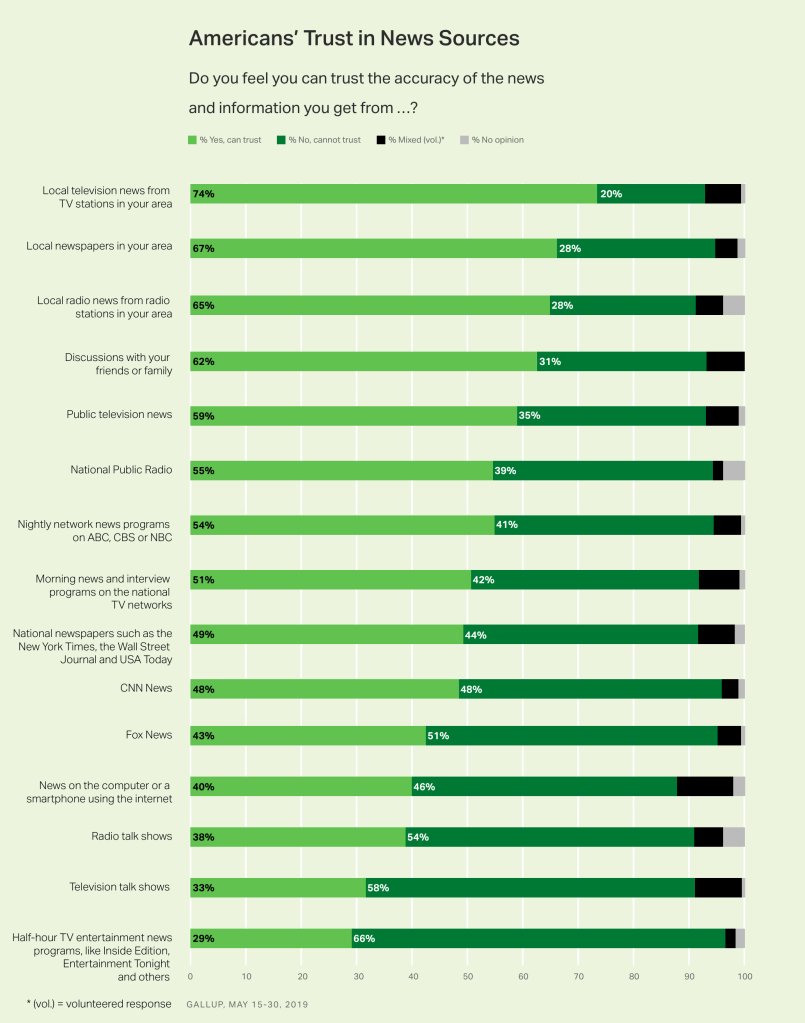
US broadcast news may not always tell the unbiased truth, but trust in the news is still higher in the United States than in authoritarian regimes like Russia. Depending on the type of television news, ranging from local television news to half-hour entertainment news programs like Inside Edition, 74% to 29% of Americans, respectively, trust the television. This, compared to Russian trust in television news, provides some hope for regaining trust in the US press.
In Russia, trust in broadcast media as a source of information dropped 5% since 2016 to 23% in 2020. Russians mainly get their news from the internet, on both official as well as social sites, and television broadcast news. In terms of trust in the media, Russians trust official analytical sites the most at 39%, with television taking 2nd place at 23% and social media sites taking 3rd place with 16%. Interestingly, discussion with other people came in fourth at only 8%, meaning Russians trust people online more than they do people in person. This can make the information finding process even more difficult for Russian journalists.
To hear about what it’s like being a journalist in Russia, I interviewed Dmitry Saltykovsky, a Moscow-based roving journalist and producer who has produced and reported a myriad of international and domestic short and long form news stories, gaining access to hard-to-reach areas, stories, and individuals. His coverage includes international and domestic politics, wars and revolutions, and major events, especially in the ex-USSR region, and he has collaborated with media professionals from renowned programs like Reuters, Vice, and BBC World.
He told me about…
…the biggest issue facing Russian journalism over the past 10 years: self-censorship. In his words “journalism in Russia does not exist”, because it is not actively developing as any creative specialty should be. According to Saltykovsky, Russian journalists practice self-censorship out of fear, knowing that they have few options for work if they choose to speak out against the government, especially if they work for a pro-government news group.
Self-censorship represents the lasting aftermath of Russian generational oppression and fear mongering through censorship and state control of the media, but while censorship has largely dissipated in the Russian media sphere, the same can not be said for state control of the media. The clearest example of this lies in the formation of the Russia Today (RT) news channel in 2005. This channel essentially works as a soft power tool for the Kremlin, covering Putin’s political acts in the most favourable light, and fueling the flames of conflict in its coverage of US and international news. RT is recognized in Russia and internationally as an important media voice “verging between straight news and conspiracy theories”.
Saltykovsky explained to me that there is a general state of anticipation and despair in today’s Russia, which is reflected in the media sphere. This anticipation, as he puts it, stems from the lack of freedom and development opportunities available to journalists, coupled with the fact that many of them understand this dangerous reality, and accept it anyways. Saltykovsky emphasized that not only Russian, but international journalism is currently experiencing a low, far removed from its peak at the height of the 24 hour live news cycle, and has changed immensely since then, particularly with the rise of citizen journalism.
While US media…
…is largely influenced by corporate interests, and dominated with polarizing sensationalism, Russian media is dominated by the Kremlin, and largely perpetuates one narrative while restricting dissenting viewpoints. For this reason, author-style independent journalism has recently gained popularity in Russia, with some of the most popular online news sources being YouTube shows starring known individuals in the Russia media sphere, like Yury Dud and Aleksey Pivovarov.
Fascinatingly, while US media would likely benefit from distancing itself from social media in order to restore content quality, Russian media is benefiting from its dependence on commonly used social media sites, like Facebook and Instagram, but also Russian sites like Vkontakte and Telegram, to spread their content without a state-approved news channel.
Saltykovsky finally noted that the mere existence of independent and quality content does not guarantee that people, especially the younger generation, will actually read it, let alone act on it. In his view, it is now up to the generation born in the 2000’s to start looking for information, identifying bias, forming their own opinions, and acting to change the media sphere into one that works for them.

You Can Trust the Media, If You Check the Facts
Depending on where you are when reading this, you may currently be suffering from unreliable and inaccurate news that may be controlled or influenced by corporate or state powers. Trust in television broadcasting is on the decline, and newspapers are going out of style, but it is more important than ever to know where to find reliable and accurate information.
Though it may seem easier to frequent a mainstream site that will paint the news, and the opinion you should have on it, in broad clear strokes, a bit of investigation will help you find the truth on a number of data-driven, non-profit, and independent sites.
The rampant self-censorship and lack of press freedom in the Russian media sphere demonstrate the dangers of allowing the US media sphere to continue on its current path of corporatizing the news, because the result will be the same in both countries: a restricted and coerced media.
In fact, the following statement by Alex Kotch nicely summarizes the main takeaway from this country comparison that should be applied to both the US and Russian contexts to improve public trust in the media in both countries.
“I think nonprofit media, and independent media that is reader supported, is the way to go in terms of fostering trust with your readers, because when you eliminate conflicts of interest, you can be perceived as being less manipulated, and more honest”.
Alex Kotch, interviewed by Sofia Sanders on November 17, 2020.
With that said, below are some links to fact checking websites that can help you to identify bias, accumulate information, and form your own opinions.
Fact Checking Sources
To check the political leaning and factual accuracy of a media source
https://mediabiasfactcheck.com
To read the research behind political headlines (and investigations outside the mainstream)
To check the facts of claims made by the president, administration officials, and party leaders
To debunk popular misinformation shared on Facebook
https://www.factcheck.org/fake-news/
To get a rundown of the latest misinformation and the truth behind the falsehoods
 Sofi's Corner